When it comes to shonen manga, anime and games, there are few with as much knowledge and love as the Shonen Otaku. Join me as we look at all different varieties of action-packed media. Mostly games.
With Fatal Fury: City of the Wolves happily promoting a
well-known potential rapist and tax evader, Capcom Fighting Collection 2 was my
most anticipated game of the year and a huge deal for fighting games on the
whole. Just think that in the old days, having
one of the games on a console was worth 50 dollars each and now they’re all in
one place for 40 dollars. Those games on
consoles have had varying degrees of inaccessibility over the years, with one
in particular being virtually impossible to play until now.
This new collection also means that it’s time for another
addendum in this blog’s documented battle between SNK and Capcom. Until this collection I couldn’t take Plasma
Sword, Project Justice, Street Fighter Alpha 3 Upper or the first Capcom vs. SNK
into consideration, but now just like with the Marvel Collection, that will be amended
and Capcom will have the chance to break the tie and be the king of
arcades. I will still be going over the
games I’ve already looked at as well to judge any subtle differences between
the versions featured in this collection and the ports I played before.
This was the period where both company’s arcade releases
truly came to a near-close. That this
round starts in 2017 says it all. Since
2011, neither company made a single game for arcades that wasn’t an updated
version of a previous one. As I stated
last time, there were ports, mobile games and console games, but the previous
round set a precedent for both companies moving forward: now the console
versions of their fighting games would come first.
It’s a damn good thing Capcom followed that precedent in
particular because holy shit. The
release of Street Fighter 5 can be debated for being worse than The King of
Fighters 12. Compmared to the low bar
that is KOF 12, Street Fighter 5 had fewer characters, fewer features and fewer
modes to play, all at the price of a full retail game. Street Fighter 5 became the target of such
mockery and ridicule that people almost forgot about KOF 12. Almost.
As if to rub it in Street Fighter 5’s face, SNK brought out
a new King of Fighters game with a massive 50 characters and a fully featured
arcade mode with substantial story content.
I heard stories about Street Fighter players jumping ship to KOF 14
because of how much of a rip-off Street Fighter 5 was. There’s footage of a pro Street Fighter
player telling Capcom representatives to their faces that he was going to go
play Guilty Gear instead of Street Fighter 5.
It was really REALLY bad. It’s
the stuff of legends.
That is not the version being judged though. Capcom continually added to Street Fighter 5
with overpriced DLC until they finally got a feature-rich and complete game
re-released as the Champion Edition, which is what came out in arcades. SNK had already released KOF 14 for arcades
with all its DLC included by that point, plus a little spin-off. With the release of SNK’s 2019 Samurai
Shodown game later, we’ll have reached the last arcade game released by either
company. We will finally see if Capcom
will cement their lead as the best arcade game manufacturer or if SNK will tie
the score.
Curious things happened in the aftermath of The King of
Fighters 13 and Super Street Fighter 4. SNK wasn’t coming out with a lot of new games except mobile phone ones
and ports of previous games. There were
some good mobile games and good ports, mind you. I still love The Rhythm of Fighters and had
some fun with Metal Slug Defense, which led into Metal Slug Attack and apparently
Metal Slug Attack had so much of an audience that just recently they came out
with a complete console version of it called Metal Slug Attack: Reloaded. For ports, the Code Mystics ports for KOF 98
and 2002UM were made available on PC with online play, which for me was a huge
deal.
On Capcom’s side… Well a lot of people consider it Capcom’s
darkest time period and would lead into them becoming the evil fan-hating
company they are today. There were
already a lot of contentious decisions and games like the Bionic Commando
remake, Dark Void, DMC: Devil May Cry (it’s not THAT bad, guys) and of course Street
Fighter X Tekken. Street Fighter X
Tekken was a disaster for Capcom because of on-disc DLC due to a deal
with Sony and a gameplay customization system essentially kind of being pay to
win. I play Street Fighter X Tekken on
the Vita, where all the characters are included, so I didn’t get as much
withheld content and I think it’s a pretty fun crossover, but I am in the
minority.
Capcom had one possible saving grace with Sengoku Basara 4,
a game that was shaping up to be the end all be all for action gaming once it
came out in English. As long as Sengoku
Basara 4 came out, Capcom would become immortalized as the greatest game
company in the world that could do no wrong. Everything hinged on that one game as far as console games went.
Both companies were either too busy or didn’t care enough to
make new arcade games after their last ones, but both of them did throw arcades
a bone and released updated versions of their best, most recent fighting
games. Now we’ll decide which of the
company’s best of their best is THE best.
The Marvel vs. Capcom Collection is out and with its
widespread availability, Capcom has some more ammunition under their belt. While doing the Capcom vs. SNK series I’ve
had to skip all but the last two games included in this collection, but now
that I can finally play them, it’s time to fill in some gaps and maybe make it something of a review of the collection as a whole..
I had previously stated that when this
collection came out I would go back and edit the included games into their
respective year, but on further contemplation, that could cause a mess for
consistency because there’s the possibility of these games elevating Capcom
just enough to retroactively score a win for a year, which would make future posts referencing victories contradictory. Therefore, this bonus round is going to give
Capcom a few chances to reclaim a point in the competition and allow me to
evaluate the 5 games I didn’t get to play before. I will conclude each one by determining if it
was good enough for Capcom to have had a better showing in its release year
than SNK’s games. In the case of years
where Capcom won, all they have to do is not have the game be a disaster
than brings them down.
2009 was the beginning of Capcom’s golden age. It was when the far superior console version of
Street Fighter 4 came out and got more fans into the franchise, since digital
distribution of classic games wasn’t quite as available as it is now. This gave rise to the “09ers”. The newbies.
Capcom was hitting big. It wasn’t just Street Fighter 4 either. Capcom was also making tons of master works
around this time, such as Resident Evil: The Darkside Chronicles, Devil May Cry
4 and Sengoku Basara: Samurai Heroes, the game with the distinction of having
the single greatest English dub in the history of the gaming medium and one of
the cornerstones of action gaming.Capcom was the best company in gaming at this point in time.
However, that was all on consoles. Another arcade version of Street Fighter 4
wouldn’t come until later on, giving SNK their chance to swoop in with their
flagship franchise and claim themselves as the rulers of the arcades. Once again Capcom has to play catchup and try
to beat everything SNK comes out with with just one game. Let’s see if they do that.
SNK had an overall good few years for the arcades while on handhelds and consoles it was more of a mixed bag and very few of what they were putting out, like the Days of Memories visual novel games, were coming out in English. What's more, after Capcom's complete and total absence in arcades for a good while, they at last came back to challenge SNK this year in 2008. Will their new arcade games be enough to make up for all the strides SNK had already been making while they were gone? Let's find out.
Capcom laid low in the arcade scene in 2002 and 2003, but in 2004 they came out with two new titles for the arcades. This is Capcom's chance to beat the likes of KOF 2002 and Metal Slug 5 for the next point. This is also the year with what you might call a closure of a generation. This year had the truly very last game ever made for the Capcom CPS2 and the last game released for the Neogeo. After this year, both companies would move on to new arcade hardware for future games. I'll have officially played everything in both Capcom Arcade Stadiums and my entire (digital) library of Neogeo games. It has been a hell of a ride, but even with all of those exhausted for the sake of this series, I'll still have a ways to go because my access to the games from these companies don't end there. This era of arcade gaming will now have its send-off as I judge which company was the best for the years 2002 to 2004.
In the real world, not a lot of note was going on in
1999. I think there was a guy who said
he did not have sexual relations with a woman and some kids shot up a school,
but the big impacts were being felt with our friends/enemies Capcom and SNK. Late in 1998, SNK put out the Neogeo Pocket, a handheld
system of their design not unlike the Game Boy.SNK had already done some portable work on Nintendo’s handheld with a port of Samurai Shodown as well as KOF 95 and
96, but this time they made their own system to put their games on.By that point, however, the Game Boy Color
was out so it wasn’t long before they upgraded to a color system as well, the
Neogeo Pocket Color.The Neogeo Pocket Color
had a selection of miniaturized SNK games that were effectively ports of their
Neogeo games, retaining the core gameplay experiences with only 2 buttons.
It had all the SNK essentials like Fatal Fury, Samurai
Shodown, KOF and even a few sports games plus its very own Sonic game.In fact, the Neogeo Pocket Color games are
where the Japanese game developer Dimps got their start, who would go on to
make the outstanding Sonic Rush games on the Nintendo DS.That’s all great, but one of the biggest and
best games on the Neogeo Pocket Color was the one that would finally let Capcom
and SNK settle things personally.
For the first time, SNK and Capcom would truly go head to
head, as M. Bison and Geese team up to run a fighting tournament where all
their company’s fighters would fight as a part of their evil plan! Finally you could show those Street Fighter
peasants or KOF losers that your company is better and use your skillz with
your favorite character!
Technically SNK vs. Capcom: Card Fighters Clash came out
first, but that game isn’t a head-to-head crossover of SNK and Capcom as much
as it is a game where Capcom and SNK’s characters and creators come together in
a friendly little card game where Capcom and SNK characters are able to support
each other, which is just wrong!Capcom
and SNK are enemies!I would review
those crossovers, but neither were in arcades.I will say both are absolutely fantastic
games though.
This manpower being put into their handheld system is
presumably why there aren’t as many SNK games for this year. Capcom’s reason for fewer games was because apparently
not doing as hot in the arcades and they put more effort into releasing just a
few big games instead of the numbers they were pumping out in previous years.
That may have paid off because holy smokes is 1999 one hell
of a year.This year has both companies
at their best and there is not going to be a lot of negativityThe year’s winner might be down to the wire.
1998 was another big year for gaming. Some of the greatest games of all time that
are still revered to this day were coming out.
Resident Evil 2, Banjo-Kazooie, Metal Gear Solid, Half-Life and Spyro
the Dragon and of course The Legend of fucking Zelda the fucking Ocarina of
fucking Time. It was a great time to be
a gamer, particularly a console gamer.
Near the end of the year, Capcom and SNK would be introduced
to one of their best friends: The Sega Dreamcast. The Dreamcast was an incredible machine for
the time, capable of 3D and 2D graphics neither the Playstation nor Nintendo 64
could pull off. It’s best known for Soul
Calibur, but the Dreamcast was practically a fighting game machine by all
measures. While the Playstation would
struggle to run certain Capcom and SNK arcade games, the Dreamcast was able to
handle enhanced ports of those games, including some packages with 2 games in
one! It was the only console that could
run Street Fighter 3 at the time and some of Capcom’s 3D games like Power Stone
would also get their Dreamcast port down the line.
3D backgrounds!
I sure hope that doesn’t mean home console gaming is going
to supplant arcade gaming because there are some great arcade games this year,
mostly from SNK. Capcom seems to have
slowed down their arcade game production, possibly because of the cost of
making games for that beast the CPS3, and were putting more manpower into their
console games, such as the aforementioned Resident Evil 2. SNK meanwhile was still chugging along with
the Neogeo while the Hyper Neogeo 64 dragged its feet. Let’s find out who put their efforts on a
winning horse.
In the real world, 1997 was the year of Princess Diana’s
death and the transfer of sovereignty of Hong Kong from the U.K. to China, resulting in Bruce Lee’s
relative Chin wiping out all 1.2 billion of the incoming Chinese immigrants.
In gaming, 1997 was cementing the dominance of home consoles
and PCs in gaming. With polygons and
storage space further evolving, we got games like Diablo, The Curse of Monkey
Island, Tomb Raider and Final Fantasy 7, one of the worst games I’ve ever
played, but would become synonymous with the Playstation because I guess
standards were that low. SNK
translations may be bad, but holy shit Final Fantasy 7’s is even worse. IT WAS THE MOST EXPENSIVE GAME MADE AT THE
TIME?!
Anyway, Capcom and SNK apparently figured they had to up
their game with brand new arcade hardware, both of which… Could’ve gone better.
Capcom came out with the CPS3 system, an arcade board that
would allow for even more sprites and higher capacity memory. It was a super powerful system that could
outclass the Neogeo’s ever-increasing cartridge sizes. It came out at the tail end of 1996 with Red
Earth, but of course what they really needed to sell people on this thing was a
new Street Fighter, leading to one of the most fascinating disasters of the era.
SNK made the Hyper Neogeo 64, a 3D system to try and
replicate the success other companies were having with this new dimension of
play. From what I understand it was only
marginally more powerful than the Nintendo 64.
Both of these new systems had almost no games for them. The CPS3 only had 6 games made for
it (half of which are updated re-releases) and the Hyper Neogeo 64 only had
7. Both their miniscule libraries were also difficult to port to home systems. In
fact, only one Hyper Neogeo 64 game has ever seen any re-release and it’s rare,
so I won’t be able to play any of them.
Regardless of the quality of the games, the fact is that
neither company got a lot of mileage out of their new hardware and they made
safer bets continuing to make games for their existing hardware. Which company came out looking the best as a
result will now be put to the test.
In 1996 3D gaming was the hottest new thing. Sure some 3D games started trickling out the
previous year with the launch of the Sony Playstation and pre-rendered 3D
visuals had been around for a bit longer, but now that 3D graphics could be
rendered in real time with real polygons the sky seemed to be limit. Several of the lesser-selling 2D consoles of
yesteryear bit the dust and Nintendo came out with the Nintendo 64, making the
3D capable systems the dominating force.
All the big names paving the way for the evolution of gaming as were coming out, including Super Mario 64, Resident Evil, Bubsy 3D,
Crash Bandicoot, Duke Nukem 3D and Wave Race 64.
For fighting games, the 3D train continued.Capcom started to dabble in their own 3D
fighting games beginning with Star Gladiator, which I won’t be looking at for
this one because I can’t find a copy of it anywhere, though I do recall playing
it once at a convention.I don’t
remember much except that I wasn’t impressed and it was right next to a cabinet
with KOF 2002 Unlimited Match and that awesome Arc System Works Fist of the
North Star fighting game was there too so those games overrode my memory. With other companies, Sega released both Virtua Fighter 3
and Fighters Megamix, Namco released Tekken 2, the ever-popular Mortal Kombat
Trilogy came out for home consoles and of course Tecmo began the Dead or Alive
franchise with the very first game, building off Virtua Fighter’s
foundation.This all combined with smash
hit fighters like War Gods, Pray For Death and Iron & Blood: Warriors of
Ravenloft, which I imagine made it harder for Capcom and SNK to get people to
their good old 2D arcade cabinets, which by all accounts had their own
strengths that home consoles still didn’t have, as evidenced by still less than
stellar home ports. As for which among these two arcade giants did the best this
year, I’ll be the judge of that.
Much like in 1994, 1995 kept a lot of the crazes of the era
rolling with continuing advances in both game design and technology. On the Super Nintendo, Chrono Trigger came
out with its intricate time travel plot, Donkey Kong Country 2 wowed audiences
just as much as the original did and Yoshi’s Island
put new spins on the Mario series with an origin story spotlighting the
dinosaur sidekick from Super Mario World.
The big game changer of course came from Sony with what
would become their CD-based juggernaut, the Sony Playstation. With the 3D graphics possible on the PS1, the
3D gaming explosion got even bigger, with home consoles now being able to run
their own versions of the latest Tekken and Virtua Fighter games, as well as
console-exclusive games like Battle Arena Toshinden. The possibilities offered by the extra CD
storage space opened all kinds of possibilities for game developers, like Full
Motion Video, something the PC had already been dabbling in. In fact, on the PC side of things FMV games were
at their peak, with Phantasmagoria, Psychic Detective and The 11th
Hour delivering experiences players had never seen before.
In the fighting game space, Capcom and SNK had possibly even
stiffer competition than last year, thanks to the PC and console-made fighting
games you didn’t have to go to the arcades for.
This was the year of Xenophage: Alien Blood Sport, Kasumi Ninja and a
game still considered one of the best fighting games of all time, Expect No
Mercy.
Neither Capcom or SNK was any worse for wear as there were
changes coming this time, with each company’s biggest franchise making a major
shift after their own periods of re-releases.
Let’s see who pulls off those shifts best and came out as the better
company of 1995.
If we weren’t there already, we have officially reached the
peak of fighting game mania. With Mortal
Kombat, Street Fighter and Fatal Fury games bringing in the players, more and
more companies wanted a piece of the action.
There were more fighting games being made than ever before, be it on
consoles or arcades.
They didn’t even stay in the games. Fighting games were being turned into major
multimedia franchises. Both Fatal Fury
and Street Fighter got their own movies this year and Mortal Kombat was on the
way to getting one in the following year.
With such a boom, Capcom and SNK upped their arcade
production this year, so much so that I need to split it into 2 parts. It was important that they did because in 1994
there was extremely tough fighting game competition.
Some of the biggest and best fighting games came out in
1994. Games like Kasumi Ninja, Ballz 3D,
Shaq Fu and one of the most highly regarded fighting games even to this day,
Rise of the Robots. There was also this
one game called Tekken that Namco made, but who cares about that shit.
Truth be told, I don’t think either company can make a game
that can surpass Rise of the Robots, but in the comparison of Capcom and SNK’s
arcade games, that doesn’t matter. Time
to see what we got in this crazy, crazy year.
In 1993, the fighting game genre had gone into full swing. Mortal Kombat 2 came out with even better
graphics, more violence and cheating asshole computer opponents. Home ports of arcade games like it and Street
Fighter 2 were topping the sales charts and other companies got in on the
fighting action themselves, like Data East with Fighter’s History and Konami
with TMNT: Tournament Fighter.
1993 was also a big year for 3D gaming. The PC megahit Myst came out with its 3D
pre-rendered backgrounds and full motion video, while on the console side,
Nintendo made Star Fox, a game able to render polygons on a Super Nintendo
cart. For fighting games, Sega revolutionized the genre by adding a 3D element with Virtua
Fighter. It was a year of major
technological advancements for the medium of gaming.
I have to admit, 3D models having faces is pretty impressive too.
For arcades, one of the biggest technological advancements
came with Capcom's new arcade hardware. One
that could, in some ways, even surpass the Neogeo: the CPS2 board! This new technology would allow for more and
bigger sprites, more colors and even better audio thanks to QSound technology
(though Qsound was used in a less-used CPS1 variant called the CPS Dash).
Though 3D fighting would blow up in the coming years in large
part due to Virtua Fighter, Capcom and SNK were still sticking with what they
had in two dimensions, albeit with less releases this time. Capcom only has 3 games to
work with this year, but there’s a direct
point of comparison with two of Capcom’s games and two of SNK's games.
Both have an updated version of their hit fighting game and both have a wrestling game.
Let’s see who gets treated like Roman Reigns and
who gets treated like John Cena!
We're a year in now and the 90s are in full swing. This year may be the turning point for the arcade scene moving forward and there are going to be a lot of changes around here, one of which should come from you! If you like the article be sure to like, comment and subscribe!
It's 1987 and out competitors are in full swing! This year we can see the start of Capcom's drift away from the shooty shooty bang bang games that have dominated the arcades, but SNK was still going all-in on the shooting action so I guess you can say they stuck to their guns. This isn't a competition for who made the most creative and genre-busting games though. This is for who made the best games. In other words, who is the year's King of the Arcades and
Characters are the lifeblood of a fighting game. They are
the means by which the players engross themselves in the game through their
varying fighting styles and personalities as they clash in combat. From Mexican
wrestlers to masked karatekas to flawed super soldiers, the guys you see in
fighting games get wild.
Fighting game characters often shine in their own particular
way.Some are made to look cool first
and foremost, some are meant to be the most fun to play with and others are
made to be extremely difficult to use, but incredible in the right hands. Over
the years in the many many different fighting games I’ve played, I’ve
identified some fighters that excel in certain ways that no other has ever
matched.To recognize those standouts,
I’ve made this list of awards to celebrate the best of the best in fighting
game history, the Shonen Otaku Awards!
The only criteria I have for these awards is that they
cannot be from fighting games based on a license.
Some time ago the Toys R Us I work at had some Street Fighter X Tekken Minimates on clearance. Being the fighting game fanatic I am, I bought some of the little posable dudes for about $2 a pack (quite a bargain considering what they go for online). Some of them were even Toys R Us Exclusive.
Tragically, we didn't have Rufus.
Their little size and posability gave me an idea. I could have them interact with Nintendo's own cutesy little creations, the Miis! With the Nintendo 3DS' Augmented Reality, I did just that and started posting pictures of Miis of various people I follow on Twitter with the Minimates. For those of you who don't follow me on Twitter or don't even have a Twitter account, I'm making this post to put them all in one place. I hope you like them.
Just as Super Mario Brothers kicked off the platforming
genre, Capcom’s Street Fighter 2 kicked off fighting games as we know them
today. You cannot discuss fighting games as a genre and leave out Street Fighter.
It’s arguably the most popular fighting game franchise out
there, with just about every possible piece of merchandise you can think of,
from a TV show to figures to Street Fighter Monopoly. To see what gives this fighting game
juggernaut such a large and dedicated camp, it’s best to look at each component that makes it what it is.
There was a Street Fighter before Street Fighter 2, but no one cares.
Story
Street Fighter’s story spreads across several games
in a rather anachronic order. Canonically, it
starts with the first Street
Fighter (though most of its plot is retconned by the others),
followed by the three Street Fighter Alpha games, 2, 4, and finally Street Fighter 3 (and its sequel, Third Strike).
With the exception of the Street Fighter Alpha games, the
plot of each game revolves around the Street Fighter martial arts tournament
(expect to see a lot of those in these camps).
In Street Fighter Alpha, characters run around
and fight each other while establishing some character.
After the first game, each of the Street Fighter tournaments
have some kind of evil intent behind them, which I will get into when discussing the villains.
Since the people running the tournaments aren’t morally
sound, rules on using supernatural abilities get the curb and everyone breaks
out the flaming kicks and sonic booms. After the characters are done kicking
everyone else’s ass, they do the same to the villain.
Unfortunately, very little of the important plot points
aren't explained in any of the games. The Alpha games help a good deal for some characters, but for many, backstories are instead explained in supplementary material. Who exactly is the ultimate victor of each
tournament is also vague unless you read supplementary material. Even Street Fighter 4, the one with the
heaviest story elements, has a long, drawn-out anime movie that sets up its
story just so you know what the hell's going on.
Street Fighter is a game franchise that does better at
characterization than it does plot.
The Heroes
From the Street Fighter Alpha games to 4 (timeline-wise), there are essentially
two main packs of heroes, who work with each other from time to time.
The first is the iconic duo of Ryu and Ken. The two are good friends and rivals, having both trained
under the same master. Both are
disciplined and love fighting, but while Ryu is often very strict and wanders
the earth to find opponents and get stronger, Ken is much more laid back and
likes to spend time with his girlfriend/wife. Ken enters the
Street Fighter tournaments for fun. Even
though they have their differences, they love sparring with each other, and
both use identical moves that have become infamous in gaming.
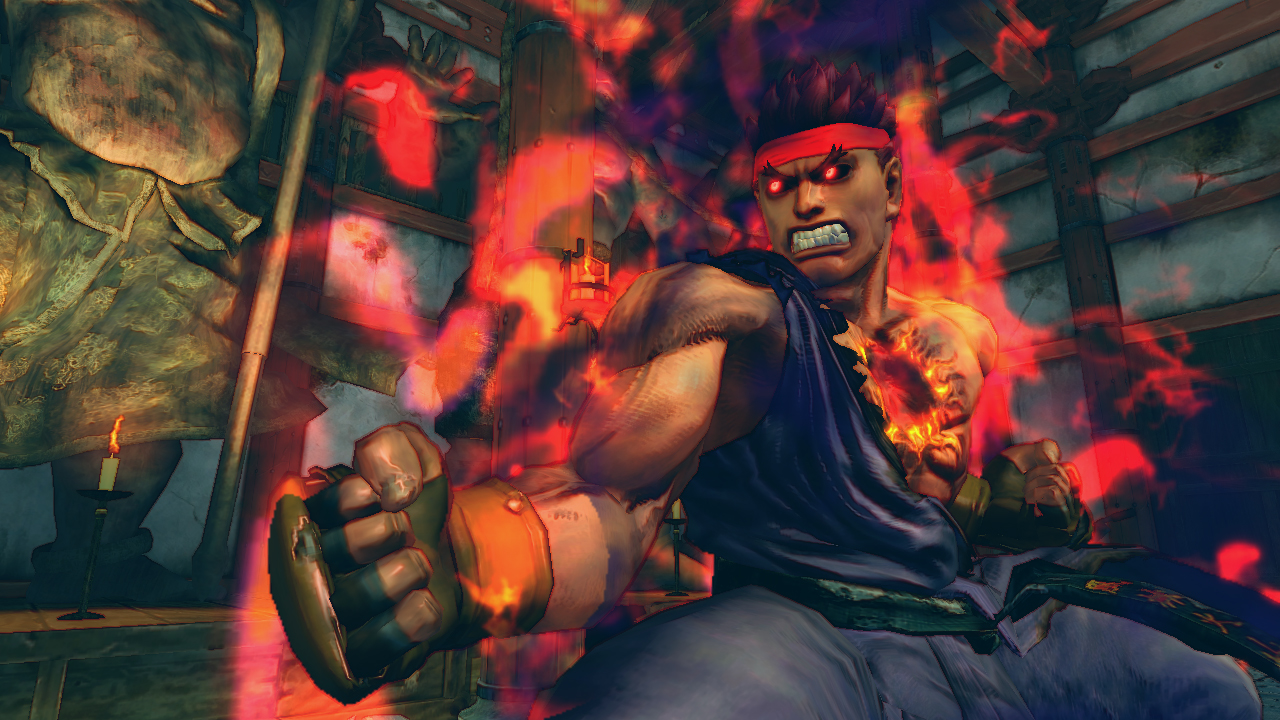
Much of Ryu's wandering is so that he can train himself to control the Dark Hadou within him (it's officially called the Satsui no Hadou, but that's too much of a mouthful for me). The Dark Hadou is kind of like the dark side. It's powerful, but destructive and can kill people if not kept under control. It's never stated outright, but it also seems to be a rare power only one other character, Akuma, seems to have. Ryu lost control of it once in a retcon that says he became Evil Ryu and struck the villain Sagat out of hatred, leaving the man his huge scar. Even though he only appeared once in canon, Evil Ryu has been playable in quite a few games.
Aiding in the fight against evil are two Interpol agents:
kick-centric fighting girl Chun Li and the army man Guile. Both are righteous crime fighters out for
vengeance and justice. Big-time villain M. Bison killed Chun Li’s father and is most likely responsible
for the disappearance of Guile’s friend Charlie (at the end of the Alpha games, in which he was playable). Chun Li and Guile work well together as foils. While Chun Li is
dedicated to her cause, she still shows that she has fun fighting. Guile, on the other hand, is almost always
stone-faced and serious. He’s depicted
as a pleasant person if you’re on his side (he has a wife and kids), just don’t
expect to see him laugh.
Although there are returning heroes in Street Fighter 3, like Ryu and Ken, the main character of 3 is a new
generation hero named Alex, a hot-headed war vet seeking revenge on the man
running the tournament for injuring his friend.
Sadly, he’s only in one Street Fighter game so far, leaving him with very
little character to speak of, even with his appearance in Tatsunoko vs.
Capcom.
The heroes are somewhat archetypal and make for a fun story, but the real driving forces of the stories told are...
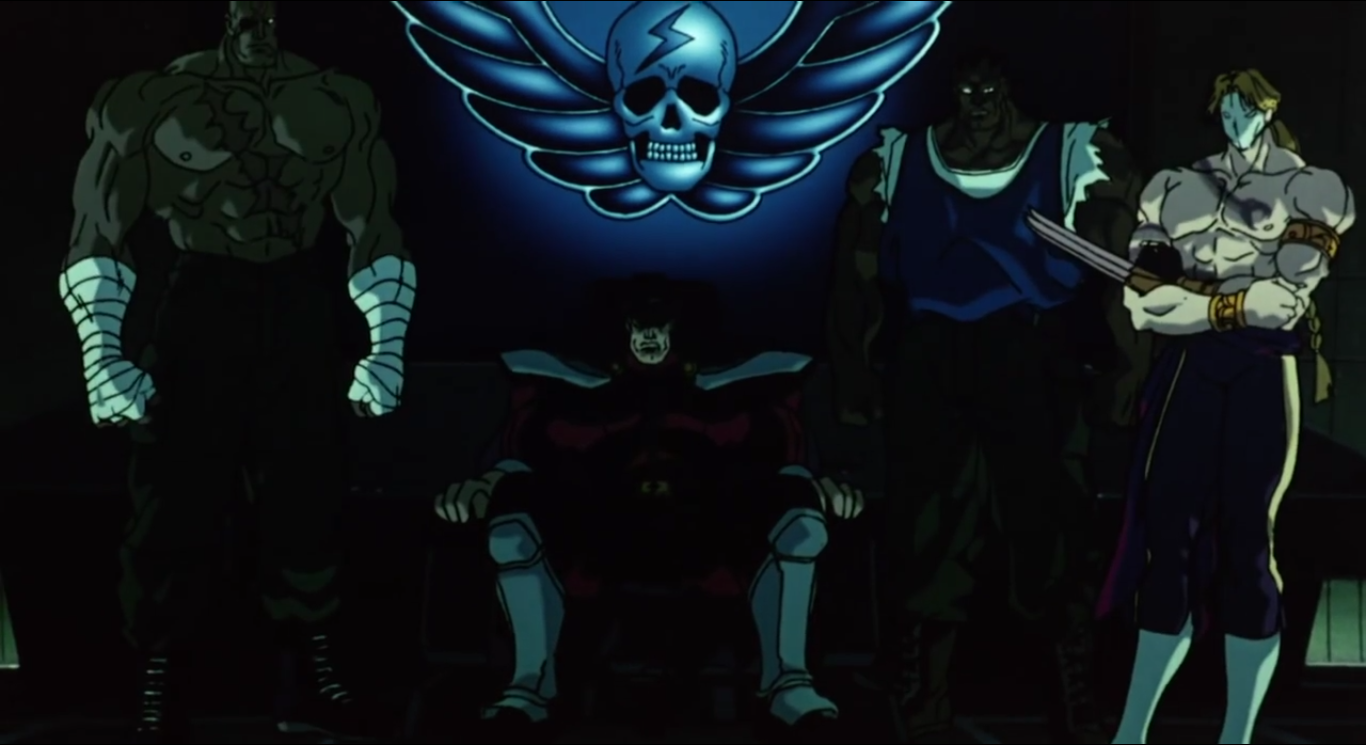
Up until 3 (chronologically), the main villain of Street Fighter has
been the criminal organization Shadaloo, led by the evil dictator M.
Bison. Just as the heroes are archetypes, Bison is the archetypal evil
villain. He’s an egomaniacal, cruel,
abusive maniac who does whatever he needs to do to get his way, and he knows
it. His famously cheesy portrayal in the
Live Action Street Fighter movie is not far off.
Bison uses what is referred to as “psycho power.” It is essentially Bison’s physical
manipulation of the evil side of his soul, giving him the ability to corrupt
the minds of others, levitate himself through the air, increase his strength,
and even live without a body, transferring his soul into compatible new bodies, which is good, because psycho power has degenerative effects on them. He purged the good part of his soul, called "soul power", to use it and transferred that into the Italian fortune teller Rose. In a sense, he utilizes pure evil.
In the first two Street Fighter Alpha games, Bison was essentially just another criminal smuggling drugs, but in Street Fighter Alpha 3 he becomes the de facto villain, having his personal assassins and himself attack other characters in order to use their power to act as a fuel source a doomsday weapon called the Psycho Drive, which ultimately fails when his base is destroyed, along with himself.
He comes back in Street Fighter 2 to prove that he's the best, but then he's killed by Akuma, another villain. Naturally, he just gets another body in Street Fighter 4.
One of Bison’s associates is the villain of Street
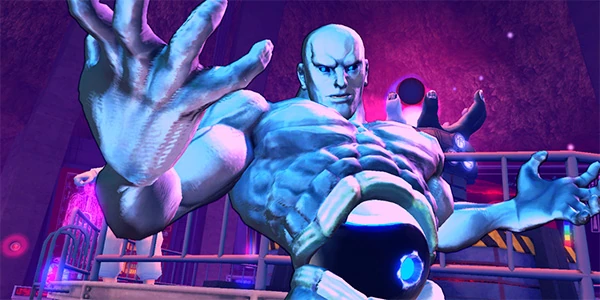
Fighter 4, Seth. Seth is the leader of
Shadaloo’s weapons division, S.I.N., and in the events of Street Fighter 4, he took over while his boss was away, prompting Bison to come after him.
Using a special device he has in place of a belly called the
Tandem Engine, Seth can copy moves from other fighters using their
combat data. The moves he copies in-game are all from the original 8 Street Fighter
2 characters, such as the yoga master Dhalsim’s stretchy limbs, Guile’s sonic boom, and Russian wrestler Zangief’s atomic buster.
Seth's ultimate goal is a little less simple than simply wanting to become all-powerful. He organizes the Street Fighter 4 tournament in order to bring out Ryu's dormant Dark Hadou, as that is the last missing piece of power he needs to complete his project known as BLECE. BLECE (Boiling Liquid Energy Cell Explosion) is a special implant that uses a person's ki in order to make all their cells (and thus, their whole body) violently explode. Such a weapon would allow suicide bombers to go undetected through security and could spell chaos if it were ever completed and distributed. Before focusing on Ryu, S.I.N. captured a number of martial artists, presumably in an attempt to learn to manipulate ki.
Working under Seth is the franchise’s only villainess (not counting Bison's brainwashed female bodyguards): Juri,
a hedonistic, psychopathic, masochistic tae kwon do master who was given what
seems like a miniature Tandem Engine called the Feng Shui Engine in her
left eye. Though it can’t copy moves
like the Tandem Engine, the Feng Shui can absorb ki from her surroundings to
substantially increase her physical performance, as shown in her ultra combos.
Siding with Bison is Shadaloo’s fearsome trio of their
strongest fighters: Vega, a narcissistic and acrobatic Spaniard who wears a
mask to protect his beautiful face, Balrog, a brutish boxing thug only in it
for the money, and Thailand
muy thai bruiser Sagat.
Sagat is more of an anti-villain compared to the psychos
Vega and Balrog. Ever since Ryu (or rather, Evil Ryu) defeated and scarred him in the first tournament, Sagat has sworn to defeat him with the help of Shadaloo. He’s not obsessed with beating Ryu like so
many similar villains are with their arch nemesis, but needless to say, if he
sees Ryu, Sagat won’t let him walk away.
Eventually though he learns that revenge is not the way to go, leaves Shadaloo, and quits
being evil, unlike his fellow chums.
Unaffiliated with any other villain is the rogue warrior Akuma. Akuma is not unlike Darth Vader to Ryu’s Luke
Skywalker, except Akuma isn’t Ryu’s father.
Akuma embraced the dark side of the Dark Hadou, making him
stronger, but also ruthless. Throughout
Street Fighter’s story, Akuma seeks worthy opponents to beat into a pulp,
usually with his signature move the Shun Goku Satsu (Wrath of the Raging Demon). When using it, the screen turns black (or
white, depending on the game) and the enemy is horribly mangled. What exactly happens at that time depends on
the source, but it’s known for being a dangerous, forbidden technique. Akuma used the Shun Goku Satsu to (almost)
kill his brother Gouken, Ryu and Ken’s master, So he's primarily the enemy of the series' main duo. Like Ryu, Akuma travels the earth, and thus
crosses paths with the other fighters.
The villain of Street Fighter 3 is slightly less
of an obvious villain than M. Bison or Akuma, but only slightly.
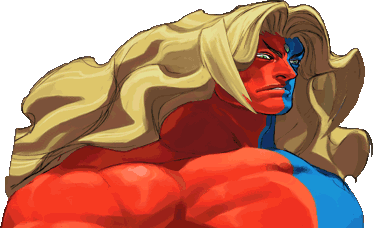
Gill is the modern-day leader of the Illuminati,
an organization has existed for thousands of years. The Illuminati have manipulated events over the course of history to
follow a prophecy that predicts the apocalypse, and have genetically
experimented with people to make supreme beings. Gill is their most successful supreme being, and the Illuminati believe him to be the reincarnation of their former emperor.
Gill holds the tournament
in Street Fighter 3 in order to find the best humans to repopulate the world
with after the apocalypse by taking them to a special area of the world that
will be safe when Armageddon comes.
In simpler terms: Gill and the Illuminati believe that the
apocalypse is going to happen anyway according to their prophecy, so he might
as well go with it and make the most of the end of the world by preparing to
rebuild it as best he can. Unlike Bison,
Gill believes what he does is for the benefit of mankind.
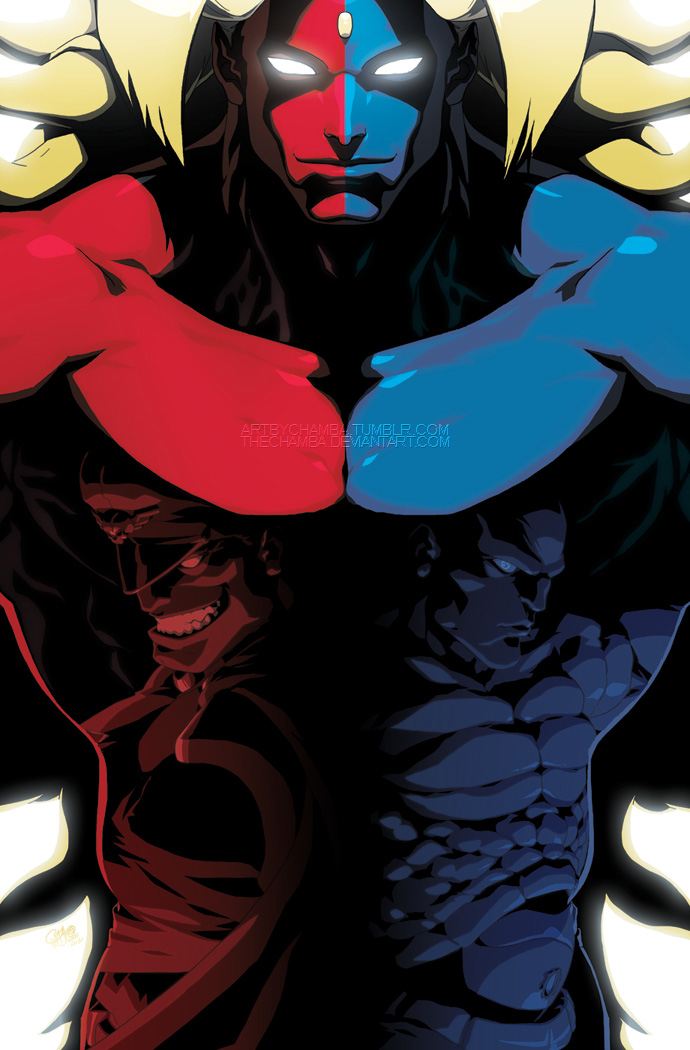
If his appearance doesn’t tip you off, Gill’s genetic
enhancements (somehow) allow him to use fire and ice, and his faux holy backstory
also gives him some divine power, most notably his seraphic wing and
resurrection moves. Seraphic wing does a
shitload of damage if you’re not guarding (similarly to a move from King of
Fighter’s Orochi), and resurrection allows him to completely refill his health after being killed! Resurrection is probably campStreet
Fighter’s most despised super move.
"Ded."
The Other Guys
The handful of main characters don't do justice to the sheer volume of characters. Street Fighter has a vast collection of quirky fighters that are minor in the grand scheme of things, each with their own reasons for fighting, be it fame, the prize money or revenge. To name a few:
Dee Jay, a Jamaican dancing part machine, Cammy, a British special forces unit who was previously one of Bison's assassins, and Dan, a
jokingly pathetic fighter trying to promote his dojo.
Dan Hibiki is a playable mockery Capcom made to insult SNK, specifically the Art of Fighting games, now most known for its characters being in The King of Fighters. His "saikyo" (awesome) fighting style is a lot like the Art of Fighting's Kyokugen style... Only shit. His appearance is also one big composite, having Robert's face, a pink version of Ryo's gi, and some of Yuri's girly mannerisms, plus his dead dad's face looks like Takuma's Mr. Karate mask (though that was changed in the comics).
Dan was essentially conceived as a form of humiliation. You could prove how superior you are to someone else by using Dan as a handicap.
But come Street Fighter 4, the joke's on Capcom. Dan rules!
Almost as if by fate, Dan has been in the crossover games Capcom vs. SNK 2 and SNK vs. Capcom: SVC Chaos with Ryo.
There's also Rufus, who is simply awesome.
With all the muscular, serious, and prettyboy and muscular characters in Street
Fighter (and most fighting games, for that matter), Rufus stands out from the
crowd by being fat, talkative, and silly. He
rambles on, mistakes other people for his archenemy Ken Masters
(who doesn’t even know who Rufus is), and at the same time is able to kick
copious amounts of ass, practically ignoring his weight. It helps that his voice actor is Christopher
Corey Smith, one of my favorite actors in gaming, who does a fantastic job
giving Rufus a bumbling and semi-gruff voice to match his biker persona as well
as pulling off a funny Brooklyn accent.
He’s got a great leitmotif too.
Rufus is also example of what makes Street Fighter
characters so memorable: they’re exaggerated.
Whether it’s an exaggerated stereotype like T. Hawk or El Fuerte, or an
exaggerated character trait like Bison’s villainy or Vega’s vanity, Street
Fighter characters each have one trait that Capcom plays up. While several of the characters are established beyond that, they still reinforce their most noteworthy trait with virtually
everything they say and do on the battlefield, cementing their quirks into the
heads of players.
That exaggeration carries over into many characters’ visual
design. The constantly smiling Dee Jay
has a perfectly square jaw, the American fighter Guile wears an army uniform
with the American flag tattooed on his shoulder,
Turkish oil wrestler Hakan has red skin and metallic hair, and Akuma has a very
malformed, demon-like face. Several
Street Fighter characters are relatively normal-looking (by stylized anime standards), but for every 2 humans
Street Fighter has, it has one weirdo that symbolizes his or her big character
trait. That’s a good thing though,
because exaggerated characters are fun to watch and distinguish Street Fighter from
the other fighting game franchises.
Music
Complementing the characters are catchy
soundtracks. How the music is handled in
Street Fighter varies, but generally they have catchy beats you can tap your
foot to and never distract from the fighting.
They’re traditional game background music fitting with the stage or
characters that, in a way, make you want to keep your groove.
Street Fighter also has what I consider to be the best
character select music in gaming. In how many games do you notice that?
I’ll admit that SNK doesn’t have character select themes
nearly as awesome as these.
But as much as music, characters, and story are important to
a game’s identity, it’s the gameplay that defines it. Street Fighter (2) is practically the progenitor
of modern fighting games with its controls.
Combat
Players are given 6 buttons: weak, medium, and heavy punches
and kicks. Every punch and kick has its
own range, attack speed, damage output, and recovery time, some of which vary depending on the character and direction of the control stick when thrown. By using their moves in quick succession,
players can skillfully execute combos by not giving opponents the chance to
block (done by moving backwards). With
two ways to block (standing and ducking) and the ability to jump or bypass
blocking with a grab (how to grab depends on the game), there are a variety of
ways for players to keep their opponents guessing.
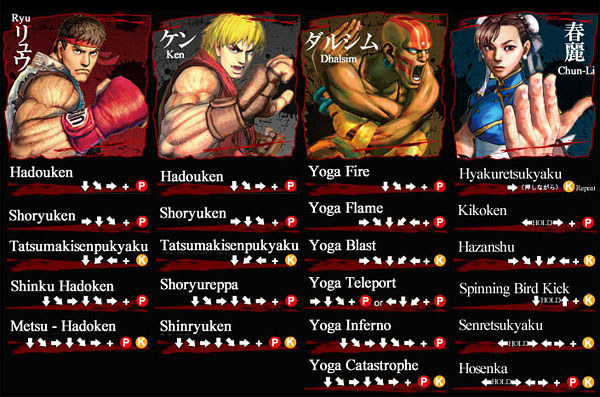
The big divider that differentiates the combatants are their special moves. By quickly inputting varying movement and/or
button commands (often circular motions and then pressing the corresponding
attack button type), characters execute more specialized and fantastical moves
that define the characters, such as Ryu's infamous Hadouken, Russian wrestler Zangief's Atomic Buster grab
move, or the acrobatic Vega's Flying Barcelona.
Adding to the
combat’s depth, the strength of the buttons used for the command usually
determines the move’s strength, speed, and/or range. For example, using the weak button for most
special moves may not do as much damage or have less range, but it’s faster and leaves you less
open if it doesn’t connect.
It's complicated at first, but get the half circles down and it's not that hard.
The combat rules beyond the core mechanics vary with each
installment in small ways. Eventually
Street Fighter adapted more powerful super special moves that could be used after
filling a gauge in varying ways. These super special moves are used through slightly more complex commands, such as
two quarter circles forward and a punch.
There are also EX moves in Street Fighter 3 & 4, done by pressing two of the required button
type at once, which use up part of the meter in order to enhance a special
attack.
Street Fighter 4 also introduced the even more powerful ultra
combo moves, the meter for which can only be filled by taking damage and at
most can only be used twice per match for each player (unless a near-impossible scenario occurs involving "white health"). Additionally, SF4 added focus attacks that take a
moment to charge, but can break through an opponent’s guard at
full power and shrugs off one attack during the charge.
Regardless of the Street Fighter you play, they are games of
pacing, method, and reaction. You have
to judge and adjust the distance between you and your opponent, think of what
your opponent might do to lower their guard, consider how long you’re left open
after certain attacks, react to them, and mix up moves so that your
opponent can’t predict them. This is especially emphasized in Street Fighter 3. In that game, tapping toward your opponent right before a hit strikes leaves you invincible for a split second to allow for a counterattack, putting an even stronger emphasis on pacing. Street Fighter is less for
the hot-blooded button mashers and leans more toward the cool, collected,
strategizing types. The
hot-blooded players are too busy playing The King of Fighters, which I will get
into in the next post.
This video embodies what makes Street Fighter’s combat so
fun and shows off camp Street Fighter’s most epic moment ever. Notice how often the players shifted left and
right or just struck the air in front of them.
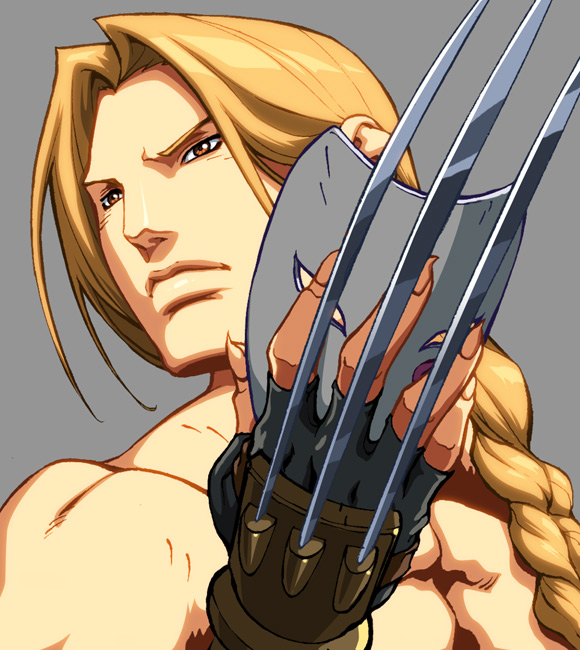
Personal fighter of choice: Vega.
Vega is a beautiful, flawless badass, and he knows it. Wearing a mask to preserve his beauty, Vega
works to get rid of everyone he finds inferior or ugly. He knows he’s awesome and vies to prove it
time and time again using his flashy and smooth moves, not unlike how I try to
look great when I play a game.
In battle, Vega is very acrobatic and has impressive range thanks to his clawed glove’s punches and special attacks. Vega has strong special and super moves that go straight across the
field, making it difficult for him to miss, provided you use good timing, and his scarlet terror attack is a good way to knock an opponent back at close range. In the right hands, he can be a seriously
slippery opponent.
His style of fighting is more in line with the faster
screen rakers seen in The King of Fighters, which made him much easier to
adjust to for me. In fact, he’s the
first character I beat Super Street Fighter 4 with on hard mode.
I don’t like being obvious with character choices by
choosing ones that are popular, but Vega’s fast play, eccentric
personality, and showmanship make him my character of choice in any Street
Fighter game he’s in.
As for Street Fighter 3, where Shadaloo is completely
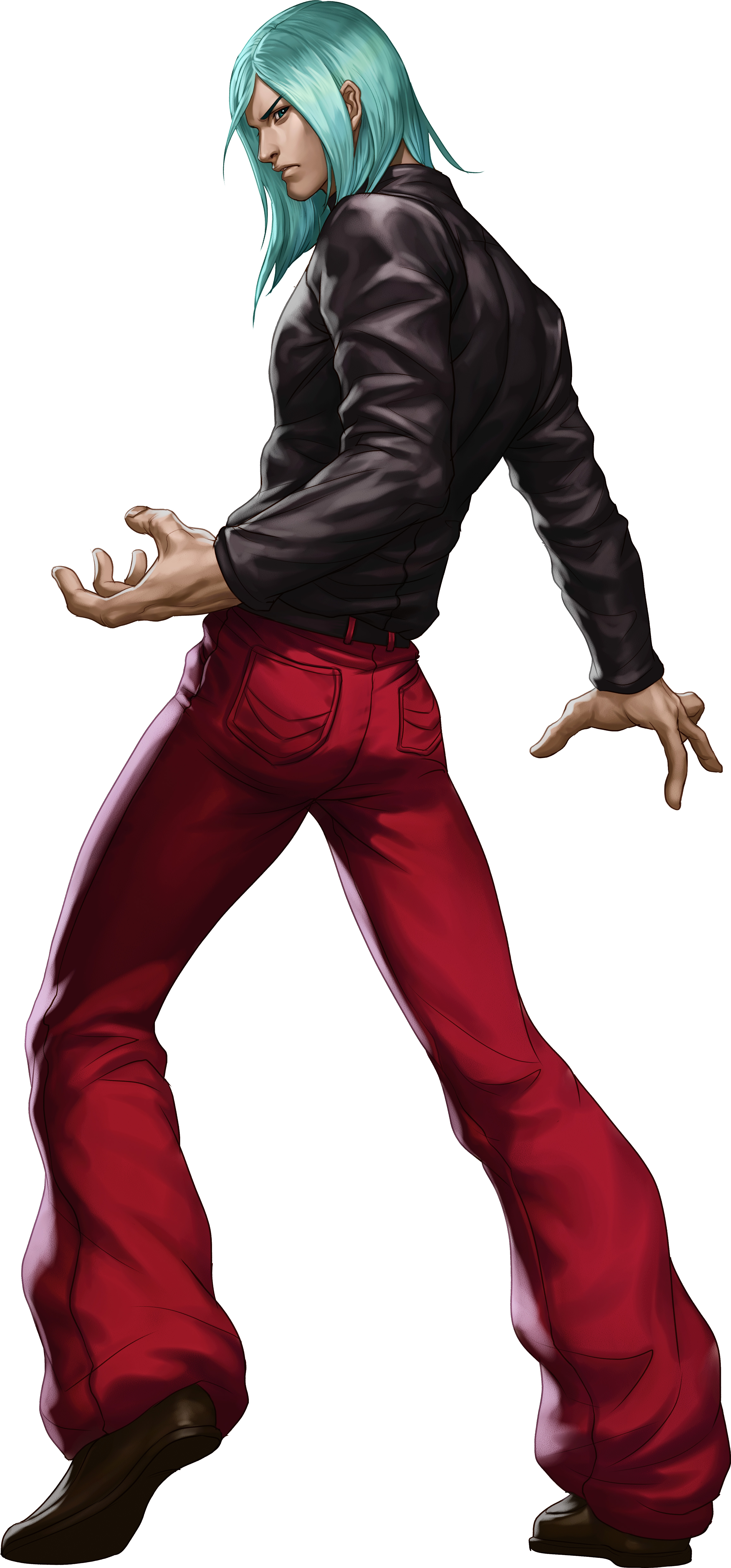
absent, I go with Remy in Third Strike, because he is an actual King of Fighters character. He has Robert Garcia's projectiles from KOF 2003 as well as his dive kick, Ash Crimson's updraft kick and Iori Yagami's fashion sense (with Omega Rugal's insignia; that or a shirt once worn by Mick Jagger). Hell, one of his super attacks is practically the exact same as Ash's minus the green flames. I'd say they made him just for me, and there's clearly some inspiration from SNK visually, but Ash was actually made after Remy. Whatever was behind him though, Remy is my go-to Third Strike character.
The best of the bunch
If there’s any single Street Fighter
game I recommend, it’s Super Street Fighter 4.
Whether it’s the first Super Street Fighter 4 or any of its updated
re-releases, it stands above every Street Fighter game before it. While the Street Fighter Alpha titles are
strong on backstory and Street Fighter 3 has unique visuals and characters,
Street Fighter 4 has the strongest character count and content. Every character is fully voiced in English, endings are fully animated, there are actual prologues and the stylized 3D is
the perfect transition from the 2D titles before it.
I particularly recommend the 3D edition on the 3DS, which has every DLC outfit for every character unlocked
from the start, optional touch screen taps to use moves, an impressive 3D
effect with a special camera mode to show it off and the entire thing is portable. The trade-off is that
none of the stages are animated. Only the characters.
Why Capcom didn’t release Street Fighter 4 on the Wii, a
much stronger system, perplexes me.
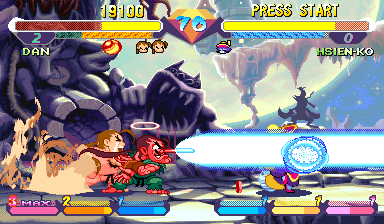
I also enjoy the spin-off game Super Gem Fighter: Mini Mix, a much more lighthearted, simplified and cutesy Street Fighter game (with a few non-SF characters) in which most of the fighters change into different outfits for their combos and use the most delightfully absurd special attacks. You can get the original release on the PS1 or on the Street Fighter Alpha Anthology for the PS2. Yes, I have a disc with 3 of the biggest Street Fighter games and my favorite out of them all is Gem Fighter. Of course, it wouldn't be nearly as funny without knowing the source material.
"Oyaji biim!"
Other Media
As stated in the third paragraph, Street
Fighter has a lot of merch outside of the games. Some are promotional tie-ins, such as two OVAs for Street Fighter 4, and adaptations that tell their own stories. There’s the semi-famous live-action movie
starring Jean Claude Van Damme as Guile, as well as a 26-episode animated TV show slightly based off of it. Both the movie and show paint Guile as the
main hero, who fights the evil forces of M. Bison with other Street Fighters
from the games. As you can tell from the
premise alone, they deviate from the games in many many areas. Some people like to watch the live-action movie
for its cheesiness and Raul Julia’s acting in his final role, but the animated
series…
Just sucks. The characters are bland and derailed, fight scenes have no weight or finesse, the voice acting is poorly directed, and not to mention the animation is painfully inconsistent.
I’ve
heard some people like to watch it just to laugh at it, but I doubt anyone has
willingly suffered through the entire run and enjoyed it.
There’s another live-action movie based off of Street
Fighter called Street Fighter: The Legend of Chun Li, but it’s pretty much one
big insult to Street Fighter fans, possibly even moreso than the first live-action movie. You can see exactly why in Matthew Buck’s detailed review.
The Street Fighter movie you want to see is the animated movie based off of Street Fighter 2. It’s not great, and it certainly
suffers from some of the shortcomings 90s anime usually did, but the animation
is solid, the characters are accurate, and there’s a lot of (good) street fighting that
goes down. I guarantee the animated
Street Fighter 2 movie will give you more enjoyment than 5 episodes of that
awful TV show.
As sort of a follow-up, the animation studio behind the Street Fighter 2 animated movie also made a short series called Street Fighter 2V. Unlike the movie, 2V reinterprets the characters of the game in their younger years before the Alpha games came out, so knowing the characters well by this point makes it a bit of a pain to watch, honestly.
There were animated movies based off of the Street Fighter
Alpha games too, but trust me when I tell you that they are forgettable.
There are also Street Fighter comics. At first there was a comic adaptation by Malibu Comics, which was just about as bad as the TV show for many of the same
reasons, but since then there have been more faithful manga adaptations,
including a spin-off manga called Sakura Ganbaru, which centers on the daily
life of Street Fighter Alpha 2’s Sakura Kasugano. It’s amusing, but not especially notable.
The best comics are the ones by UDON Entertainment,
which I swear the Street Fighter camp immortalize on museum pedestals in vacuum-sealed diamond cases in a sacred booby-trapped temple. If they do, it’s for good reasons,
because the UDON Street Fighter comic may be one of the best comics based on a game I
have ever seen. It expands on the story and has strong, flashy fight scenes courtesy
of UDON’s nearly flawless artwork, in which they have great experience with
drawing for Capcom games (the endings in Tatsunoko vs. Capcom and all the graphics for Super Street Fighter 2 Turbo HD Remix, for example). Every panel in the Street Fighter comics are
rich, colorful, and full of texture and detail. To see a nice showcase of some of their work, browse UDON's official DeviantArt page.
Like I said though, "nearly flawless." On occasion characters can look off-model.
Apparently using the Tiger Shot too much shrinks your head.
Street Fighter is truly the fighting game of fighting games, like the Fist of the North Star to shonen. Once it kicked off the fighting game genre, we got the varied fighting game camps we have today.
If you think this wimpy franchise is badass
and action-packed, you’d best be ready for the next post, in which I’ll objectively
and completely without bias detail Street Fighter’s rival and SNK’s massive,
superior fighting game flagship (because I haven’t gone into detail on it
enough already)!
You’ve seen it before: that point in your favorite action
game where it’s just you and your enemy.
Your party is gone, there are no monsters around to fight, and you and
the villain are on equal ground. The
resulting clash is nothing short of epic as both characters block, parry,
dodge, and duel each other to the death in an awesome display of finesse and
spectacle.
Now imagine if they made a game solely out of that. Fighting games are built around those
moments, having a variety of colorful characters fight evil and each other in
mano-a-mano bouts of spectacular physics-shattering awesomeness.
Every major fighting game franchise has the same game
objectives and even similar mechanics to each other, but the finer details in
the way the games are played and presented all combine to form very distinctive
styles that appeal to very specific kinds of gamers. They all have their own heroes, villains,
stories, art style, and game flow each one builds their games around. And when so many of these games vary, the fans
they pick up are some of the most dedicated you will ever meet.
Those gamers make up what I like to call the fighting game
camps. Every fighting game franchise has
one: a community of dedicated fans that have played every game in the franchise
to death, memorized every special move, can recite the entire decade-long story
by memory, mimic characters in synch with them on the screen, and will probably
roar in your face when you challenge them to their game of choice (except for
the Mortal Kombat fans, who instead scream “MORTAAAL KOMBAAAT!”). They’ll play other fighting games and enjoy
them, sure, but they have their one franchise that they play three times more
than any other. They are the reason crossover
fighting games are made: because that lets fans prove that theirs is better in the most surefire way they can think of.
You can probably single out some members of these camps. Noah Antweiler is in the Tekken Camp, where
nobody lets their opponent hit the ground.
Craig Skitsmas is in the Street Fighter camp, where everyone paces each
other, make sure they strike at the right time and think ahead. Patrick “Debaser” Breeden is in the Mortal
Kombat kamp, where hospital trips are frequent, and I myself am in the King of
Fighters camp, where everyone thrusts into each other and regularly combust.
They even have their own theme songs.
For this series of articles, join me as I explore each of
these duel-centric camps by analyzing each franchise’s aspects and the appeal
that comes with them: The story, heroes, villains, visual style, and gameplay, among other things. For those of you who would like to get
involved with one of these franchises, I will also point out which titles in
each one I deem to be the best. Finally,
I will point out my characters of choice, as it’s always them that keep
the story and play interesting as well as emotionally investing. I never specialize in a character just
because I play well with them; when I play, my opponent should be fighting ME
on the screen.
Like looking into a mirror.
Keep in mind that while much of it will serve as a factual
introduction to each franchise, Opinions as well as personal observations will
be expressed. I like all these fighting
game franchises (they have their camps for a reason), but there are some I
favor over others. Do not let that deter
you from loving the ones you do.
There’s a lot to cover, so to start out I’ll be looking at
the granddaddy of all fighting game camps: Street Fighter.