Showing posts with label shonen. Show all posts

Saturday, July 4, 2026

Yu-Gi-Oh Early Days Collection Review Part 5

 In 2004, the original Yu-Gi-Oh manga ended and America, being as late to the party as we possibly could, only then started getting it translated in 2005 while the anime was going into the filler arcs.  You would think the original series would be wrapping up with the story ending, but if you think that you clearly don’t know Shonen Jump.  The anime was such a money maker in America that 4Kids commissioned Studio Gallop to make a movie and the Capsule Monsters miniseries.  Even Japan wasn’t done with the manga because they made Yu-Gi-Oh R!  The original Yu-Gi-Oh was being kept around for at least a little while longer while the sequel to the anime, Yu-Gi-Oh GX, was starting to take off.

Recommended read.
That means more original-era games and the last game included in the Early Days Collection.

Wednesday, July 1, 2026

Yu-Gi-Oh: Early Days Collection Review: Part 4

A player might notice something around this time of Yu-Gi-Oh game releases; there were no new characters introduced in them and, barring the game-original Reshef of Destruction, there hadn't been for a while.  That's because Battle City was the last part of the manga to center around the card game.  After that came the final part with exploring the pharaoh's memories, where only two card games would be played for the rest of the story, none of which was between any new characters.  By 2004, in Japan, at least, the original manga ended.  This means the games had to start using the same roster of characters in new ways.

Yu-Gi-Oh Expert 2 is the only game in the Early Days Collection that has no translation, at least for its original version.  After Eternal Duelist Soul borrowed Expert 2’s dueling system for the English release, Expert 2 as a whole would get a revision released for international audiences.  I call it a “revision” and not an “updated version” because it takes a handful of cards out, changes some art and tweaks a few things that could be considered either for better or for worse.  I guess Digital Eclipse threw the original version in there for the sake of thoroughness and for the Japanese gamers that care.  The game we got in America would be titled Yu-Gi-Oh: Worldwide Edition: Stairway to the Destined Duel.

Tuesday, June 23, 2026

Yu-Gi-Oh: Early Days Collection Review: Part 3

The Game Boy Advance era is where I think Yu-Gi-Oh games hit their first big stride.  Up to this point, the games other than Capsule Monster GB with cheats have only reached the level of “good enough.”  Dungeon Dice Monsters comes off like an experiment to see what the designers could do with the GBA’s increased power and memory, which would explain why the monster clashing graphics are the most visually interesting and system-pushing part of the whole thing in an otherwise barebones framework.  After that, they took a big leap and made the first Yu-Gi-Oh game to follow the rules of the real card game, the game that would be released in America as Yu-Gi-Oh: The Eternal Duelist Soul.

Sunday, June 14, 2026

Yu-Gi-Oh: Early Days Collection Review: Part 2

 At the turn of the millennium, Yu-Gi-Oh started finding its footing and established what the franchise would become moving forward.  The official card game from Konami was taking hold and just as impactful was the premier of the Yu-Gi-Oh Duel Monsters anime.
There was no stopping the Yu-Gi-Oh hype train in Japan and that meant there was no stopping the assembly line of Yu-Gi-Oh games to feed the hungry masses that couldn’t get enough of it.  It was another year and another Yu-Gi-Oh game, this time titled Yu-Gi-Oh: Tri Holy God Advent.  In Japan, that is.

It wasn’t until a year later that Yu-Gi-Oh made its American debut when the Duel Monsters anime was dubbed into English by 4Kids Entertainment, hot off the success of the merchandise fountain that is Pokemon.  Fitting that the 4Kids dub of Yu-Gi-Oh named a god after Roger Slifer because this thing exploded like the ending to Lobo’s Paramilitary Christmas Special.
I could go on a long-winded old man monologue about how it was the hottest thing in cool and one of my first shonen anime ever that I still enjoy to this day despite its faults, but this is a game collection review so I’ll keep it short.  Yu-Gi-Oh’s anime became a monster hit, but the manga it was based on still wouldn’t be translated to English for a few more years.  If you look on the back of some of the English game boxes (they’re in the instruction manuals in the collection) they say they’re based on the hit television series, which is not technically true, and on the back of some manga releases, a bit of text tacked on says it’s the inspiration for the hit anime featuring scenes too intense for television, which actually is true in both languages.  In America, Yu-Gi-Oh was riding the coattails of the anime specifically.

Tuesday, June 9, 2026

Yu-Gi-Oh: Early Days Collection Review: Part 1

As I already stated in my review of Yu-Gi-Oh: Duel Links, I’ve been a fan of the original Yu-Gi-Oh ever since it arrived in America through the anime from Studio Gallop.  When Kazuki Takahashi wrote his manga about a kid gaining Egyptian magic and playing games, he couldn’t have predicted the phenomena that it would become, let alone that his little one-off Magic: The Gathering knock-off would be at the center of it all.  When Shonen Jump gets a hit manga on their hands you’d better believe they’re going to merchandise that sonbitch.
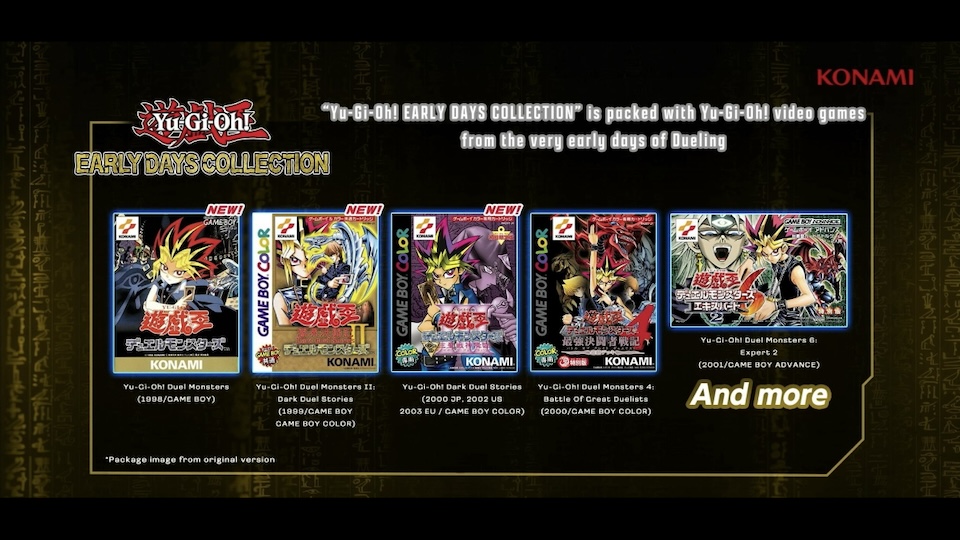
Inevitably that meant games across all manner of consoles, in particular Nintendo’s handhelds.  The Yu-Gi-Oh Early Days Collection puts the first 13 (the marketing says 14, but I’ll get to that) Nintendo handheld Yu-Gi-Oh games into one package and I was hyped to get to both replay games I used to love and play games I never got to before.  The enhancements and new translations made it all a big deal, but I swear you wouldn’t know just how big a deal it was if you read the reviews.

I was going to get the collection anyway, but I’m disappointed by the reviews of it I’ve read thus far.  Regardless of whether I agree with them or not, most give a general overview of the collection and come across as though they only played each game for a little while before writing them off.  Understandable, since there’s 13 games and they only have so much time, but I’m of the mind that even if one were to recommend the game, readers might want to know which games are more worth their time, how many are any good, what to expect from each game in more detail and what the cheats included in the collection can do to enhance their enjoyment.

The other sentiment I see is that it’s a collection made only for the old-school Yu-Gi-Oh players and that the only people who will enjoy the games are the ones nostalgic for them.  I think that’s both a reductive way of thinking and not true.  There are games in the collection that, even today, are a fun time, outdated cards or not.  I would love for younger people who weren’t around for them to experience some of these games and maybe get invested into the card game’s simpler times.
I’m going to review the Yu-Gi-Oh Early Days collection more thoroughly, less at the package as a collective whole and more the parts that make it up so that readers can make a more informed purchase.  I’ll look at every game in the collection, give some context of where the source material was at the time of each game’s release and some context of where I was at the release of some of these games.  I am writing this as a fan, but I’ll try to keep the nostalgia goggles off.

Tuesday, April 23, 2019

Digimon: Data Squad Review

In my review of Yu-Gi-Oh: Duel Links I said Yu-Gi-Oh was an anime that stuck with me, but another franchise that defined my childhood just as much was Digimon.  The show was Fox Kid’s juggernaut back when it was around, almost like what Teen Titans Go is to Cartoon Network today.  In direct contast to Teen Titans Go, however, it was a well-written character-focused adventure with a lot of heart that many people, including myself, still love to this day.

The first two seasons are the ones the most people remember since they’re within the same continuity and hooked everyone to begin with.  Like some people, I lost interest in Digimon around the time Tamers came along because of the unfamiliar characters and tonal shift.  Then I missed out on the fourth season, Digimon Fronteir thanks in part to airing on a new channel.  I did catch up with the ones I missed on Disney channel re-runs and appreciated them on their own merits, but I still preferred the original adventure.  When I got to Digimon: Data Squad, the fifth series, I wasn’t able to catch every single episode, but what I did watch was interesting and possibly even darker than Tamers.  Fusion, the most recent one, I was able to watch in its entirety.  It was pretty fun, but certainly not my favorite.

For a long time Digimon was unlocky when it comes to home releases.  It was a very TV-only affair for a long time.  Some of the seasons got a few episodes on VHS or DVD if it was lucky.  You could only really watch the series outside of TV through recordings of the TV airings, which weren’t the optimum quality.  After over a decade of this, things changed around the 2010s when New Video Group released them all in DVD box sets for relatively cheap prices.  Crunchyroll also streamed the Japanese versions of the earlier series and Netflix added Digimon Fusion to their lineup.  Since it’s one of the more controversial Digimon seasons not enough people have seen, I thought it best to take advantage of this and get the box set for the season I don’t think enough people have seen: Digimon: Data Squad.

Wednesday, July 8, 2015

J-Stars Victory Versus + Review

J-Stars Victory Versus and Senran Kagura 2 have been my two most anticipated games of 2015.  Both are centered around extreme power-clashing speedline-using shonen badasses on powerful handheld systems, but since J-Stars came out far sooner I counted the days for its release first.  That is, until Bandai Namco told me it wouldn’t be released physically on the Playstation Vita.

Apparently Bandai Namco hasn’t learned what XSEED did after the first Senran Kagura: that forcing customers to download a multi-gigabyte full-retail game on their expensive (especially on the Vita) memory cards through a digital distribution service that may not keep it forever is a really fucking stupid idea!  I wouldn't even be that offended if they didn't release it physically on two other systems and showed that they're perfectly capable of doing so!  Fuck you Bandai Namco!

At that point I should have stopped counting the days and not given in to their stupid fucking digital-only fucking didn’t-learn-anything fucking run-by-lobotomized-chimps fucking bullshit, but if I didn’t review a game synonymous with the word “shonen” I might have this blog’s title called out for being a lie.  So I got the damn thing, with only a Vita theme based on the game that plays its (admittedly awesome) theme song as the background music as compensation for the lack of a physical release’s pre-order bonus.  Fuck you Bandai Namco.

If you can get over J-Stars Victory Versus’ slap in the face for Vita owners and focus on the game as it is, then it’s an amazing action game and for some will likely beat out Super Smash Brothers 4.  The big question is whether or not you can honestly do that.


Friday, December 19, 2014

Naruto Shippuden: Ultimate Ninja Storm 3: Full Burst Review

For a blog called the Shonen Otaku Corner, I haven’t written very much about anime or manga.  It’s been almost entirely focused on games instead of what the term “shonen” is usually applied to.  This is because, at heart, I’m a gamer first and as much as I love the action-packed stories of shonen, I find the way they can translate into kickass action games (and vice-versa) captivating.  Sometimes the games can be better than their source material, as is the case with the rock-crushingly popular shonen franchise Naruto.

Saturday, October 25, 2014

A Look at the Jojo's Bizarre Adventure Capcom Fighting Game

The most recent anime adaptation of Hirohiko Araki’s multi-part manga epic Jojo’s Bizarre Adventure has been making the rounds, quickly gaining popularity in the anime-loving crowd, particularly once it reached part 3.


For all the years the series has been around, through all of its 8 parts and generations of different heroes and villains, part 3 is considered the major turning point and the most famous.  It’s so influential, the hero and villain of part 3 are the only playable characters from the series in Jump Ultimate Stars, while the heroes from the other parts are only support characters.  It’s a story almost as iconic as other Shonen Jump classics like Fist of the North Star and One Piece.