When it comes to shonen manga, anime and games, there are few with as much knowledge and love as the Shonen Otaku. Join me as we look at all different varieties of action-packed media. Mostly games.
At the turn of the millennium, Yu-Gi-Oh started finding its
footing and established what the franchise would become moving forward. The official card game from Konami was taking
hold and just as impactful was the premier of the Yu-Gi-Oh Duel Monsters anime.
There was no stopping the Yu-Gi-Oh hype train in Japan
and that meant there was no stopping the assembly line of Yu-Gi-Oh games to
feed the hungry masses that couldn’t get enough of it. It was another year and another Yu-Gi-Oh
game, this time titled Yu-Gi-Oh: Tri Holy God Advent. In Japan, that is.
It wasn’t until a year later that Yu-Gi-Oh made its American
debut when the Duel Monsters anime was dubbed into English by 4Kids Entertainment,
hot off the success of the merchandise fountain that is Pokemon. Fitting that the 4Kids dub of Yu-Gi-Oh named
a god after Roger Slifer because this thing exploded like the ending to Lobo’s
Paramilitary Christmas Special.
I could go on a long-winded old man monologue about how it
was the hottest thing in cool and one of my first shonen anime ever that I still
enjoy to this day despite its faults, but this is a game collection review so
I’ll keep it short. Yu-Gi-Oh’s anime
became a monster hit, but the manga it was based on still wouldn’t be
translated to English for a few more years.
If you look on the back of some of the English game boxes (they’re in
the instruction manuals in the collection) they say they’re based on the hit
television series, which is not technically true, and on the back of some manga
releases, a bit of text tacked on says it’s the inspiration for the hit anime
featuring scenes too intense for television, which actually is true in both
languages. In America, Yu-Gi-Oh was riding the
coattails of the anime specifically.
This means a couple of things for what was known as Tri-Holy
God Advent in Japan. Since America was late to the Yu-Gi-Oh
party, that also means the game was late and wouldn’t come out until 2002, two
years after its Japanese release, where it took the name Dark Duel Stories from
the second Game Boy game. In that time
there was a sequel released in Japan,
but that wasn’t the one chosen for an English release for reasons I’ll get to
later. I’ll refer to this Dark Duel
Stories as DDS from now on.
Dark Duel Stories (DDS)
Just call it Dark Duel Stories. We're never translating the second one.
This being an old translation means is there are discrepancies
with the names used after the previous games, which were translated for the
first time in the Early Days collection.
At the time of DDS’s release, the anime hadn’t gotten to some of the
characters featured in it and thus there weren’t any English names made up for
them. That means it has Pandora instead
of Arkana, Isis instead of Ishizu and for some reason the character of Simon
(pronounced “see-mohn” because he’s Egyptian) Muran was renamed to Paradox. Marik’s henchmen in this game and others also
name their organization the Ghouls. In
the manga, the organization is named the Ghouls and the card players who got
the rare cards for them are called Rare Hunters, but the 4Kids dub would simply
refer to them all as Rare Hunters.
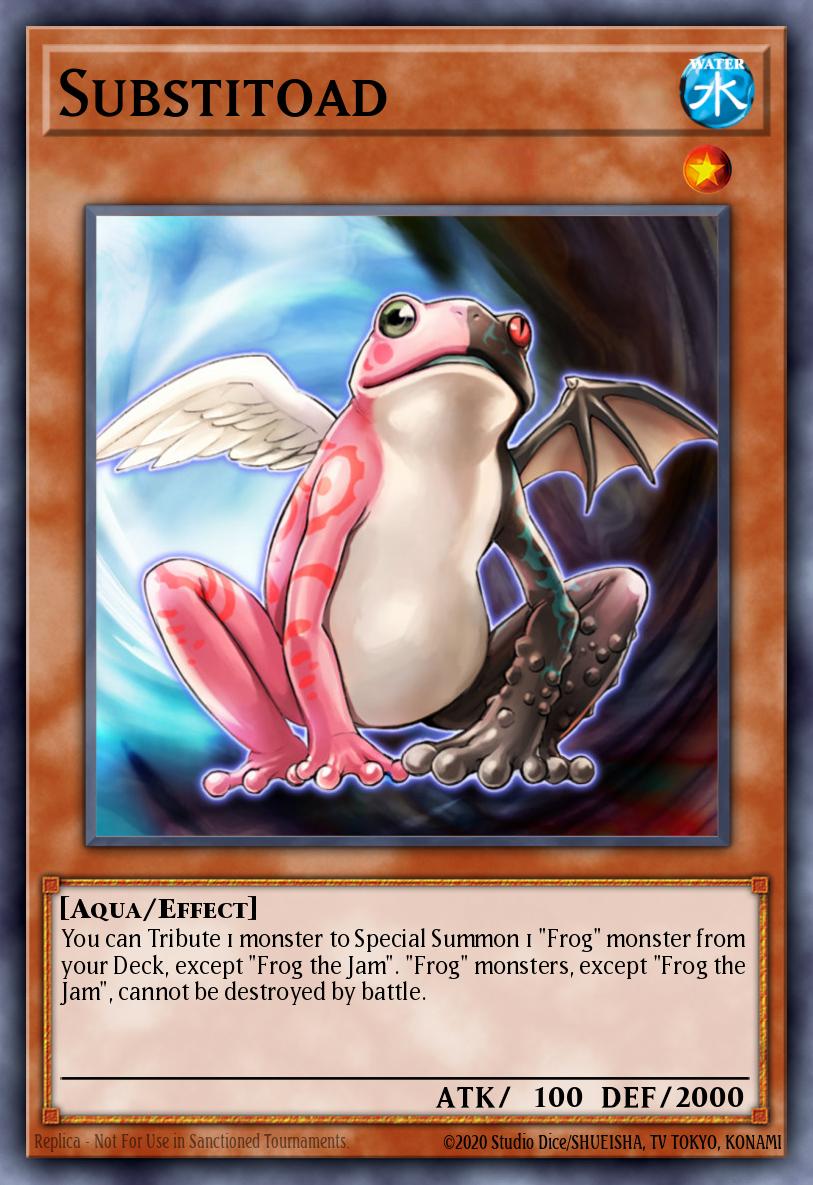
A few cards have different names too because this was back
in the days when the translators didn’t realize the name “Frog the Jam” would
lead to having to print “except Frog the Jam” to every single frog archetype
card.
SLIME TOAD is not invited.
Since I was there and I still have my original copy of DDS,
it’s hard not be a little biased, but now that I have the context of the games
that came before it, not to mention decades of tabletop game experience, I
think I have a new perspective on DDS.
The BattleCity rules of the manga,
which are closer to the real rules, started to creep into DDS, most noticeably
with tribute summoning being added and fusion monsters being unable to attack
the turn they’re summoned. The fusion
monster summoning sickness was only ever a rule in the source material and a
lot of characters would use a made-up card called Quick Attack to allow them to
attack. It’s a dumb rule.
Tribute summoning helps to balance the game by making it
harder to bring out heavy hitters, but the way it’s done is a little
weird. In every other Yu-Gi-Oh game
after the Game Boy ones, you tribute monsters by selecting to play the monster
you want to summon from your hand, the game asks if you want to tribute summon
it and you then select which monsters to tribute. In this game, tributing monsters is a command
for the monsters on the field that puts them in a sort of offscreen tribute
resource pool that allows you to then play the tribute monster from your hand. It’s not annoying. It’s just weird if you’re used to any other Yu-Gi-Oh
video game.
DDS is the game that finally added single-use monster
effects that can be activated the turn they’re summoned, but like ritual
monsters, there are so few of them that they almost aren’t even worth
noting. At least magic cards found more
use, but because of their high deck capacity a lot won’t see use unless you
cheat for max DP.
Yes, magic cards. Not
spell cards. At some point some other
company you’ve probably never heard of had a problem with Yu-Gi-Oh using the
term magic cards and made them change its terminology to spell cards.
The most unique gimmick in DDS is the custom monsters. Alongside the usual card after every win,
players are also given a card part.
These card parts are combined to make a variety of different monsters
with a variety of different stats. There
are two sets of them: one consists of a top half and bottom half and the other
consists of a body and a head.
I really like the custom monster system because it reminds
me of the tabletop games where clear cards with designs on them are overlaid on
sleeved cards to change them up and turn them into better cards, like Custom
Heroes or Mystic Vale. It also rewards
experimentation because some of the combinations result in extremely powerful
monsters and all of them have a low deck capacity cost, meaning you can build
up a deck of your own custom-made monsters to get an edge.
It’s an amusing thought that some of these weirder-looking combinations
bring the same excitement drawing a Blue-Eyes does in the source material.
If the core gameplay were still slow like in the previous
Duel Monsters game, none of the improvements would matter, but, to my
satisfaction, the speed isn’t a problem anymore. It’s still not as fast as the first Game Boy
game, but the computer doesn’t take 2 seconds to do anything anymore and only
every once in a while is there a half second delay. It all flows smoothly enough.
“Enough” is a word to describe DDS. The game is fast enough, the graphics are
good enough for a Game Boy color game, the music, following the quality of
Capsule Monster GB, is pretty good and the custom monsters do enough to make it
unique among the Yu-Gi-Oh games by adding a fun layer to deck building. If the deck capacity becomes a problem, you
can cheat that away. Overall it’s a
serviceable game and the best one across the Game Boy and Game Boy Color. If you’re going to sink your time into just
one of them, make it this one. This or…
Duel Monsters 4: Battle
of Great Duelists
I think this game requires some greater context to explain
why it is the way it is. See, in Japan the Duel
Monsters games on the Game Boy and Game Boy Color apparently had a competitive
scene, to the point that there were some cards you could only get in them
through special means as prizes. From
the beginning there was some dialogue in the games encouraging playing against
others. Battle of Great Duelists leans
into that competitive play and player interaction harder than any other game up
to this point.
As such, it tries to prevent some cards from being too
powerful. Levels are now determined by
monster attack strength, there is no more extremely powerful custom card
crafting and there is now a limited list, where certain cards are restricted to
how many you can have in your deck.
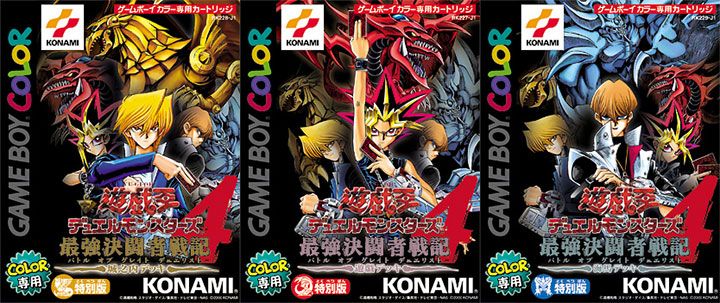
Obviously the biggest incentive to get players to bust out
their link cables is that this time there are three different versions of the
game, Pokemon-style. Each one represents
one of the big 3 duelists and the Egyptian God Card associated with them, or at
least for Yugi and Kaiba. I don’t know
why the Joey one has Ra on it. He never
even touched that card. Each version has a different starter deck, to prevent all the
players from using the same decks against each other, but, more importantly,
there are some cards that can only be used in certain versions, which is an
especially big incentive to trade cards with other players, particularly when
it comes to the flagship monsters.
The following is one of the wackest ideas I’ve ever
heard. The Egyptian God on the cover of
each version is the card that can be USED in that version, not the card you
actually GET in it. Once they beat the right
endgame opponent to get one of the god cards, players were expected to trade
that god card they couldn’t use with another player who had their own god card
they couldn’t use. This means if you
didn’t know anyone with a copy (which, given the Japanese sales of this, isn’t
as likely as you’d think), your ultimate reward was useless. I get wanting to encourage trading, but
that’s such a dick move. Thankfully the
Early Days Collection has a cheat that lets any version use any card.
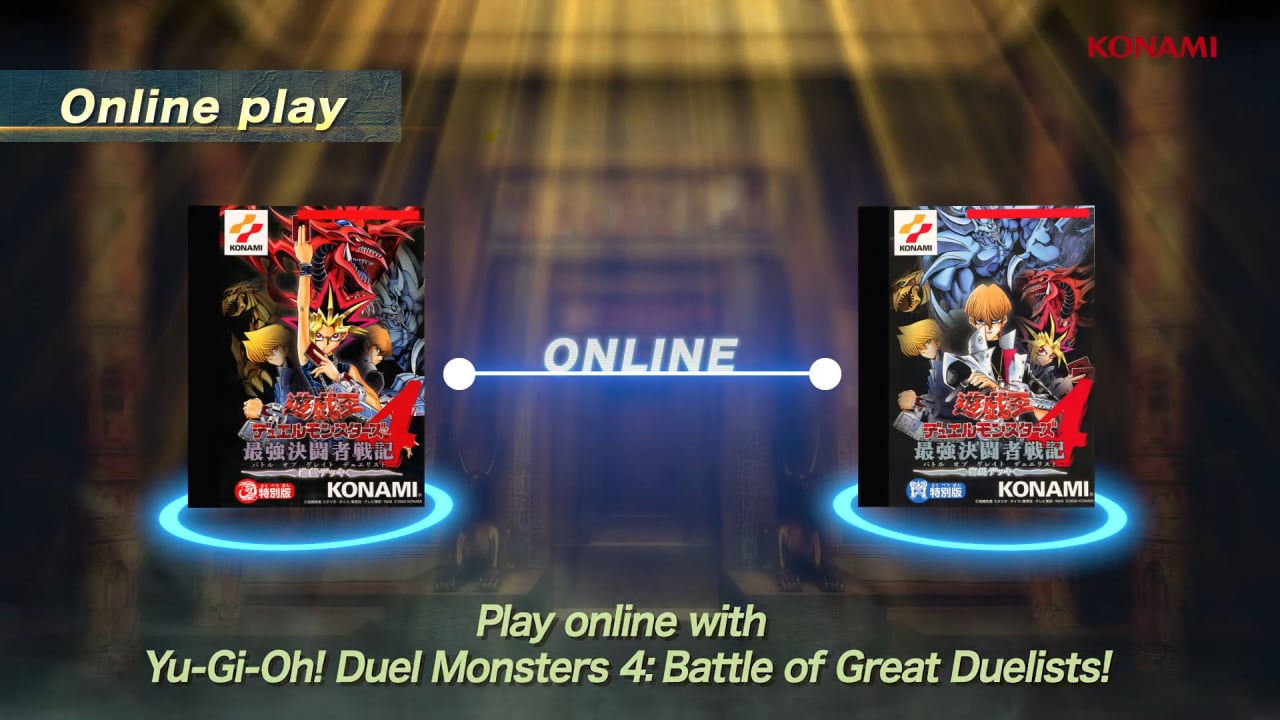
With how much Battle of Great Duelists doubles down on
dueling others, it makes sense that this is the one among the Game Boy/Game Boy
Color games that is available for online play in the Early Days Collection. The multiple versions in the collection can
also be used as a form of save slots.
For me, I have one version I’ll play totally legit with no cheats and
another version with all cards enabled and max deck capacity.
With so much put into the multiplayer aspect and less than a
year of development time since DDS, not a lot was done to make the single
player experience any different. Most of
the characters use the exact same character portraits from DDS. The biggest improvement Battle of Great
Duelists makes to single player is that the duel music is character-based
instead of stage-based and the soundtrack is still pretty great.
For me, the card crafting and some of the characters not
from the manga found in DDS makes it superior, but I can see someone enjoying
Battle of Great Duelists more for its tweaks and online multiplayer (for the PC
version). Like DDS, it’s serviceable.
I can see a myriad of reasons as to why Battle of Great
Duelists wasn’t translated to English, despite the Yu-Gi-Oh hype in America at the
time.
DDS wasn’t
that well received when it came out.
It had its fans (like me), but it didn’t catch on like the Game Boy
Color games did in Japan. That means a game that puts emphasis on
everyone owning a copy and restricts you for not connecting with other
players was not going to go over well.
The
English anime hadn’t even gotten to Slifer the Sky Dragon’s first
summoning, let alone all 3 gods. It
wasn’t time to hype them up yet.
3
different versions needing translation was probably a lot of work.
By the
time DDS was out in America there had already been Game Boy Advance games out
in Japan that were more worth translating.
There
are some Japanese quirks that just wouldn’t make sense for American players,
like some of the passwords. After
beating Pegasus as a sort of final boss again, players unlock the “dark
stage”. In the previous game, the
dark stage let players fight some post-game duelists, but there would only
be one of those duelists in it at a time and it could change by random
chance after a certain number of duels.
In this game, players manually have to change the dark stage with a
password. I like me a good secret
password, but I think the only way to get them was if you got it from a
Japanese magazine Americans had no access to. In the Early Days Collection you simply
select these things off a cheat menu without needing to type a long password
in.
Building
on the previous point, there are two characters that can be unlocked with
a password that no American would recognize, those being Kaiser Umiuma and
Yugi Gonbutori. I first saw Kaiser
in one of the later DS games.
From my understanding, these characters are models or cosplayers
that appeared in the magazine V-Jump to promote Yu-Gi-Oh and caught on as a
sort of “we have X at home” joke.
They’re like guys you would see on a silver bordered MTG card. American players wouldn’t know who these guys
are supposed to be, even if they’re inherently amusing to look at.
What the American players wanted at the time was a Yu-Gi-Oh
game that followed the real rules of the card game, something that had already
been made in Japan. After much anticipation, we got exactly
that. Too bad I’m doing this review in
Japanese release order.
Dungeon Dice Monsters
In Japan,
the game based on Dungeon Dice Monsters was the first to release on the Game
Boy Advance, but Konami delayed its release in America for a few years, instead
translating the first simulator of the proper card game. Like I said, what American players were
wanting was the real card game on a portable cartridge so they made the right
call. America wouldn’t get DDM until the
real life American version of the game (which I own) was released.
Dungeon Dice Monsters, like Capsule Monster GB, forgoes
cards, this time to play with a lot of dice.
You roll dice to build up resources to allow for movement, attacking,
defending and special abilities, but more importantly they can be used for summoning
monsters. Summoning a monster builds a
pathway to the piece that represents the opponent and it’s all about getting to
that opponent with your own monster while defending yourself against theirs.
I like moving my creatures around the battlefield,
strategically building said battlefield against my opponent doing the same and
I like having the monsters clash with each other. I like rolling dice too. I’m Ameritrash all the way!
The monsters clashing is my favorite part. When one monster attacks another, it shows
the attacking monster using its attack on the other, which may or may not be
guarding. Every single monster in the
game has its own combat model, sometimes a multisegmented one, and attack
animation, all taking place on that flat 3D plane the GBA could render in games
like the port of Mortal Kombat: Deadly Alliance. That flat 3D plane is also different
depending on the arena the game is played on.
If you’ve ever wanted to see what monsters like Three Legged Zombie or Fiend’s Mirror look like when they attack, Dungeon Dice Monsters answers.
Dark Eyes Illusionist has an interesting one.
It also answers the question of what kinds of names the pre-DuelistKingdom characters would have in the English dub. Some are generic names like
Jeremy Harrison, Kreiger and Lint Greendale.
Some are inherently cool names like Diesel Kane and Demitrius. The best ones are the names that refer to
something related to the character, like the dragon cards player being named
Damien Draco or the loud, obnoxious bully with the bad voice being named Fender
Shrill. Names like that can be a little
too on the nose though. My favorite name change by far is what they named the Bruce
Lee-obsessed fighting game player who beat up Yugi after constantly losing to
him. In Japanese he’s not given a name
and is only known as “street fighter”.
This game names him Feng Long.
He’s a fighting game-playing Bruce Lee fan named street
fighter so they gave him a name one step away from Street Fighter’s Bruce Lee
character and also one step away from the infamous “sheng long” of the original
Street Fighter 2. Whoever came up with that
name should give themselves a pat on the back.
The old translations weren't always the best.
I like the presentation and the gameplay of DDM, but it has
a bad reputation among players, and for good reasons, but the Early Days
Collection’s features address some of the biggest problems. If it weren’t for the Early Days Collection I
have no doubt I would get sick of Dungeon Dice Monsters.
The grind is a problem. There are over 100 different dice to
get, but you only get one per match and it’s usually the same handful of crappy
ones you’ll get sick of using. You can
get others at grandpa’s shop, but not only does he usually have a weak
selection of crap you already have, but they can be so expensive that you’ll
never get them, especially not the crazy overpriced Exodia pieces. The time spent getting anything new is never
worth the end result. Turn on the cheat
that gives you every dice. Think of it
like playing a tabletop game with all the expansions included. This is not the game to play for the
collection aspect.
The other problem is the single player content, or lack thereof. All you can do is enter tournaments where you
battle against a series of opponents.
There are a ton of characters to play against, but all they really are
is manga panels, some introductory text and a set of opposing dungeon dice that
correspond to their character with whatever is included in the game. The tournaments themselves were a big problem
on the Game Boy Advance because the game doesn’t save until you’re done with
one. You have to beat at least 3
opponents in a row and the individual matches can potentially get lengthy,
which the Game Boy Advance’s battery couldn’t hold out for. Obviously the Early Days Collection has save
states to make that a non-issue.
The single player content is also notorious for being piss
easy to the point of opposition sometimes being non-existent. It ramps up after the first set of
tournaments, but even then the AI doesn’t seem to know what it’s doing most of
the time. I still get a kick out of
experimenting with the many different dice monsters, even if my opponent is a
punching bag, and besides, DDM is one of the games in the collection that was
given online multiplayer. Human
opponents are much more interesting to play against and let the strategic
gameplay shine so at least there’s that for anyone wanting more of a challenge.
I really enjoy Dungeon Dice Monsters for what it is. It’s a game I like to pick up and play when I
want a hit of some tabletop monster fighting.
You’re probably not buying the collection for it unless you want to play
online, but I’m happy it’s included.
With 3 more games assessed, I’ve found the Early Days
Collection has 2 more decent games and one fun side activity. I know that starting with the next game
there’s going to be a lot more straightforwardly positive feedback for the
games in the collection. Any old-school
Yu-Gi-Oh fan probably knows why.






No comments:
Post a Comment