When it comes to shonen manga, anime and games, there are few with as much knowledge and love as the Shonen Otaku. Join me as we look at all different varieties of action-packed media. Mostly games.
If 2000 marked the sharp decline of Capcom and SNK’s arcade
days, 2001 practically marked the end of it, or at least the near-end because
there’s more years to go. SNK officially
went bankrupt and was bought out by the South Korean company Eolith while Capcom
put even more focus on console games, which worked out well considering they
made Devil May Cry.
SNK’s dire financial situation meant they were only able to
put out one game before they went bankrupt (presumably already long since in
development) and then just one King of Fighters game in collaboration with Eolith,
who had their own ideas and their own game developers on the scene, for better
or worse.Capcom’s new strategy meant
they only put out two games as well.I
mean I guess it was that or be
It makes sense that arcade gaming would be on the decline. I guess rising manpower requirement played a
hand in it, but part of what made most of these arcade games so amazing when
they came out was that they were on hardware much more powerful than what was
available on home consoles and most ports of them were imperfect. 2001 was the year of the Xbox, Gamecube and
PS2, and the Dreamcast was already on the scene. All of them were not only capable of running
both company’s latest and greatest games, but enhanced versions of them, which
was a good thing for them to take advantage of, and I’m sure as hell happy with
my PS2 copies of KOF 2000 & 2003, but it also showed that arcades no longer
had quite the appeal they used to.
That doesn’t mean it was all over.Through all the odds SNK was still able to
make another yearly addition to The King of Fighters and Capcom made another
game to throw down with SNK for cross-company grudge matches.With two games from each company, both have
an equal opportunity to win 2001!Who
will it be?!
As I stated at the conclusion of the last article, SNK apparently went bankrupt following KOF 2000 and had to survive by
joining with little-known Korean media company Eolith.
Eolith didn’t exactly have the same kind of recognition as
SNK; in fact, it seems Eolith is only known for making KOF 2001 & 2002
along with a few mobile phone games here and there. Joining such a small-time company with
fighting game juggernaut SNK doesn’t seem like the best idea.
I wouldn’t go as far as to say King of Fighters 2001 suffers
from Eolith’s involvement (I can’t prove just how much they influenced), but I
doubt anyone can deny it’s not one of the best King of Fighters games.
If you guessed the plot is that some jerk is holding a King of
Fighters tournament and everyone is stupid enough to enter while an evil
organization is still at large, you’ve really been paying attention.
What attracts some of the entrants to the 2001
tournament is the arrival of a new team of NESTS agents. Kula and her mother Foxy have entered with
two of NESTS’ assigned operatives: the Mexican wrestling gal Angel and the polymorphic creation K9999
(pronounced “K four nine”).
There’s some kind of controversy surrounding K9999. Apparently he shares many
similarities with the character Tetsuo in the anime “Akira,” right down to
sharing the same voice actor. Perhaps
because of this, K9999 was removed altogether and replaced with a new character in the remake
of King of Fighters 2002, making him present in only two games.
I fail to see why he deserves the cold shoulder treatment
SNK and their fans seems to give him. Maybe it’s
because he’s not creative, but wouldn’t having a copy of a popular anime
character be kind of cool? I’m just
saying, if they had a character that was almost exactly like Jotaro Joestar,
I’d be all for him. I guess we already
have Benimaru though.
Hmmmmmm.....
The returning teams got the shuffle again for 2001. Most notably, Kyo and Iori both have teams
this time (finally!).
The special agents Vanessa, Ramon, and Seth recruited
Iori because they were short one member and he’s such a strong contender, and Kyo formed a new Japan team with
Benimaru, Shingo, and, returning after a 2-game long break, Goro!
Meanwhile, Lin and Whip (who formally left the Ikari Warriors in 2000) both joined K’ and Maxima, with
Whip’s spot on the Ikari Warriors team being filled by another returning
character, Heidern!
King swapped back with Yuri on the women’s fighting team,
and Kasumi was been replaced with Li, leaving the team with Li, Mai,
King, and Hinako.
The Korean team has an interesting case. Jhung Hoon got
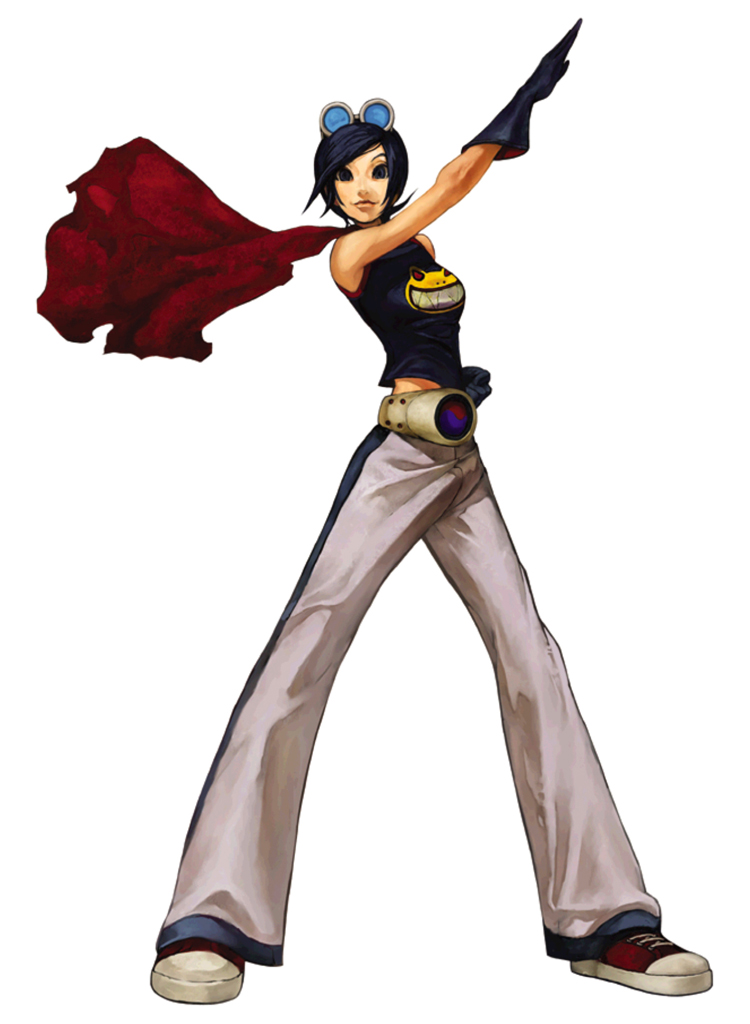
into a rather embarrassing accident involving a cardboard Athena standee, so his place is taken by a new character named May Lee, a costumed self-proclaimed justice-enforcer. Personally, I don’t like her.
My biggest problem with May doesn’t come from her character
design or her difficult-to-use stance system, but her lack of
characterization. She appears in this
game, returns in KOF 2002, and then is never seen again.
At least the New Faces team from ’97 were memorable thanks to the role
they played in that game’s finale. May
just comes and goes. Seeing as how SNK designed her by Eolith’s orders, she’s probably not coming back either, leaving her a flat, forgettable character in the long run unless they decide to bring her back sometime in the future.
Along with the handful of new characters with new fighting styles, more returning characers' move sets were adjusted. Kensou got his powers back at the end of the
2000 tournament, and both Heidern and Robert have gone back to the usual
quarter-circles for moves instead of having to step back for a second first.
Also Ralf’s Galactica Phantom was made into a regular special
move. God help us all.
For this KOF installment, the super modes were taken out, presumably to make way for the new system. I hope players said goodbye to the special
strikers in 2000, because they do not make a return. Instead, strikers work on a system of
give & take.
In this system, every team starts out with one maximum super
stock. When selecting characters, they
can choose up to 3 team members to use as strikers. For every team member the player uses as a
striker, they get one more maximum super stock and more
health. That means you can take the most
common strategy the computer uses and have 3 fighters with one striker (like
the last 2 games), or fight with one character and have 3 strikers. In order to choose which striker to use in
battle, you have to tilt the control stick in a certain direction when you call
for one.
The combat itself was tightened for the 2001 installment. Combos are a bit easier to make, and the game
has a faster pace overall. It may be
difficult to notice for some, since it uses the same control scheme and the
changes aren’t to a drastic degree, but it’s there and it builds upon an
already invigorating fighting system.
A minor and cosmetic, but important addition to the KOF franchise 2001
introduced was the character-specific win quotes. If you beat a character with a certain
other character in the final round of a match, the winner may say something
exclusive to the loser on their victory screen.
The bosses at the end of the game show this off by having a special win
quote for each of the pre-set teams.
Like the special character introductions, they’re a great way of adding
a touch of characterization and relationship establishment. It would be more effective if the
localization was better though.
After beating the Ikari Warriors
It's perfectly functional and has a good character selection, but what makes KOF 2001 “not one of the best” is mostly due to its
presentation. Since KOF '96, SNK excelled
in creating music and artwork. By those
high standards, 2001 is like a kindergartner’s project.
First the stages; It’s not that they’re awful on their own,
but after the colorful and dynamic backgrounds of 2000, the stages took
a step back and reverted to having washed-out colors, a lack of detail, and repetitive looping animations akin to the earliest games in the series.
The returning details of the tournament being broadcasted is welcome.
That weak artwork is also present in the character art. Some look decent enough, but many have
distracting cartoonish proportions and facial art, and all of them don't have the same shading details as the other games, which I don't think was a stylistic choice.
He's not THAT bad looking.
How do you get Mai's hair color wrong?!
But that’s not nearly as difficult to forgive as the music. Gone are the epic, rocking, minute-and-a-half-long solos of previous games. Instead, KOF 2001 has repetitive,
looping, synthesized crap.
The music is something in which I feel Eolith was trying to inject
their own personal touch. Maybe it works
for them and some other people, but for a King of Fighters game, it sticks out
from the other soundtracks like a blemish.
Long-time fans expect better than this.
The only good themes are reserved for the villains.
And speaking of the villains, the game finishes off the
NESTS saga with a showdown with the men in charge. The finale alone honestly makes the game worth
playing in my eyes, as it is the best-presented part of the entire thing, as
well as simply audaciously awesome. What happens at the end of King of Fighters 2001 is a perfect example as to why I love the series so much.
Don't bother trying to find a copy for yourself though. King of Fighters 2001, like 2000, is more or less impossible
to find. There’s a PS2 version of it
that’s bundled with 2000, but it’s extremely rare and goes for unreasonable
prices you can only expect from scalpers.
The PS2 version has a few notable improvements from the original Neo
Geo version. The stages in the PS2 version
look significantly better and less washed-out, and the character art from the Neo Geo version is
replaced with better, but still questionable artwork.
Too bad you'll never find a copy!
Winkawaks.
The NESTS saga already had mixed reactions with its shift in
focus I detailed in the ’99 post, so KOF 2001’s shoddy presentation and
debatable new characters didn’t really help things. Still, it could have been far worse, and it wrapped up the NESTS chronicles,
meaning the story could move on.
But before that, SNK gave the NESTS chronicles its own
sendoff with King of Fighters 2002. It
wouldn’t be fair if the Orochi Saga were the only storyline to get a final farewell.