It’s 1992. Last year Street
Fighter 2 kicked off fighting games in a big way and every company was jumping
in on the new competitive martial arts gameplay, Namco and Midway included. At least, Midway did in America
However, I’ve never seen a cabinet for the original Ridge
Racer in my life.
I could only get my hands on one Namco game and it’s from
1993 so you know what that means: another 2 year judgment time span. They’d better hope Midway drops the ball
again, but considering what I know is ahead, I don’t think they are going to.

Total Carnage has the advantage of improved movement speed,
some more stage variety and more enemy variety with armored vehicles, but it
also suffers from the same pacing problem where it’s a very lengthy game that
wears out its welcome. Thankfully the
gameplay fatigue is alleviated this time with a level select password system,
something I haven’t seen in any arcade game before or since. When you reach a new level in the game, you
are given a short password that can be entered through a spot at the very
beginning of the game to warp to that level.
This makes a big difference because it means that if you need a break
from the all the shooting you can come back to it when you’re ready to go
again. With that, the drawn-out game
length isn’t as bad and if you have all the passwords (through online means or otherwise)
it also means you can skip to your favorite parts. Even with passwords though, levels can drag
on, but not as badly as in Smash TV. I
can at least give Total Carnage a pass.

Mortal Kombat(MID):
For as antiquated as the first Mortal Kombat is, it’s
surprising how well it holds up. Right
off the bat it has a well-established story.
Having the same idea that SNK did with Fatal Fury 2, a prequel comic by
series co-creator John Tobias was made to set the game up, establishing the
evil demon sorcerer villain, his otherworldly champion and the kombatants
arriving at his island for their own reasons.
 |
| John Tobias worked on the Real Ghostbusters comic. |
It’s a pretty good comic on its own and Tobias was a
talented and experienced artist. It’s
just that actual copies of the thing were downright mythical. Thankfully all the prequel comics made across
the 90s are available in their entirety on the Mortal Kombat Legacy Kollection
and some of the artwork was used for more accessible console port manuals. The actual game doesn’t seem like as much of
a tournament as the story suggests though.
There’s a beautiful simplicity to the first Mortal Kombat’s
kombat. Every character has the same
basic moves, but two special moves with different properties; usually one
distance-closing move and one projectile (both at once, for Scorpion).
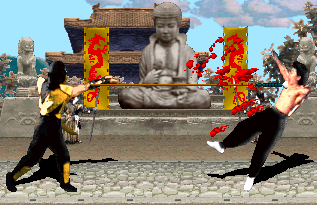
That makes characters easy to learn. If you know how to use the punches and kicks
of one character, all that’s left with the others is their special moves. There are also no real combos beyond rapid
punching an opponent if you get close enough.
It’s more about landing the good hits, kind of like early Fatal Fury
games, but with a lot more emphasis on the hits and blood spatter. The digitized actors combined with windup and
cooldown animations give the attacks some weight to them, making it more
closely resemble a real martial arts fight, but not so much that it’s sluggish. Realism was one of the taglines so it needed
to deliver on making hits feel like they hurt.
 |
| I had this nightmare, but it wasn't Kano. It was Freddy Krueger and the machine had KOF 94. |
The single player experience isn’t too bad either. Sure the computer tends to cheat, but I think
it grants you mercy by lowering the difficulty every time you continue so at
the lowest difficulty level it’s fun enough fighting opponents, finishing them
off with fatalities and getting to face the 4-armed claymation Shokan himself.
What keeps me from coming back to the first Mortal Kombat is how
light it is on content. I’ll give a pass
to most characters having only 2 special moves because Street Fighter 2 was the
same and fatalities were kind of an afterthought so everyone only having one is
understandable.
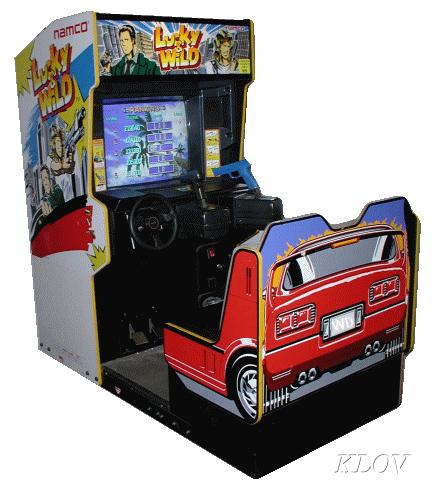
Lucky & Wild never expects the driver to play it like a
racing game. He only needs to steer left
and right to dodge obstacles thrown out by enemies and make sure that foot is
on the accelerator because if players run out of time, the criminal gets away. There’s a brake pedal, but it doesn’t seem to
slow the car down much so it might as well not be there.
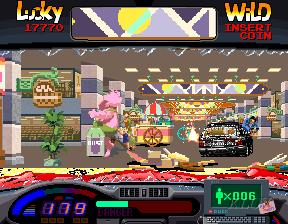
Lucky and Wild themselves are fun protagonists because of
how much detail went into their expressions.
They’re fully voiced and you see their faces in the rearview mirror reacting to the triumphant moments and mistakes. Then, if you catch the criminal, you get to
see them out of the car and hold them at gunpoint as a satisfying victory
screen. Sure their personalities aren’t
different from other buddy cop duos, but they make a memorable impression.
Lucky & Wild is like an interactive ride from Universal
Studios with the only thing missing being a vibrating seat. I yelled “woo” more than once while playing
it. It oozes with style and excitement. I’m lucky one of the local arcades had this
and if you ever see a Lucky & Wild cabinet in person, play it. It’s the game of the year. Namco only had one game this time, but it’s a
bigger slam dunk than the next game that’s known for its slam dunks.
Lucky & Wild should be making cameo appearances in Namco games, not Don-Chan or Pac-Man for the umpteenth time. Can I at least have a Lucky & Wild paintjob in a Ridge Racer game? Please?
Lucky & Wild should be making cameo appearances in Namco games, not Don-Chan or Pac-Man for the umpteenth time. Can I at least have a Lucky & Wild paintjob in a Ridge Racer game? Please?
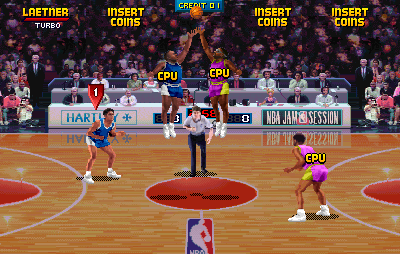
I kind of miss the cartoon cutaways from Arch Rivals, but I
suppose taking those out helps move the game along. I liked Arch Rivals and this is a better
version of that. NBA Jam is still THE
arcade basketball game, regardless of what version you play.
Mortal Kombat 2(MID): With the villains from the first game
defeated, Mortal Kombat 2 ups the ante by having their emperor bring the fight to his home turf: the outworld. Again the plot is set up in a great prequel
comic that can be viewed in the Legacy Kollection.
 |
| Incoming sub-boss. |
With the new setting comes many new characters and
stages. The lack of content the first
game suffered from doesn’t apply here.
It has 12 playable characters with two bosses and far more stages, which
are much more interesting and imaginative this time. The outworld setting allowed the creators to
make some bizarre and creative backgrounds that remind the player they are no
longer on earth.

The combat is faster and characters have more special moves
and more finishing moves, including the new friendship and babality finishing
moves you can use to style on the other player.
It does everything the first game did, but better and fighting other
players leads to hours of fun. I should
know. I played a lot of it on a Sega
Genesis back in the day and with the Legacy Kollection I still come back to
fight others in it.
The computer fucking cheats!
The computer cheats like crazy!
It cheats as much as it possibly can!
There is no fair fighting against the computer! The computer can do things in situations you
can’t, uses moves faster than you can and will always grab you! The computer can grab you from anywhere! For most players, grabbing isn’t especially
practical, but for the computer it’s the most reliable move they have! Your foot can be right in their face and your
punch can be hitting them dead-on, but instead the game will say “fuck you” and
the computer will grab you MID-ATTACK!

It doesn’t even go easy on you after you continue like the
first game did! It might obviously lower
the difficulty for one round just to let you think you have a chance and then
in the next round shoot the difficulty level up to “cheating bitch” difficulty!
The Mortal Kombat Legacy Kollection has an option to help
with this, where you can play the arcade mode on a fixed difficulty so it
doesn’t get out of control as it goes on and it also has a rewind option to
cheat the cheaters in your own way, but both of these options serve to highlight
how shit the computer opponents are.
The lowest difficulty for fixed difficulty is level 0 (out of 9), but that’s not fun because the computer at difficulty 0 is brain-dead and walks right into your attacks or loops making one simple punch you can duck under to avoid while the computer continues to swing at the air. The jump from level 0 to level 1 is big because at level 1 the computer will start cheating and throwing you as you hit them, just not as frequently as it does at higher difficulties. That means your best difficulty options are either no challenge or dealing with a cheater.
The rewind option highlights that the computer doesn’t actually do anything strategic. It just instantly counters whatever you throw at it and it’s almost funny using the rewind tool to dissect how the computer has a perfect counter for every situation BEFORE THE ANIMATION STARTS! What a shitload of fuck! Who thought this was acceptable?!
The lowest difficulty for fixed difficulty is level 0 (out of 9), but that’s not fun because the computer at difficulty 0 is brain-dead and walks right into your attacks or loops making one simple punch you can duck under to avoid while the computer continues to swing at the air. The jump from level 0 to level 1 is big because at level 1 the computer will start cheating and throwing you as you hit them, just not as frequently as it does at higher difficulties. That means your best difficulty options are either no challenge or dealing with a cheater.
The rewind option highlights that the computer doesn’t actually do anything strategic. It just instantly counters whatever you throw at it and it’s almost funny using the rewind tool to dissect how the computer has a perfect counter for every situation BEFORE THE ANIMATION STARTS! What a shitload of fuck! Who thought this was acceptable?!
The Winner
As much as I loved Lucky & Wild, that was only one big hit for Namco. Midway had 3 hits plus half a hit, most of which had more longevity and depth. With Lucky & Wild you play it once or twice and you’re done, again comparable to a Universal Studios Ride. With NBA Jam or the Mortal Kombat games, there are hours of fun to be had with other players by their competitive nature, the variety of teams and characters given with the different strategies and varying experiences that come with them. Lucky & Wild is one of the best light gun shooters I’ve ever played, but Namco needed more than that this time. Midway wins.Meanwhile…
Capcom and SNK were going full force on all cylinders at this point. 1992 to 1993 saw all manner of shooters, fighters and beat-em-ups from them. There were so many I had to split 1992 into two parts. Street Fighter 2 got better and better versions, Fatal Fury got its sequel followed by an update of its own and SNK went further than that by also introducing the world to Art of Fighting, World Heroes and Samurai Shodown. It was a hell of a time to be a fighting game fan.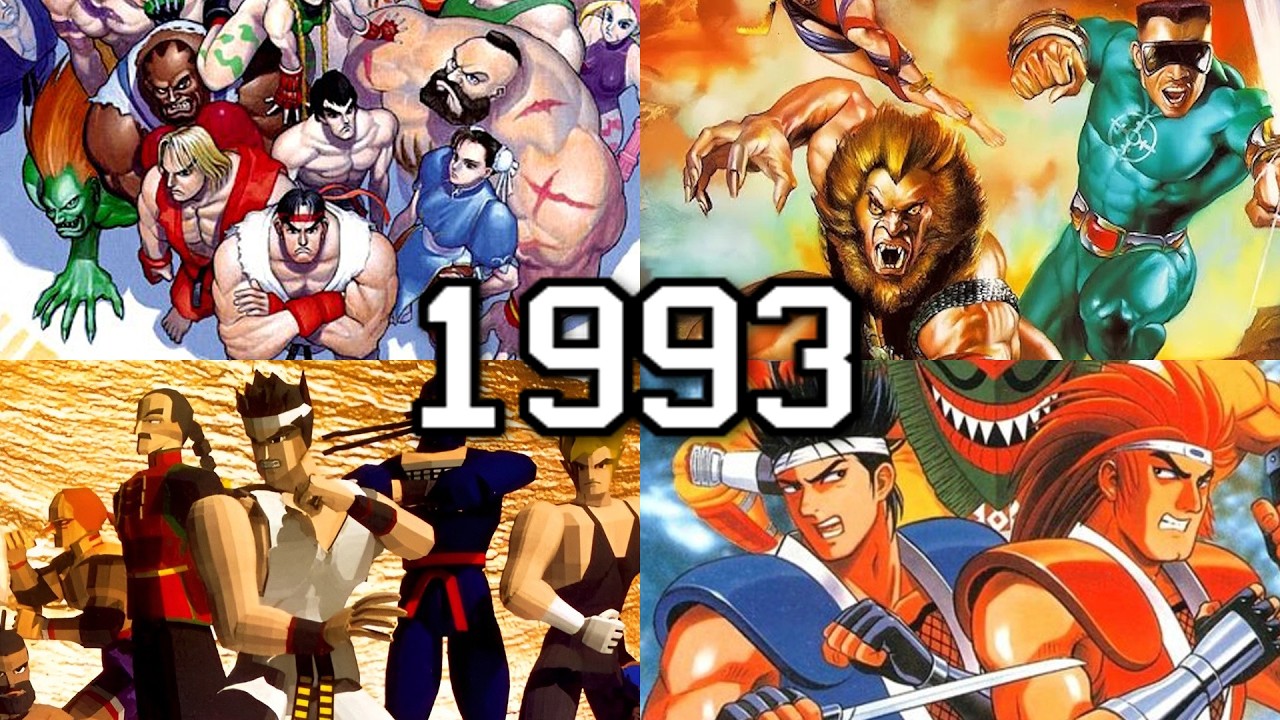
Neither of our current competitors measure up to our
previous ones for this time span overall, but NBA Jam is a better sports game
than the ones from SNK and Lucky & Wild is at least on par with the best
beat-em-ups the previous competitors had to offer. Capcom and SNK weren’t investing in the big,
tricked-out driving cabinets.
As fun as all the games from these companies were, a very
interesting game from 1993 came not from Capcom, SNK, Midway or Namco, but
Sega; a fighting game that used polygonal graphics to allow for 3 dimensional
movement. We already saw polygonal
graphics with some of Midway’s games, but to put that into a martial
arts combat simulator? It’s unheard of.

Maybe such a new dimension opening up for the genre will
inspire one of our current competitors next year.

No comments:
Post a Comment