When it comes to shonen manga, anime and games, there are few with as much knowledge and love as the Shonen Otaku. Join me as we look at all different varieties of action-packed media. Mostly games.
The Game Boy Advance era is where I think Yu-Gi-Oh games hit
their first big stride. Up to this point,
the games other than Capsule Monster GB with cheats have only reached the level
of “good enough.” Dungeon Dice Monsters
comes off like an experiment to see what the designers could do with the GBA’s
increased power and memory, which would explain why the monster clashing
graphics are the most visually interesting and system-pushing part of the whole
thing in an otherwise barebones framework.
After that, they took a big leap and made the first Yu-Gi-Oh game to
follow the rules of the real card game, the game that would be released in
America as Yu-Gi-Oh: The Eternal Duelist Soul.
The Eternal Duelist Soul
If you ask any old-school Yu-Gi-Oh fan to list off some of
their favorite Yu-Gi-Oh video games of all time, I promise you most of them are
going to mention Eternal Duelist Soul.As a simulator for the real card game, it’s designed to near perfection
and the only reason why later games are better is because EDS set the
groundwork of how a Yu-Gi-Oh card game simulator should be.
Structurally, the game follows the previous Duel Monsters
games, where there are tiers of opponents that must be defeated a certain
number of times while you get cards to improve your deck, but besides the
obvious rule shift, there are several other drastic changes.
Instead of having to beat everyone 5 times for the next
tier, you only need to beat them a different number of times for each tier,
opening up the next set of characters much faster.For example, you only need to beat the first
tier opponents twice each and the second tier opponents 3 times each. Instead of starting with a garbage deck, the three starter decks
players have the option of starting with aren’t too bad (for the time) and come
with some of the most powerful cards in the game, like Mirror Force, Megamorph,
Dark Hole and Swords of Revealing Light, the original stall card.
Instead of being rewarded with one card for winning, you’re
given the choice of an expanding variety of booster packs that come with 5
cards each. Instead of artwork made specifically for the video game,
artwork is scanned directly from the real cards.I like the original pixel artwork of prior
games, but this is much sharper.
No art on the overview screen though.
There are further bonuses and goals with the introduction of
a calendar.With every duel, a day
passes.On some days there are issues of
Weekly Yu-Gi-Oh Magazine and Monthly Yu-Gi-Oh magazine, neither of which you
can read, but they come with promotional card packs, just like how Shonen Jump
often came with promotional Yu-Gi-Oh cards.The magazines ARE Shonen Jump and V-Jump in the Japanese
version, but they changed the name for some reason.
On certain calendar weekends there are also special weekend duels
and card game tournaments.As if Eternal
Duelist Soul wasn’t enough of a simulator, duels in these events are done in a
best 2 of 3 match that lets players use the side deck, something only ever used
for such matches in real life.
This is all done with probably the best gameplay
possible.The card playing is fast and
responsive as long as you hold down the R button when the duel is loading
in.When the initial rock-paper-scissors
for turn order is resolved, make sure you’re holding down the R button and
you’re good to go.When you do that,
animations are short, the computer doesn’t take several seconds to think and
everything is zipping by while you play a game of back and forth with monsters,
magic and trap cards all working together to seize a victory against a variety
of opponents.That’s not the nostalgia
talking.It still feels amazing to play
and you get to listen to some of the best music ever in a Yu-Gi-Oh game while
you do.
Every single last track in Eternal Duelist Souls’s
soundtrack is a mood-setting gem really showing off what the multiple channels
of a Game Boy Advance sound chip can accomplish.Choose any duel track and it’s a bop.
There’s a funny thing about the music and gameplay
though.It’s actually not how the
original Japanese version is.Remember, America was a year behind in the game releases and
by the time Eternal Duelist Soul was out in America,
Japan
already had the sequel out.To make the
best version they could, Konami used the improved dueling interface and duel
music from that sequel for the English version of this one.
If you switch to the Japanese version in the Early Days
Collection, you’ll notice the main menu is completely different and the dueling
interface is noticeably worse.There’s
less information on the cards on the field screen, the camera doesn’t have as
good a view of the field and some of the streamlining in the English version
wasn’t implemented so it’s a little awkward the way it has players change phases
and select attack targets.
The worst part is that in the Japanese version, holding down
the R button at the start will not speed up the game, meaning you’re forced to
hold down the B button at all times to keep the animations on
fast-forward.The music in it is also
forgettable and the deck construction screen has fewer filter options.America got the better deal with
this one and getting it late ended up being a good thing, but this decision
leads to a case of deja-vu with one of the other games in the Early Days
Collection.
Obviously, being the first of its kind, Eternal Duelist Soul
has some quirks that show room to grow, mostly with how opponents make their
decks and act.All the opponents in the
game are distinct from each other and have decks matching their theme from the
source material, but it’s obvious the designers had to fudge some decks by
putting in cards that give them a needed edge regardless of their theme.There weren’t a lot of really good dinosaur
cards at this point so Rex Raptor has Summoned Skull and insect cards didn’t
have the best support either so Weevil has some Giant Rats in his deck
because getting Insect Queen out is hard.That doesn’t happen with every opponent, thankfully.Mako Tsunami and Espa Roba have their ace
cards Fortress Whale and Jinzo, respectively, so they didn’t need a competitive
boost.
Of course, if it’s a Yu-Gi-Oh game, no matter when it’s
made, no matter what technology is available, the AI is going to do some stupid
things.The most consistent here is that
they refuse to change attack mode monsters into defense mode even when they’re
wide open for defeat in doing so, but I’ve also seen them use two copies of
Swords of Revealing Light at the same time, like they think that’ll make me
even less able to attack.I get a good
chuckle out of Yu-Gi-Oh AI making dumb moves as long as it doesn’t happen too
frequently.It’s like the lovable AI
idiots in the original Star Wars Battlefront games.It just wouldn’t be the same without them.
Needless to say, Eternal Duelist Soul is a big winner.I still open it on the collection from time
to time.It has great gameplay, great
music, great artwork and it keeps me coming back, later games be damned.
The game after Eternal Duelist Soul in the collection is the
aforementioned Japanese sequel and the only one in the collection not translated
into English except it is, basically.I’ll explain when I get to Yu-Gi-Oh: Worldwide Edition.For right now there’s a very interesting
duology of Yu-Gi-Oh games that are much more divisive than Eternal Duelist
Soul.
The Sacred Cards
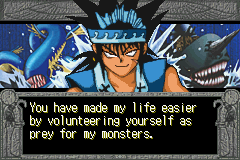
This never happens in the game.
Yu-Gi-Oh: The Sacred Cards and its sequel, Reshef of
Destruction, moves far away from the gameplay of Eternal Duelist Soul and goes
back to the rules of the Game Boy and Game Boy Color games.That means the attribute affinity system,
deck capacity, duelist level and getting one card per win is back.The dueling itself has the same lack of
phases and odd tribute system as before, but there’s now a full 5 spaces for
magic and trap cards, you can see compressed images of monsters on the field
without needing the cursor on them and the lack of animation for most
everything that can happen makes the gameplay run at a speed that rivals the
first Game Boy game.Fusions are gone
entirely, but ritual spells are now possible to use, if impractical.
None of those are big changes.That would be the framing behind the
duels.Sacred Cards is an adventure game
with an explorable world full of characters to talk to and duel as you go
through a story, meaning there’s a real end goal that isn’t just unlocking all
the duelists.
The story is based on the BattleCity
arc of the source material.If you don’t
know, it’s a tournament Seto Kaiba holds in which anyone can duel anyone else
anywhere, without the need of a fixed duel arena, and must obtain 6 locator
cards from other players in order to find the location of the finals.In the series, there is also a rule that the
loser of a duel must give their rarest card to the winner, but in Sacred Cards
players can put a card of their choice up for grabs that may or may not be
their rarest.
You don’t play as any Yu-Gi-Oh character in this game
though.Sacred Cards is essentially an
official self-insert fanfic that writes itself in such a way that the player
character ends up dueling (sometimes optionally) every major character from BattleCity.You get to duel the different Ghouls, go up
on the blimp for the finals, duel Ishizu for one of the Egyptian God Cards and
even Bandit Keith is in the game.In the
manga Keith is kinda sorta dead (before R), but these games seem to follow their
own continuity that takes characters and plot points from both the anime and
manga.Some dialogue makes it clear that
DuelistKingdom happened, but no specifics are
given.
Sacred Cards’ story doesn’t give much time for character
motivation and the dialogue is very straightforward.The player is dropped into a crazy plot and
has to deal with all the different scenarios that entails with only minimal
explanation given and I kind of love that.It’s like in Pokemon where the player has to deal with Team Rocket when
what he really wants is to get the damn gym badges and everything else is a
stepping stone.
One of those stepping stones is apparently Joey.I hope you don’t like him because he got the
shaft in this game.You get the locator
cards from all his opponents while you only ever see him lose and struggle to
get to the finals, where he also loses.
Sacred Cards is not a well-written story on its own, but it’s sure as
hell a fun one and, besides the card game itself, a big part of that comes from
the audio and visual aspect.Backgrounds
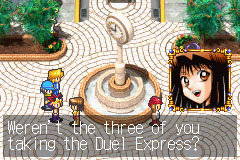
in the overworld are static, but sharp and gorgeously detailed.Character portraits are high quality scans of
the manga with animated mouths and eyes that are so sharp they look almost like
the later editions of the Ace Attorney games, where they scanned in the artwork
directly into the game instead of pixelating them to fit on the Game Boy
Advance.
As nice as it looks, it’s the music that steals the show in
this game.I haven’t played every single
Yu-Gi-Oh game, but Sacred Cards probably has the best soundtrack of any game in
the franchise and definitely one of the best soundtracks to ever come out of
the Game Boy Advance.Konami got the
composer of Metal Gear Solid 2 and 3 for this game and you can tell he was not
half-assing anything.Music is used to
accentuate ominous or tense moments, there’s impressively clear ambient noise for
locations without music and the duel music is the kind of stuff you’d hear from
top-grade orchestras.Remind me again
why this collection doesn’t have a music player.
Sacred Cards is often accused of being way too easy.I’m more of the mind that it’s a very
casual-friendly game and besides that there are a handful of tough parts that
require thought into deck construction.It’s not difficult to make the game a lot easier, but figuring out how
to make things easier is part of the challenge in its own right.That said, I personally recommend using the
cheat for max deck capacity.
Cheating might seem like overkill for a game that’s already fairly
easy, but every time I play The Sacred Cards, and whenever I see someone else
playing it, like this particularly funny text-based Let’s Play, everyone seems
to resort to the same tactics and that’s because a lot of the cards in the game
are left to the wayside because their deck capacity is too high to work in a deck.Some, like ritual monsters without the ritual
spell, cannot be used at all because of their cost.Opening up the deck capacity lets all the
cards get a chance to be played.The
duelist level does enough to keep players from getting cards that are too
strong too early.
The Sacred Cards could’ve used some more work in its
balancing, like shadow attribute monsters being too strong or the player being
given more money than they’ll know what to do with, but I still think it’s a
fun experience.Definitely play it.
Reshef of Destruction
The Sacred Cards was a modest game with some high production
values with a story on the shorter side that twisted around the plot of the
manga and anime to suit the player.Reshef
of Destruction one-ups it by making an entirely new plot wholesale.
In Reshef of Destruction, as explained in a front-loaded
plot dump, the power of the Egyptian God cards are sucked out of them and the
cards are turned to stone in order to power the resurrection of something
called Reshef the Dark Being.How cards
turn into stone from that is beyond me, but Yu-Gi-Oh could never decide what
the cards are made of.
Are they steel shurikens?
With no physical form, Reshef has to rely on someone else to
get things done.The main villain
driving the plot to resurrect Reshef is a man named Sol Chevalsky, who looks
exactly like Pegasus, is missing an eye just like Pegasus and has Pegasus’ men
from DuelistKingdom in his employ.I wonder who it is.
In order to restore power to the Egpytian God cards and gain
the power to stop Reshef, Ishizu needs the Millenium Items, but after BattleCity,
the items have been put into the care of various guardians from around the
world and the Millenium Puzzle is stolen at the start of the game.
The plot is a globe-trotting adventure where the player and
his posse travel to different countries and retrieve the millennium items,
along the way meeting a lot of old faces in new settings.It is the best part of Reshef of Destruction.It’s probably the best story any Yu-Gi-Oh
game has ever had.It gives one-off
characters from the source material more to do, showing what they do when
they’re not competing in card games.It
plays with what’s established and makes a villainous faction that’s both old
and new with the Neo-Ghouls, who are working separately from Chevalsky’s
ambitions.At one point the player has
to go back to all the different duelists all over the world they met on their
journey to make the Yu-Gi-Oh equivalent of The Avengers.It’s great.
I even like Reshef as an idea for a villain.Chevalsky is effectively Reshef’s proxy in
the human world and that makes Reshef seem like he’s a creature from beyond the
realm of mere mortals, similarly to the Egyptian God monsters themselves.Like Ra and Osiris (Osiris is in Slifer’s
Japanese name), Resheph is the name of an Egyptian deity.In fact he’s also in the series Danmachi,
only he looks… Different.
While the god cards are commanded by chosen humans, Yu-Gi-Oh’s
Reshef commands a chosen human instead and it’s his lack of screen time that I
think works in his favor.The last level
of the game has a room that goes into his backstory a bit so there’s at least
some explanation as to where he came from. The graphics and sound for the story are still on point from
Sacred Cards.It still has those
beautiful pre-rendered backgrounds, but the character portraits were changed
into smaller ones with more than one expression.
Norihiko Hibino Came back for the music and it’s still amazing, but a
few duels now also have little voice acting samples in them from the anime’s
English cast.It only amounts to
declaring their turn and declaring an attack with their signature monster, but
that’s a cool bonus. I think most people would agree with everything I’ve typed
so far, but anyone who knows Reshef of Destruction will also tell you that all
of that effort and all the good things about it are completely ruined by one
gigantic problem: the mother fucking grind!
Any and all discussions about the quality of Reshef of
Destruction might as well begin and end with the absolutely mind-melting amount
of grinding that is required to make it anywhere in the game.In Sacred Cards, you got enough Deck Capacity
to make it to the end just from playing normally.You got 5 for regular duels, 30 for the more
important ones and the Deck Point cost of cards were a little wonky, but manageable.
In Reshef of Destruction, you get ONE deck capacity for a regular duel and 3 for an important one!Do the math!You have to duel your ass off just to make any progress anywhere!It is Earthbound Beginnings levels of
grinding!I challenge anyone to give me
one other game with a grind worse than Reshef of Destruction in the decade it
came out! I'm dead serious!
Besides making the whole game one of the most tedious ever
made, this means the problem of rigidity in player tactics is astronomically
worse than in Sacred Cards.Anyone who
has played this game has resorted to the exact same tactics with the same few
cards because playing any way other than optimally means it’s damn near
unbeatable! The story is great, but the grind fucks with the pacing like
I’ve never seen before!Playing through
it is like quickly hitting a brick wall and being unable to progress the story,
then grinding for literally several hours, dueling the exact same people ad
nauseum, just to make a little more progress, then hitting another brick wall
and starting it all over again!It’s as
if the designers hated the players!
It sucks so hard because the writers, the artists, the
composer and even the English localization team put serious effort into this
game, but their contributions are wasted all because of the designers of the
actual game!
Wait a minute… What’s this?
That right there is why Reshef of Destruction was the game I
was second-most interested in next to Capsule Monster GB.With Capsule Monster GB I asked how good the
game is now that it’s playable without a language barrier.For Reshef of Destruction, I asked how good
the game is without grinding.The
answer, it turns out, is pretty good. It’s crazy how just those two cheats change Reshef of
Destruction from the worst game in the collection to one of my favorites!All Konami had to do was
remove the deck capacity bullshit and they would’ve had a hit!It’s a complete and total game changer!No more brick walls!No more mandatory grinding!Cards that were literally unusable because of
their deck cost can now be used!The
cheats make Reshef of Destruction actually fun!
Granted, it doesn’t solve every problem.There are still other befuddling design
decisions Reshef of Destruction is known for that don’t have any cheats to fix
them and the game has universally been rightfully criticized for them, but I
find that those design decisions were such big problems because they worked in
tandem with the deck capacity grind for maximum frustration.I’ll explain.
The shop you would buy cards from in the original game is
gone.Now you get all your cards from
Grandpa Mutou’s shop.Apparently gramps
looked at the people selling Metal Gear Solid: The Twin Snakes and Clock Tower
2 for hundreds of dollars and thought they were brilliant businesspeople rather
than worthless dregs of society that should be beaten within an inch of their
life and forced to watch someone play the games right in front of them.All the cards in the shop are at insanely
high prices and every means of getting money, be it through selling cards or
winning duels, gives out a pittance.In
my playthrough I maybe got 4 cards from him for the entire game so players have
to be selective.
As badly designed as it is, having unlimited deck capacity
and duelist level mitigates the need for his shop in the first place.With the cheats, as long as you’re anteing
good enough cards, you’ll walk away from duels with solid cards that you can
immediately upgrade your deck with.Without the cheats, the card shop is needed because all the good cards
from winning duels can’t be used and you have to go buy something you can use and that means more
grinding.Play with cheats.If you want you can use the cheat to get
every card.I already explained why I
won’t do that, but I won’t discourage it for Reshef of Destruction.
Imagine dealing with a powerful multiplying monster with no cheats!
The other major sore point for people is the field scanning.Reshef of Destruction adds continuous effects
to the gameplay and even though Eternal Duelist Soul had no problem
implementing them, Reshef of Destruction went about it in the most cockamamie
way I can think of. Every single time a move is done, every card play, every
attack, every card face down and every effect activated, makes the game take a
third of a second to scan the field just in case there’s a continuous
effect.Then, if there’s a monster with
a continuous effect on the field, a text box comes up to declare the monster’s
continuous effect each and every time it scans.
Yes, it’s horrible game design and whoever thought it was a
good idea should be put in a bedlam house, but I think how bad it is has been
overstated.Continuous effect monsters
aren’t common and the game does everything so fast otherwise that the field
scan doesn’t slow it down enough to be painful.It still plays faster than the first Dark Duel Stories, that’s for sure. I think the field scan was a big problem before because
the grinding meant a lot of duels and when you’re forced to duel and just want
to get it out of the way, anything slowing down the process is made a hundred
times worse.It doesn’t help that one of
the borderline required tactics without the cheats is to use
Mammoth Graveyard, which has a continuous effect.Slifer has one too, but if you got out a
monster with no affinity weakness that can get 9999 attack points, that duel is
about to end unless you drag it out like the guy in the video above.
There’s also the matter of life points carrying over between
duels and forcing the player to travel all the way back to their room to save
and restore them.I should point out
that this is a short jog away for the player even if they’re in China or the
Galapogos.It’s the miracle of a world
map screen.I was constantly going back
to the bedroom to save in Sacred Cards anyway and the running speed is fast
enough that it only takes a few seconds.The few times you’re forced to duel multiple times with no healing can
be helped with the save states.
Much like Capsule Monsters GB, it might come off as
discouraging that Reshef of Destruction is only enjoyable with cheats, but there’s
a good game in here when its critical failing is stripped away. Up until the final boss, anyway. That’s a load of bullshit whether you cheat or
not. All three games this time are good enough to contribute to the
Early Days Collection’s value, even if one of them needs cheats to be any
good.The final few games are where they
begin to settle into being mostly yearly installments with updated card pools,
albeit with one more oddball game thrown in.







No comments:
Post a Comment