Ever one for pushing boundaries of what can be done with
their games, Capcom jumped right on the high memory capacity the CD drive of
the Playstation was capable of. They
didn’t exactly leave Nintendo in the dust for the Nintendo 64 era though. They did release Mega Man & Bass Megaman
64 and the Xtreme games, but it’s clear the PS1 was where their priorities
lie. Thus we got a trilogy of Mega Man X
games for the system and in the classic series we got Mega Man 8. I’ll be the judge of how much improved with
the new system’s horsepower.
Sunday, October 11, 2026

Tuesday, September 29, 2026
A Tourist's Thoughts on the Mega Man X SNES Trilogy
I’m what some people would call a “tourist” when it comes to
the Mega Man franchise. I didn’t grow up
with the blue bomber and I didn’t play any of the games until the Anniversary
Collection on the Gamecube and even then I didn’t follow the franchise loyally. Later I would go through almost the entire
classic franchise again thanks to the Legacy Collections and Capcom Arcade
Stadium 2.
Classic Mega Man’s sequel series, Mega Man X, is a whole
different ballgame. The things people
have said about the Mega Man X games are all over the place and after playing
them over the course of this year I think my thoughts about that
particular branch of the Mega Man franchise might be a little more
interesting. I have some takes that fans
might consider “spicy.”
Saturday, September 19, 2026
TV Edits of the Viewtiful Joe Anime: Episode 22
With the most heavily edited episode out of the way, we now move onto episode 22, titled Cleanliness is Next to Escape-liness in English, named after the line "Cleanliness is next to Godliness." They had to come up with a title that has to do with the plot and this one doesn't consistently reference a particular movie.
This episode mostly centers around Silvia sneaking around Jadow's HQ after the Biankies carelessly let her go get a bottle of cleaner. Meanwhile Joe fights the Jadow trio in less-focused-on battles. Since it's in Jadow HQ it means there's going to be editing around Sprocket, but not as much as you'd expect.
Sunday, August 23, 2026
TV Edits of the Viewtiful Joe Anime: Episode 21
I was holding off on this one because I already knew this was going to be one of the most, if not the most, edited episodes. In this episode, Joe and Junior are on the run from Biankies and the returning Bianco Billy and Junior gets help from the old man that found Machine Six and his friend Gina.
The episode is a reference to Butch Cassidy and the Sundance Kid. There's a bit with Junior referencing the scene where Sundance says he can't swim and the English dub even references the characters directly.
The episode name, Bianco Billy Rides Again, is probably named after the McCloud episode titled Butch Cassidy Rides Again, which is about a bank being robbed by guys who look just like the famous outlaw himself. A fitting reference, since Billy is the villain in this scenario.
Sunday, August 9, 2026
The Game Scammer Days of Reckoning
Good used game sellers are an important part of gaming. It’s thanks to places like Ebay, Gamestop,
Half-Priced Books and smaller retail shops that we’re still able to buy games long
out of production at generally reasonable prices. Say what you want about Gamestop, because
they deserve it, but there are several used games I couldn’t have gotten
without them, one of which was a big contributor to my Namco vs. Midway series
(sorry I haven’t gotten back to that, but I hit a snag with one of the
games). Without these decent sellers I
would have never gotten games like Neogeo Battle Coliseum, Ninja Gaiden: Dragon
Sword or the King of Fighters Maximum Impact games. These are the people that should be
supported.
Saturday, July 4, 2026
Yu-Gi-Oh Early Days Collection Review Part 5
In 2004, the original Yu-Gi-Oh manga ended and America , being
as late to the party as we possibly could, only then started getting it
translated in 2005 while the anime was going into the filler arcs. You would think the original series would be
wrapping up with the story ending, but if you think that you clearly don’t know
Shonen Jump. The anime was such a money
maker in America
that 4Kids commissioned Studio Gallop to make a movie and the Capsule Monsters
miniseries. Even Japan wasn’t
done with the manga because they made Yu-Gi-Oh R! The original Yu-Gi-Oh was being kept around
for at least a little while longer while the sequel to the anime, Yu-Gi-Oh GX,
was starting to take off.
| Recommended read. |
That means more original-era games and the last game included in the Early
Days Collection.
Wednesday, July 1, 2026
Yu-Gi-Oh: Early Days Collection Review: Part 4
A player might notice something around this time of Yu-Gi-Oh game releases; there were no new characters introduced in them and, barring the game-original Reshef of Destruction, there hadn't been for a while. That's because Battle City was the last part of the manga to center around the card game. After that came the final part with exploring the pharaoh's memories, where only two card games would be played for the rest of the story, none of which was between any new characters. By 2004, in Japan, at least, the original manga ended. This means the games had to start using the same roster of characters in new ways.
Yu-Gi-Oh Expert 2 is the only game in the Early Days Collection
that has no translation, at least for its original version. After Eternal Duelist Soul borrowed Expert
2’s dueling system for the English release, Expert 2 as a whole would get a
revision released for international audiences.
I call it a “revision” and not an “updated version” because it takes a
handful of cards out, changes some art and tweaks a few things that could be
considered either for better or for worse.
I guess Digital Eclipse threw the original version in there for the sake
of thoroughness and for the Japanese gamers that care. The game we got in America
Tuesday, June 23, 2026
Yu-Gi-Oh: Early Days Collection Review: Part 3
The Game Boy Advance era is where I think Yu-Gi-Oh games hit
their first big stride. Up to this point,
the games other than Capsule Monster GB with cheats have only reached the level
of “good enough.” Dungeon Dice Monsters
comes off like an experiment to see what the designers could do with the GBA’s
increased power and memory, which would explain why the monster clashing
graphics are the most visually interesting and system-pushing part of the whole
thing in an otherwise barebones framework.
After that, they took a big leap and made the first Yu-Gi-Oh game to
follow the rules of the real card game, the game that would be released in
America as Yu-Gi-Oh: The Eternal Duelist Soul.
Sunday, June 14, 2026
Yu-Gi-Oh: Early Days Collection Review: Part 2
At the turn of the millennium, Yu-Gi-Oh started finding its
footing and established what the franchise would become moving forward. The official card game from Konami was taking
hold and just as impactful was the premier of the Yu-Gi-Oh Duel Monsters anime.
There was no stopping the Yu-Gi-Oh hype train in Japan
and that meant there was no stopping the assembly line of Yu-Gi-Oh games to
feed the hungry masses that couldn’t get enough of it. It was another year and another Yu-Gi-Oh
game, this time titled Yu-Gi-Oh: Tri Holy God Advent. In Japan , that is.
I could go on a long-winded old man monologue about how it
was the hottest thing in cool and one of my first shonen anime ever that I still
enjoy to this day despite its faults, but this is a game collection review so
I’ll keep it short. Yu-Gi-Oh’s anime
became a monster hit, but the manga it was based on still wouldn’t be
translated to English for a few more years.
If you look on the back of some of the English game boxes (they’re in
the instruction manuals in the collection) they say they’re based on the hit
television series, which is not technically true, and on the back of some manga
releases, a bit of text tacked on says it’s the inspiration for the hit anime
featuring scenes too intense for television, which actually is true in both
languages. In America , Yu-Gi-Oh was riding the
coattails of the anime specifically.
Tuesday, June 9, 2026
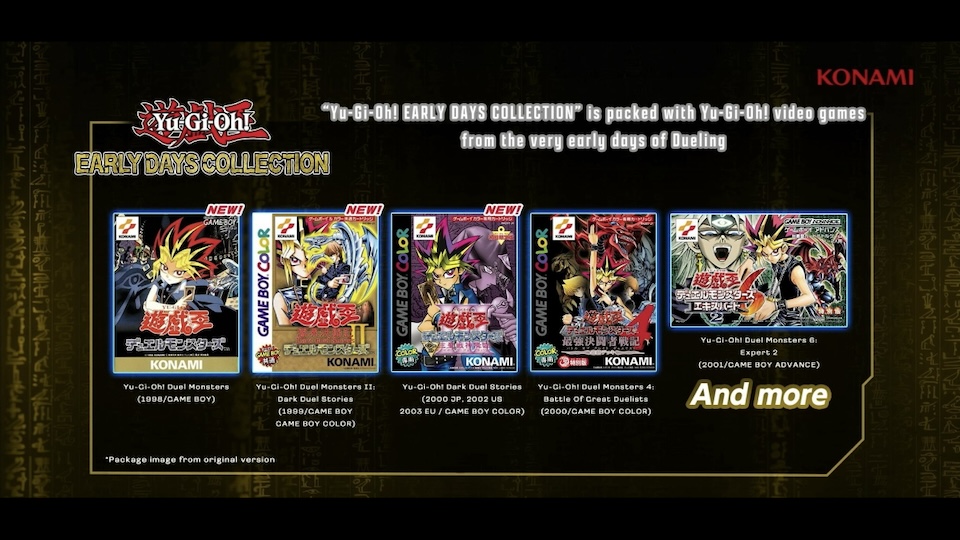
Yu-Gi-Oh: Early Days Collection Review: Part 1
As I already stated in my review of Yu-Gi-Oh: Duel Links,
I’ve been a fan of the original Yu-Gi-Oh ever since it arrived in America through
the anime from Studio Gallop. When
Kazuki Takahashi wrote his manga about a kid gaining Egyptian magic and playing
games, he couldn’t have predicted the phenomena that it would become, let alone
that his little one-off Magic: The Gathering knock-off would be at the center
of it all. When Shonen Jump gets a hit
manga on their hands you’d better believe they’re going to merchandise that
sonbitch.

Inevitably that meant games across all manner of consoles,
in particular Nintendo’s handhelds. The
Yu-Gi-Oh Early Days Collection puts the first 13 (the marketing says 14, but
I’ll get to that) Nintendo handheld Yu-Gi-Oh games into one package and I was
hyped to get to both replay games I used to love and play games I never got to
before. The enhancements and new
translations made it all a big deal, but I swear you wouldn’t know just how big
a deal it was if you read the reviews.
Thursday, May 7, 2026
Namco vs. Midway: The King of Arcades 2: 1996 & 1997
Like I said in the first King of Arcades competition, 3D
gaming was in full swing in the latter half of the 1990s thanks to the
Playstation and Nintendo 64’s polygon rendering abilities. As evidenced by last time, Namco was already
on that by this point, but for Midway, though they did dabble in 3D polygons in
the past, the usual pre-rendered visuals were their reliable aesthetic, though
even that started to change.
Namco was also chugging along in the console space with PS1
ports of their arcade games, most notably Tekken and their new Namco Museum
Tuesday, April 21, 2026
TV Edits of the Viewtiful Joe Anime: Episode 20
In this episode, Joe and the Jadow trio wake up on a mysterious train full of toys, run by an enigmatic kitty conductor. It's an episode that focuses squarely on Joe and the Jadow trio with all of their allies excluded from the plot. This one is a favorite among fans for its underlying theme of childhood innocence and feelgood nature of the whole thing in a time where so much anime is blood and violence like Bleach, Chainsaw Man and Demon Slayer.
There's a lot to like about this episode and for me one of those things is Bob
Papenbrook. I've talked him up before, but for a lot of the Viewtiful Joe anime up
to this point he's been doing his Almighty Leader voice and hasn't
played Captain Blue since the first few episodes. Blue's Japanese voice
sounds like he's going through the motions, but every line delivered by
Papenbrook really feels like an old-school hero. Big ups to a voice
acting legend. If he were still around he would be the Great Old One of the West instead of Peter Beckman.
The movies this episode is based on are Toy Story and the Polar Express... Or is it? Joe references the Polar Express by name in the English dub, but on closer inspection, the train setting might be a wild coincidence. The Viewtiful Joe anime started right at the beginning of October of 2004 in Japan and Robert Zemeckis' hit movie The Polar Express didn't make its debut until partway into October of the same year. There was no time for the movie to be a classic like the other movies referenced in this anime. The popular children's book the movie is based on was almost 2 decades old by then, but so far Movieland has had places based on movies and only movies.
Toy Story is definitely an inspiration here though without a doubt and if you don't see it by the end, you're blind.

Considering this is an episode with toys, children and rules against violence, you can't expect a lot to be edited out for inappropriate content.
Sunday, April 12, 2026
Namco vs. Midway: The King of Arcades 2: 1995
1995. The peak
of Mortal Kombat
Mortal Kombat got so much attention that
other companies were trying to get in on the digitized actors and violence,
usually to poor results.
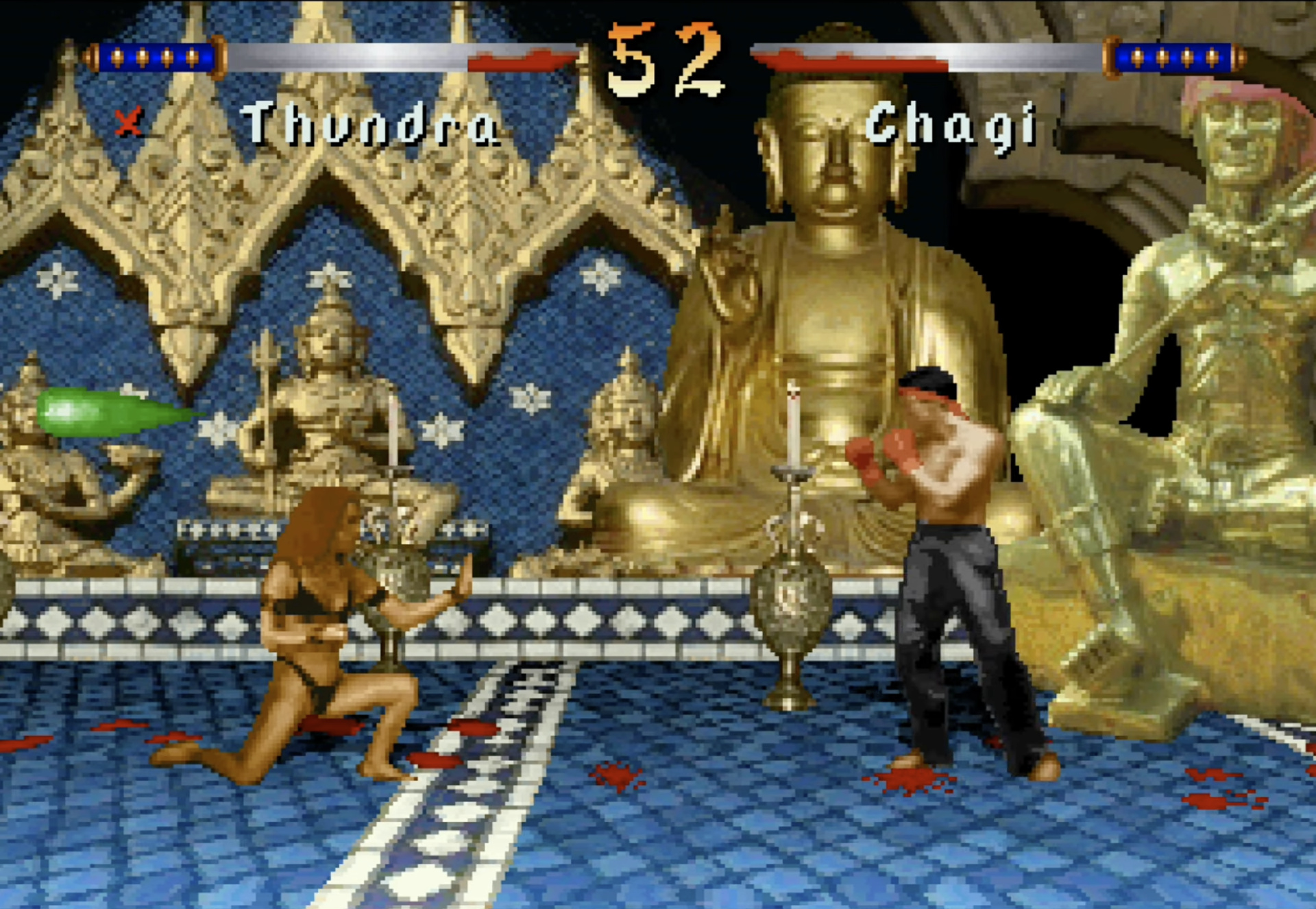
Oh yeah, Namco is in this.
They released games mostly in Japan
and not in America
so they got left in the dust, although Tekken was shaping up to be their
heaviest hitter in arcades. 1995 was also the debut of the first Time Crisis, but I have never in my life seen that game. I've only ever played the sequels. Here in this
competition, popularity, public recognition and hype means nothing.
All that matters is who made the best games. The current score has Midway in the lead, 7
to 5. Namco isn’t far behind and still
has a few years left to take the lead.
Wednesday, April 1, 2026
Devil May Cry 5 Review
After Capcom released Ninja Theory’s Devil May Cry reboot, I
don’t think anyone was expecting a sequel to Devil May Cry 4. I think Ninja Theory’s game gets way too much
flak because of its title, but regardless of the merits of the game itself,
fans wanted a Devil May Cry 5. However,
in the intervening years Capcom came out with Sengoku Basara: Samurai Heroes,
which became a monster hit despite no advertising or promotion whatsoever, and
then later followed it up with Sengoku Basara 4 in Japan . Over the years Sengoku Basara 4 built itself
up as the most hyped English version of a game in the history of the human race
to the point that everyone forgot about wanting a Devil May Cry game. Something very strange happened though. Instead of releasing Sengoku Basara 4 in
English and bringing about world peace and a panacea for all diseases, Capcom
not only made Devil May Cry 5, but fully dubbed it and released it in English.
I am at least a moderate fan of the Devil May Cry
franchise. Devil May Cry 3 is one of my
favorite action games of all time and of course you know Devil May Cry 4 is good because it has the same producer as
Sengoku Basara: Samurai Heroes.
That said, it’s curious that instead of translating and
dubbing a fully released, content-rich game being exalted as one of the
masterpieces of the gaming world that everyone and their dog wants, just like
they had already done for the previous game in its franchise, Capcom instead
made a new game from scratch with an English version. That would have to mean that Devil May Cry 5
is practically godlike and I had to take a look to see for myself if it truly
lives up to that hype.
Sunday, March 15, 2026
Namco vs. Midway: The King of Arcades 2: 1994
1994 was a slow year for our two competitors, for arcades at
least. Midway was busy with the home
ports of Mortal Kombat 2 and as usual Namco was not releasing games in English
because… Because. Both companies did put
out at least one game each in 1994 though. On Midway's side is a
tried and true rail shooter that sticks to a lot of its companies established
conventions and a stop motion fighting game. On Namco's side is the beginning of one of the biggest names in fighting
games. It’s a one-on-one. We shall see which game carries their company to victory.
Saturday, March 7, 2026
Namco vs. Midway: The King of Arcades 2: 1992 & 1993
It’s 1992. Last year Street
Fighter 2 kicked off fighting games in a big way and every company was jumping
in on the new competitive martial arts gameplay, Namco and Midway included. At least, Midway did in America
However, I’ve never seen a cabinet for the original Ridge
Racer in my life.
I could only get my hands on one Namco game and it’s from
1993 so you know what that means: another 2 year judgment time span. They’d better hope Midway drops the ball
again, but considering what I know is ahead, I don’t think they are going to.
Friday, February 27, 2026
Namco vs. Midway: The King of Arcades 2: 1990 & 1991
We’re back from my Sengoku Basara detour and our contest
picks up in 1990 and 1991. Since I can’t
get any Namco games from 1990, this is a judgement for a 2-year time span,
where most of Midway’s games are from 1990 and Namco’s games are in 1991. Once again, Namco’s failure to release arcade
games in English has them going in with a very low ammo count. Technically one of their games for this year,
Tank Force, didn’t even initially come out in English at all, but since they
would otherwise only have one game for entry, I need to throw them a bone. Maybe it will be the game that comes in
clutch.
Tuesday, February 10, 2026
Extra History: The Sengoku Basara Way: Part 3
With Nobunaga dead, the last 2 parts of the Extra History videos cover Hideyoshi, his death and the battle of Sekigahara. This post is going to be shorter than the other ones because, well, the videos go into a lot of backgrounds that Sengoku Basara chooses to push to the wayside for the sake of an exciting action story, but there is still a fair bit to note.
Sunday, February 8, 2026
Extra History: The Sengoku Basara Way: Part 2
I've held off on discussing Nobunaga's Sengoku Basara design. Everyone knows it. He's portrayed as an evil overlord with a spiky and intimidating outfit with a blood red cape and he laughs at the carnage and atrocities he commits. Up to this point in the Extra History videos though, Nobunaga has just been a very tactical and pragmatic warlord, not a lot worse than the others. It's starting around here where we start to see where his reputation comes from.
Saturday, February 7, 2026
Extra History: The Sengoku Basara Way: Part 1
We aren't done with Sengoku Basara yet. In the first part of my Sengoku Basara retrospective I directed people to a series of videos from Extra Creditz, specifically their Extra History sub-series. This 6-part series of short videos does a good job of detailing all the most important moments of the Sengoku period while making them fun and expressive through the use of artwork. Even more fun an expressive is one of my favorite franchises, Sengoku Basara.
It's always funny to me when I learn something about history and think back to how the madcap action of Sengoku Basara interpreted that, especially with Sanada Yukimura Den steering closer to real history. As such I thought it would be fun to go over some real history and how that was interpreted into what we see in the games. The Sengoku era of Japan is already pretty crazy, as the videos show, so watching it become more crazy is pretty entertaining.
Sunday, February 1, 2026
Sengoku Basara Retrospective: Sengoku Basara: Sanada Yukimura Den
I originally ended my Sengoku Basara retrospective at
Sengoku Basara 4 because the main series and all the English media was already
covered and the last game, Sanada Yukimura Den, is story-focused when fan
translations are already incomplete and sparse for Sengoku Basara 4, which is
still more than Sanada Yukimura Den got.
Since then I discovered a miracle.
An app for the iphone that, in a way, breaks through Capcom’s attempt to
stop American players from enjoying Sengoku Basara 4: the translate app.
With the translate app, players can take pictures of the
screen as the dialogue appears and form halfway comprehensible translation of
all the text. It doesn’t make the
Japanese voice acting any better, but with the help of the translation app I
can finally understand and somewhat enjoy the stories of Sengoku Basara 4,
which, it turns out, are wonderful.
Sengoku Basara 4’s stories have something for everyone. It has stories that are funny, sad, cute,
awesome and everything in between. It’s
a pain to have to take constant pictures of the screen as the dialogue goes
along and it doesn’t alleviate the depression of Capcom’s vicious betrayal, but
it does make it partially possible to play the game to the potential it was made
to be played.
It also means that Sengoku Basara: Sanada Yukimura Den is on
the table. Now that I can understand
this more story-centric game, I can give my thoughts on it proper.
Sunday, January 25, 2026
TV Edits of the Viewtiful Joe Anime: Episode 19
In this episode, Joe helps a young girl reunite with her mother while inspiring a team of little league baseball players led by Mona Marshall to not give up, all the while Gran Bruce concocts a plan to defeat Joe by cutting him off from cheeseburgers.
This episode is probably taking beats from a sports movie (pick one), but the movie it seems to take place in is Friday the 13th. Yes, really. I'll get to that.
Monday, January 19, 2026
Namco vs. Midway: The King of Arcades 2: 1989
How did it come to this, Namco? An entire year and nothing to show for it in
English. Namco officially has nothing
for me. They made arcade games, but not
for America . Valkyrie Densetsu looks like fun, but we
didn’t get to play it. Finest Hour looks
like potential game of the year material and so does Burning Force, but the
most we got of the latter was the inferior Genesis port. The only game they might’ve had an entry with
is Dangerous Seed, but it’s never seen a re-release and I’ve never been to any
arcade that has it. In fact, going to
local arcades to play more games is to Namco’s detriment because there are far
more Midway games at them than Namco ones.
That’s why I’ll be fudging the rules just a bit and giving
them the only game of this year I was able to play: Rompers. Similarly to Tower of Druaga Tower
of Druaga
Saturday, January 10, 2026
Namco vs. Midway: The King of Arcades 2: 1988
As I pointed out in the previous post, Namco has a lot
riding on just one game for 1988. It’s
not that they didn’t make a lot of arcade games that year or that they weren’t
even making good ones. I mean they had
an even better arcade board for even better games. It’s just that almost none of their games
came out in American arcades. They made
games that appear to be strong contenders like Ordyne, Marchen Maze and
Phelios, but none of that was for America . From what I can tell the only games from this
year that came out in English are Splatterhouse and Metal Hawk, but since Metal
Hawk heavily relied on a fancy motion simulator machine it means it never got
re-released for new consoles with standard controllers. None of my local places have a Metal Hawk
machine either so Namco is placing all their bets on Splatterhouse. It had better be the game of the year if they
want to win.
Friday, January 2, 2026
Namco vs. Midway: The King of Arcades 2: 1987
So far Namco has been losing pretty badly and they needed to
step it up to keep up with Midway’s constant technological innovations. Good thing then that in 1987 they did just
that. I’m not sure exactly what kind of
arcade hardware Midway was using, but 1987 marked the debut of the Namco System
1, an upgraded arcade machine capable of better sound and graphics, not unlike
what the CPS-1 was for Capcom. Midway’s
arcade offering so far have left me in awe with their presentation, but new
dedicated hardware might be the boost Namco needs to start racking up more
wins. Let’s see if they can get out of
their losing streak.
Subscribe to:
Posts (Atom)