I've held off on discussing Nobunaga's Sengoku Basara design. Everyone knows it. He's portrayed as an evil overlord with a spiky and intimidating outfit with a blood red cape and he laughs at the carnage and atrocities he commits. Up to this point in the Extra History videos though, Nobunaga has just been a very tactical and pragmatic warlord, not a lot worse than the others. It's starting around here where we start to see where his reputation comes from.
"So yeah, of course, as soon as Nobunaga and Tokugawa's forces have gotten to Asakura territory, the Azai decide that 'eh what the heck.' They've known the Asakura for longer. NOW is a good time to revolt."
This is the reason given in Oichi's story in Sengoku Basara 2: Heroes, with another factor being that Nagamasa had enough with Nobunaga's atrocities. The Nagamasa in Sengoku Basara is a champion of justice who fights for love and peace no matter what. In Samurai Warriors that personality is given to Kanetsugu Naoe.
Nagamasa's betrayal is never shown mid-battle though. It's offscreen.
"The combined Tokugawa and Oda forces have marched into Azai land. They move to threaten one of the main Azai castles, but they're met at the Anegawa river by the combined armies of the Azai and the Asakura."
Anegawa is Nagamasa's stage in Sengoku Basara 2, where in order to get to him and his wife Oichi you have to capture 4 points that represent the Chinese constellations (Tiger, Phoenix, Turtle and Dragon).
"The night before the battle, when he sees the Azai flags to the east, he switches his whole line around so that his army is facing the Azai while Tokugawa handles the Asakura, because nobody kills Nobunaga's brother-in-law except Oda Nobunaga."
Nobunaga does indeed kill Nagamasa in the games. In 2 he does it directly and in Oichi's story in 2: Heroes, Nagamasa jumps in front of Nobunaga's bullet intended for Oichi. Nobunaga I guess only really needed to kill one to make a point and forces Oichi into servitude for the Oda.


Extra History briefly mentions the Miyoshi and even calls them a historical footnote. They are a footnote in Sengoku Basara as well. The only trace of them is the Miyoshi Three, a trio of warriors who work for Hisahide Matsunaga. They appear in a few missions in some games and in the adaptation of Kojuro's 2: Heroes story in the anime.

Extra History also goes into the Ikko Ikki and the warrior monks of Honganji. The temple of Honganji is a stage in Sengoku Basara 2.
"These monks had been refusing to pay taxes, disrupting trade and generally just being a nuisance for some time."
In Sengoku Basara, that is because they love money. Holy crap do they ever.
The boss of the Honganji temple is Kennyo Honganji and that reputation of liking money is played up to an extreme degree.
The temple has gold finishings everywhere, money chest carriers are all over the place, Kennyo wears gold all over him, they have big mechanical statues made of gold to fight with and Kennyo's victory animation is him going for a soak in a tub full of gold coins like he's Scrooge McDuck.

It gets better. When you actually fight him he eventually starts throwing gold around at your own soldiers and they switch to his side.
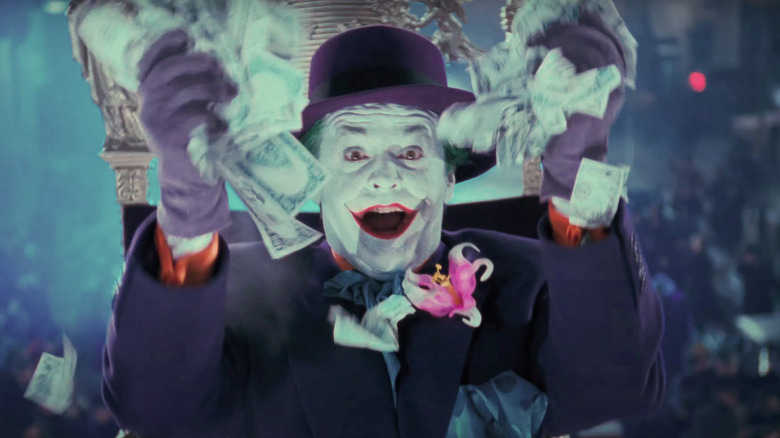 |
| "It's time for 'who do ya trust?' Hubba hubba hubba, money money money! Who do ya trust?!" |
In the anime Mitsuhide kills Kennyo offscreen at the start so that's one less character to spend time on.
"As fire roared up the mountain and started to consume the temple at its summit, Enryakuji, Oda Nobunaga gave the order to slaughter every man, woman and child fleeing from the burning temple. 20,000 people died on that day and all of Japan learned just what kind of man Nobunaga really is."
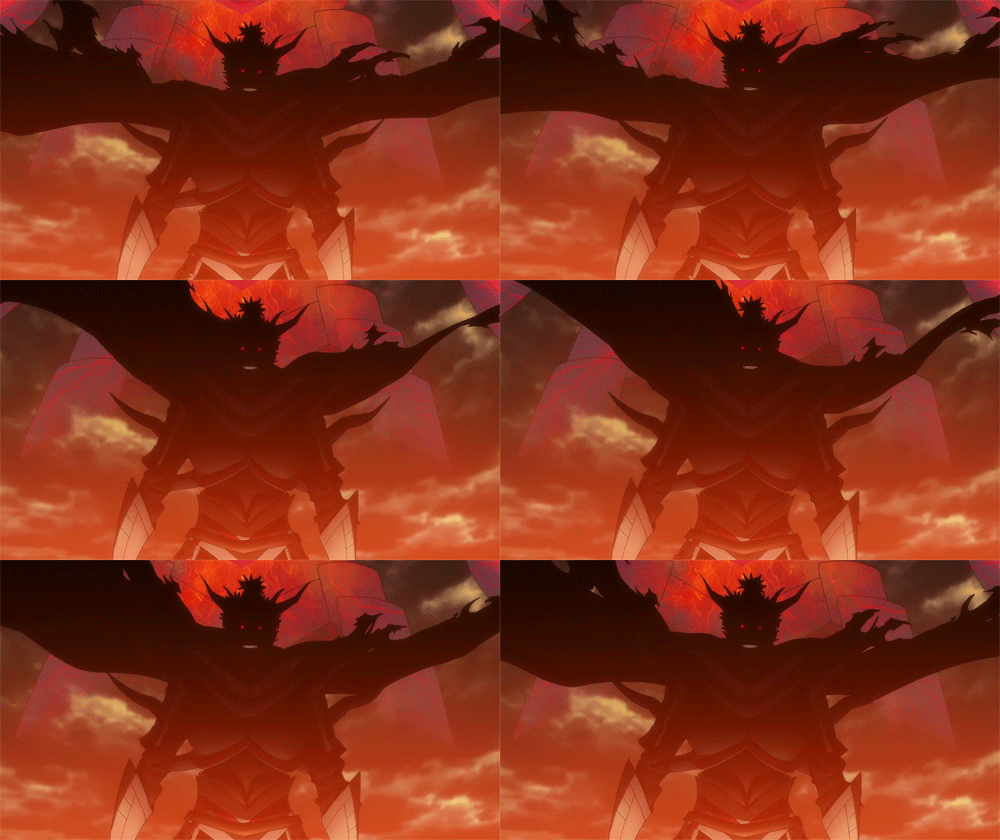
This particular incident is a huge point of reference in why Nobunaga is portrayed as so categorically evil. Hell, it was after his burning of Mt. Hiei that Nobunaga would tell Shingen that he's the Demon King of the Sixth Heaven. Supposedly he was being sarcastic, but he shouldn't have put himself down like that. Of course he was an evil demon.
Sengoku Basara isn't even the only Japanese media to villainize the hell out of Nobunaga. It's just the most prominent one.
Sure, there is such a thing as historical context and a lot of people of generations past were ruthless dicks by today's standards; it's not like the founding fathers aren't guilty of murdering native Americans en masse, but even still the burning of Mount Hiei is some next-level evil if you ask me.
With Nobunaga's biggest atrocity covered, we move on to part 4 of Extra History, where he finally dies.
To start off, the big battle between Ieyasu and Shingen is depicted in the first game with one of those awesome anime cutscenes from Manglobe. Extra History does not mention his robot warrior Tadakatsu Honda, however. The stage it precedes is pretty straightforward, with its main gimmick being that you need to run from Tadakatsu.
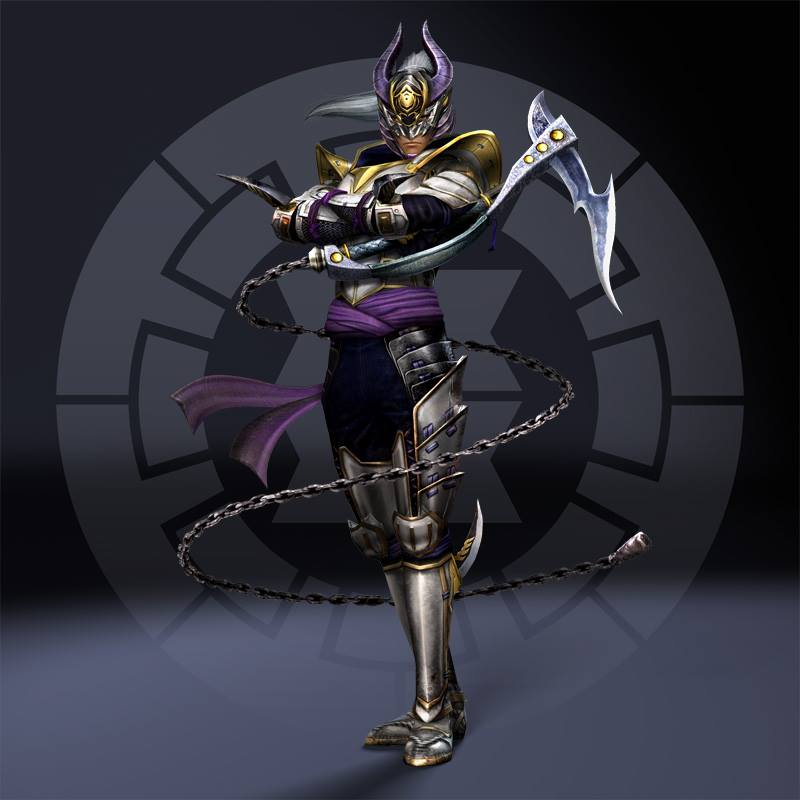
"At a minor castle siege, Takeda Shingen is shot by a sniper and dies."
That's debated. Some records say that Shingen died of illness. In Sengoku Basara: Samurai Heroes the illness is why he's incapacitated and Samurai Warriors says illness killed him as well. Either way, Ieyasu got lucky.
Extra History then details the battle of Nagashino. Sengoku Basara doesn't go terribly hard on the politics or the setup for that battle, but it's such an iconic battle in history that it gets an anime cutscene in the first game too. The big difference there though is that Shingen is still alive (we need him to be playable) and Yukimura Sanada is there.
As I stated in the post on Sanada Yukimura Den, Sengoku Basara's Yukimura is a cross between the real Yukimura and Katsuyori Takeda, so Yukimura takes his place. Also in Sengoku Basara Yukimura does polevault spins on his horse and deflects a firing line of bullets, which I kind of doubt either he or Katsuyori did, but I wasn't there.
In the first 2 games there are versions of Nagashino for Nobunaga's side, which means fighting that fearsome Takeda cavalry, or Shingen's side, which means tons of riflemen. For Shingen's side in Sengoku Basara 2, players must stop Nobunaga from getting too many supplies or else the final battle with him at the end will have a gigantic firing line backing him up.
We now come to Honno-ji, again a landmark that Sengoku Basara likes to visit with Mitsuhide's betrayal. Sengoku Basara doesn't go into what Mitsuhide was doing before arriving there or what Nobunaga was doing there. As far as the franchise is concerned it's just the place Mitsuhide betrayed his lord. The reason for the betrayal is speculated, but if you go by Sengoku Basara, it's because Mitsuhide is completely unhinged, loves violence and thinks killing the demon king is the ultimate pleasure.
In the first game, after you conquer the land as one of the other members of the Oda clan, Mitsuhide betrays Nobunaga and tries to have him killed at Honno-ji, making Mitsuhide the final boss. In most versions of it, Nobunaga is the boss of the Honno-Ji stage and it will be set on fire by the end. In Sengoku Basara 4, there's a stage in which you intrude on Mitsuhide and Nobunaga fighting each other in the burning temple.

"There, they light the room on fire and commit seppuku."
Nobody commits seppuku in Sengoku Basara. Instead, when you defeat Nobunaga on the Honno-Ji stage in the first 2 games (and there's no story-specific cutscene), Nobunaga gives out an evil laugh as he's consumed by the flames all around him. That's more dramatic and less violent. It's like he accepts his death and is ready to go to hell, where he'll never bother anyone again.
There are other possible versions of Nobunaga's defeat in the franchise, but the historically-aligned one is the canon one in Samurai Heroes, which does say Mitsuhide forced Nobunaga to kill himself, but doesn't give any details. We'll be getting to the parts Samurai Heroes is based on next time, in the final part.

No comments:
Post a Comment