I originally ended my Sengoku Basara retrospective at
Sengoku Basara 4 because the main series and all the English media was already
covered and the last game, Sanada Yukimura Den, is story-focused when fan
translations are already incomplete and sparse for Sengoku Basara 4, which is
still more than Sanada Yukimura Den got.
Since then I discovered a miracle.
An app for the iphone that, in a way, breaks through Capcom’s attempt to
stop American players from enjoying Sengoku Basara 4: the translate app.
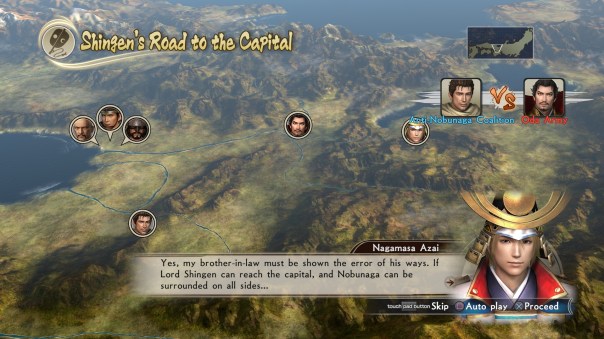
With the translate app, players can take pictures of the
screen as the dialogue appears and form halfway comprehensible translation of
all the text. It doesn’t make the
Japanese voice acting any better, but with the help of the translation app I
can finally understand and somewhat enjoy the stories of Sengoku Basara 4,
which, it turns out, are wonderful.
Sengoku Basara 4’s stories have something for everyone. It has stories that are funny, sad, cute,
awesome and everything in between. It’s
a pain to have to take constant pictures of the screen as the dialogue goes
along and it doesn’t alleviate the depression of Capcom’s vicious betrayal, but
it does make it partially possible to play the game to the potential it was made
to be played.
It also means that Sengoku Basara: Sanada Yukimura Den is on
the table. Now that I can understand
this more story-centric game, I can give my thoughts on it proper.
It’s a very odd decision for Capcom to make another Sengoku
Basara game after 4. For Japanese
audiences at least, there was no way in hell they were ever going to top
that. When you reach the peak there’s
nowhere to go but down. Trying to make
another game is a fool’s errand.
Apparently it was done because some kind of anniversary in Japan
 |
| It doesn't have Yukimura's name because Masayuki is just as important. |
Demands, screams and begging for Sengoku Basara 4’s English
version overshadows Sanada Yukimura Den.
It’s the last game anyone mentions when people discuss the Sengoku
Basara games coming out in English. It
wasn’t well received in Japan
See, Yukimura in Sengoku Basara was always more of a
combination of the real life Yukimura and Shingen Takeda’s hot-headed successor
Katsuyori Takeda. In this game Katsuyori
Takeda is his own faceless background character and dies as part of the more
history-adhering plot. Yukimura doesn’t
even serve Shingen in this game. He’s
dead by the time Yukimura is of age.
Without Shingen and with Katsuyori made into his own character, Yukimura
doesn’t have as much of his impulsive, silly and borderline sycophantic side,
but he’s no less firey or fiercely loyal.
The whole story is less silly and comedic moments are very sparse,
bringing to mind the central conflict of Sengoku Basara: Samurai Heroes. Make no mistake though, Sengoku Basara is
unavoidably silly on a base level.
It’s fun seeing how Sengoku Basara plays with history in
this game, if you know it. One of the
things known about the Sanada brothers is that Nobuyuki eventually joined
Ieyasu’s side and their forces would fight against each other. Naturally Sengoku Basara makes it into a Cain
and Abel story, not dissimilar to how the brothers are portrayed in Samurai
Warriors 4 and 4-2.
Then there’s Masamune.
In real life, Yukimura and Masamune probably never met and if they did
meet it only could have been when Yukimura and Masamune’s forces clashed at Osaka
My favorite part is Masamune’s assault on Hideyoshi. In real life, Masamune knew that Hideyoshi
had pretty much already won and decided surrender was the best option, but
instead of making himself look like a weenie he went up to Hideyoshi wearing
bright, fancy clothes while carrying a big cross on his back. The reason as to why seems to depend on who you ask, but one
interpretation is that he did it to show Hideyoshi that he was a badass mother
fucker regardless of whether he was surrendering.
In Sengoku Basara he wears a beautiful white robe with a big
glowing golden cross embroidered on the back of it that is implied to give him
super powers as he tears through Hideyoshi’s forces with all 6 swords just to
have a slug at the big guy himself and send a message to not mess with the Date
clan. He surrenders by the end though.

All these Sengoku Basara-interpreted moments in history have
cutscenes done with the highest care put into motion capture and cinematography
that all the biggest and best in-engine cutscenes the previous two games had. Even if the writing adjust things a little for
the sake of history and makes things more consistently dramatic than usual, Sengoku Basara’s
style hasn’t lost its edge.
It’d be a very different experience if I could enjoy the
story without interrupting the gameplay because the combat is unique from
Sengoku Basara 4’s, at least in the finer details. The main controls with jumping, the basara
attacks and the special attacks are all the same, but battle preparation has
seen major simplification.
There are no more items, weapon accessories, inscriptions or
weapon stats. Weapons are now purely
cosmetic. Instead there are pre-made
sets of abilities that act similarly to items, boosting stats and applying
different bonuses. These bonuses are
activated during the mission as players gather a special energy obtained from
breaking blue boxes, killing certain enemies and, with the use of a new super
mode, killing any enemy. With no items,
there is also no crafting and everything is done with money.

 |
| The presets. |
Battles are now mostly linear affairs. There are no more control camps (except in
one mission, kind of) and most of the time you only play as one character at a
time. There are times where control
between characters will switch for the next part of the story and other times
where you can switch between them on separate parts of the battlefield, but you
don’t get to have a backup partner character trailing behind you like previous
games and consequently there is no multiplayer.
This all might seem like sacrilege, but I think it’s all
part of what Sanada Yukimura Den is aiming for: it goes back to the simpler
times of the first 2 games. I love all
the customizability of the previous 2 games, but they did gradually lose some
of the pick-up-and-play aspect in the process when I’m spending so much time on
an equipment screen. Sanada Yukimura Den
lets you get right into the action while still having some choice on how to go
into a mission.

Fights with other characters feel more like they were made
with a single player in mind too. While
previous fights with other characters might as well just be fighting a second
player controlling them with all their moves, there was a effort to make the
fights in Sanada Yukimura Den feel more like boss fights with more telegraphed
attacks, phases and forms as they progress.
Having a second player works for the chaotic battlefield the other games
were all about, but the ones here try to be more isolated duels, even if they
aren’t anywhere close to the level of a game like Devil May Cry or Metal Gear
Rising.
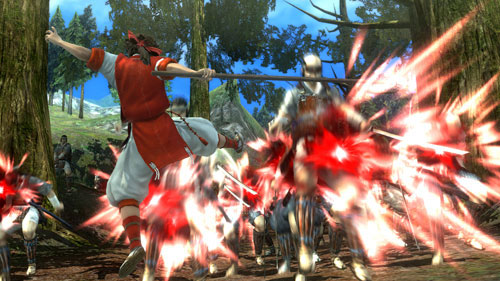
Sanada Yukimura Den is the most gorgeous game in the
franchise. I think the smaller level
designs and lack of split screen made it so rendering power didn’t need to be
spread out because these environments have never looked better. It has
a long draw distance, a high frame rate, dynamic lighting and lots of little
details for each stage like falling cherry blossoms and reflective gold. Enemies get hit with even more flash and
impact and there’s a lot of pretty glowing and streaks of light emanating from
Yukimura and Masamune’s weapons.

For anyone who can actually understand what anyone in it is saying, the main story of the game is a great time, but Sanada
Yukimura Den’s biggest flaw is that it’s the only reason to play it and yet the
whole thing is only 4 hours, give or take.
It’s an enjoyable 4 hours and I certainly can’t accuse it of
wasting my time, but not only is the story being hampered by language barrier
woes as it is, there’s not a lot else of substance in the game. There are the six-coin challenges in the
story mode that task you with fulfilling objectives for each mission, but they
don’t offer much of a reward beyond more money.
There are character side stories that let you play a mission with other
Sengoku Basara characters, but those missions are just fighting an enemy or
group of enemies in a small stage while dialogue plays out with no cutscenes
whatsoever. There’s the
previously-mentioned voiced dialogue conversations, called “voice dramas”, but
those might as well just be the side stories without the gameplay. You get the ability to play story missions
with any character after beating it, but even though every story mission is
ballin’, there are only 10 of them.
The best thing about this mode and the free play story mode is that every single playable character from Sengoku Basara 4 Utage is playable in it, all of them have their entire movesets unlocked from the start and they have all their DLC weapons and costumes available, meaning I can finally play as Wesker Hisahide and Ryu Ieyasu.

Having access to everyone and all their stuff further
contributes to the pick-up-and-play design philosophy this game seems to aim
for. It’s an ok distraction if you want
to just fight guys with a Sengoku Basara character without going through all
the battle preparations and equipment of the other games. It’d be more fun if
you could do it with another player.
It’s not just the story mode that doesn’t allow a second
player. The entire game is single player
only and that alone makes the Sanada Trials mode inferior to all the previous
mob-fighting bonus games of the franchise.
I understand why that doesn’t work for the main mode, but for what
reason is there to not to allow a second player in the challenge mode like in
the other games? This mode would be
perfect for some casual fun time with friends.
The Sanada Trials could’ve been added to one of the main
games for 5 dollars as DLC and it’s not good enough to make up for the game’s
dearth of content. You play Sengoku
Basara: Sanada Yukimura Den for the story, but even that has a problem with cohesion
between its story beats and the near-impregnable language barrier. Ironically, I would recommend playing Samurai
Warriors 4 or 4-2 before playing this just because that game can bring players
more up to speed as to what Sanada Yukumura Den is adapting from. If it were in English, I would recommend it
as a fun little spin-off game. In
Japanese it’s harder to enjoy, but I’m glad I played it. It's not bad, but I wouldn't go rushing out to get it. I give Sengoku Basara: Sanada Yukimura Den a
6 out of 10. If it were in English it would get a 7.
 |
| In some missions you can use 2 Masamunes, you meatriders. |
With my generally positive reception to this game, you might
be asking why Sengoku Basara: Sanada Yukimura Den wasn’t well-received in Japan
 |
| Pictured: connective tissue. |
If people were given a choice of
their Yukimura game, they were probably going to that one. Personally I don’t see any spinning
piledrivers or people being sucked into fancy hats in Spirit of Sanada so I
wouldn’t choose it.
We know why Sengoku Basara: Sanada Yukimura Den never came out in English.


The franchise is not dead in America


No comments:
Post a Comment