We aren't done with Sengoku Basara yet. In the first part of my Sengoku Basara retrospective I directed people to a series of videos from Extra Creditz, specifically their Extra History sub-series. This 6-part series of short videos does a good job of detailing all the most important moments of the Sengoku period while making them fun and expressive through the use of artwork. Even more fun an expressive is one of my favorite franchises, Sengoku Basara.
It's always funny to me when I learn something about history and think back to how the madcap action of Sengoku Basara interpreted that, especially with Sanada Yukimura Den steering closer to real history. As such I thought it would be fun to go over some real history and how that was interpreted into what we see in the games. The Sengoku era of Japan is already pretty crazy, as the videos show, so watching it become more crazy is pretty entertaining.
For this shorter 3-part series, I'll be going over each part of Extra Creditz videos on Sengoku-era Japan, with 2 parts in each. Whenever there's something from the video that's relevant, I'll quote it in italics and give some insight into how Sengoku Basara sees things (as well as some other media).
Obviously this is such a long period of time and such a short series of videos that not every warlord can be have their story told. Extra Creditz' videos mostly focus on the unifiers of Japan and some characters in Sengoku Basara, like Tsuruhime, were not around for some of the big moments Sengoku Basara depicts, sometimes because they were already dead by then.
I am also aware that one more video was made after this series from Extra Creditz to correct some details, mostly negligible ones. I am also capable of getting things wrong so feel free to correct me in the comments.
We'll begin with part 1, about Nobunaga's rise to power and the battle of Okehazama.
Sengoku Basara is all about the Sengoku period so most of this part is a preamble about how Japan got to that point and it doesn't factor into the games. All Sengoku Basara ever really gives is that Japan is at war and everyone wants to conquer it. Extra History doesn't get into the Sengoku Basara stuff until Okehazama comes up. Okehazama is where the Sengoku period, and Nobunaga's notoriety, really kicked off.
The following quotes factor into the Okehazama stages of the first 2 games:
"Hardly a threat for them to worry about."
"As he [Nobunaga] begins to lead his forces around a stealthy path, a storm rolls in. The rain begins to pour."
"The men in the gorge have been drinking."
"The unprepared or drunken men scatter or fall where they stand."
Yoshimoto Imagawa gets clowned on for his humiliating defeat at Okehazama and that extends to his Sengoku Basara persona. Since he was known for partying before getting absolutely massacred, his Sengoku Basara portrayal is designed around the arts. Imagawa in Sengoku Basara wields a big fancy fan, his attacks resemble dance moves and his basara attack has him attacking with a disco ball, which I'm sure existed at that point in time. More than a party animal though, Sengoku Basara's Imagawa is a wimp. His guard stance shows him trembling in fear, his dodge move is crawling away on all fours and his victory animation has him being chased by a little dog.

His Okehazama stages take place in the rain, with the second game's gimmick being that you can potentially kill him before his forces arrive, since he was taken by surprise. The kicker is that Imagawa has a bunch of body doubles around the stage and because of the rain you can't tell if the Imagawa on the map is a fake until you get right up to it. I can't find anything online about Imagawa having a reputation for body doubles, but makeup and extravagant clothes can obscure distinguishing features so I would think that's a tactic that would work.
The anime, Samurai Kings, plays up Imagawa's defeat as the big introduction of Nobunaga. In it, Imagawa has 2 body doubles and himself each ride off in a different horse carriage when he's attacked by Masamune, but Ranmaru and Nouhime kill the fakes before anyone else can get to them. Mitsuhide gets the real one and hands him over to Nobunaga, who, in an awesome entrance, holds Imagawa above a clifftop where everyone can see and then shoots him in the head. Even though he did it with what looks like a shotgun at point blank range, Imagawa's head is not blown off.
A funny thing about Nobunaga is that he has so many feats, that are all discussed in this web series, that Okehazama couldn't fit into Nobunaga's story in Sengoku Basara 2. Each story in that game only has 5 or 6 missions and since almost all of those were taken up by ones based on later events, the battle of Okehazama is relegated to the opening cutscene in Nobunaga's story. Ranmaru gets to play the stage in his story though.
"The young Matsudaira leader agreed to be, not perhaps a vassal, but more a junior partner in wherever Nobunaga's adventures may lead him. This young man who will one day be known far and wide as Tokuagawa Ieyasu."
Ieyasu isn't explicitly allied with Nobunaga in the first 2 games, but both the anime and later Sanada Yukimura Den makes him as such. In the anime he was allied with Nobunaga while still a child and in Sanada Yukimura Den he has his older post-SB2 look. From what I can get from my shaky translation of Sanada Yukimura Den, Ieyasu allies with Nobunaga because he has a certain radiance of authority that Ieyasu believes can unify the land or something. I think the implication in the anime is that he's just naive, considering Nobunaga in Sengoku Basara sits on a throne of skulls, calls himself the devil king and hangs around with a kill-crazy grim reaper-looking guy with a scythe (who later appears to kill Ieyasu in the anime).
Extra History's second part concerns Nobunaga moving on to capture Inabayama castle.
"You see, to the east of Owari, the home province of the Oda, were three great clans: the Hojo, the Takeda and the Uesugi."
Of those three, Sengoku Basara gives most of its attention to the Takeda and Uesugi, specifically Shingen Takeda and Kenshin Uesugi. The Hojo clan is more of an afterthought.
This might've been so that the developers didn't have to split focus so much. It's not like the Hojo weren't a big player in the Sengoku period. In fact, I've seen it represented by three different people across media.
In Sengoku Basara there's Ujimasa, an old man who wants to revive the clan to its former glory and mostly relies on the ninja Fuuma Kotaro. In the Samurai Warriors games the Hojo are given more attention and are led by the ruggedly handsome and much younger Ujiyasu Hojo. Sengoku Basara seems to reference Tecmo Koei's counterpart when one of Ujimasa's soldiers says "No my lord isn't Ujiyasu. It's UjiMASA."
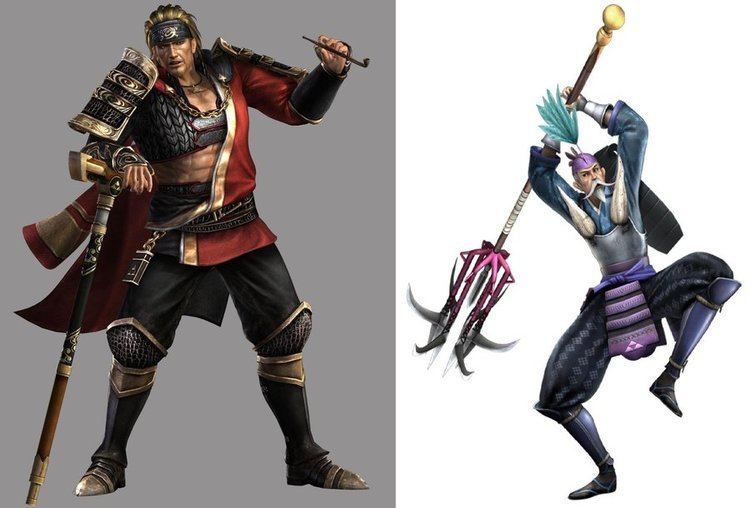 |
| Ujiyasu on the left, Ujimasa on the right. |
The point is, despite not being very important in Sengoku Basara, they were a big deal.
"So why didn't one of these clans march west and steamroll everything between them and Kyoto? Well, because every time one of them would start to, one of the others would invade their territory."
Sengoku Basara and other media portrays Shingen and Kenshin's constant fighting as a passionate rivalry and their stages are often different versions of Kawanakajima. If all the Kawanakajima stages across the franchise seem a bit much, it's important to note that these guys fought each other at Kawanakajima 5 times and never had a clear winner! That place was the designated Uesugi vs. Shingen battleground!

As far as those two went, media (Sengoku Basara included) likes to portray them as respectful friends outside the battlefield and having a rivalry against each other so fierce that the thought of going off to invade other territories wouldn't cross their mind until the battle was over. I like to think they would even team up to fight invaders as if to say "we're fighting! Back off!"
They probably didn't fight each other using meteors or cryokinesis, but the dedication and intensity toward fighting each other in Sengoku Basara isn't that big of an exaggeration.
Extra history goes into what goes on with the Saito, but they're excluded from Sengoku Basara. Nagamasa Azai isn't though.
"So he marries off his sister to the lord of the Azai, bringing them into the family and hopefully ensuring their friendship."

I hope that ends happily.
"Basically everybody in this story changes their name, like, 13 times because it seems to be a thing at the time to demand that everybody call you by increasingly cooler names the stronger you got, which, yeah, is kind of awesome, but it also gets extremely confusing so we're basically just going to ignore it and just call everybody by the names history remembers them as."
Sengoku Basara rightfully does the same thing, with a few exceptions. The child versions of Yukimura, Masamune and Ieyasu use one of their older names to differentiate themselves from their regular version. The Japanese version and the English dubs of the anime also have nicknames used for characters like Hideaki and Yoshitsugu, but in a good call the English version of Sengoku Basara: Samurai Heroes does not use those.
Samurai Warriors has names change as stories progress in a few instances, but usually those names are accompanied by the character being onscreen so you don't forget who is who.
Much of what Extra History goes through after that isn't anything Sengoku Basara references. Hideyoshi working for Nobunaga is never a thing in Sengoku Basara. He's treated as his own faction and the Saito are absent. There's an interesting story about Inabayama castle though.
Before Nobunaga took Inabayama castle, it was famously taken through trickery by Hanbei Takenaka, who later becomes Hideyoshi's right hand man in Sengoku Basara.

Since his feat at Inabayama was an especially notable achievement for him, Hanbei is the boss of the Inabayama Castle stage in Sengoku Basara 2 and he is the one Nobunaga fights there. I think in history he gave the castle back before Nobunaga came around.
This has been a pretty exciting story so far and Nobunaga seems like a capable leader. Maybe he'll lead the land to unification and peace.


No comments:
Post a Comment