When it comes to shonen manga, anime and games, there are few with as much knowledge and love as the Shonen Otaku. Join me as we look at all different varieties of action-packed media. Mostly games.
Namco vs. Midway: The King of Arcades 2: 1996 & 1997
Like I said in the first King of Arcades competition, 3D
gaming was in full swing in the latter half of the 1990s thanks to the
Playstation and Nintendo 64’s polygon rendering abilities. As evidenced by last time, Namco was already
on that by this point, but for Midway, though they did dabble in 3D polygons in
the past, the usual pre-rendered visuals were their reliable aesthetic, though
even that started to change.
Both Namco and Midway were taking advantage of the new capabilities
offered by Sony and Nintendo’s consoles in the homes. I credited The King of Fighters 98 as being
the first “Dream Match” game, because it’s where that moniker came from, but arguably
Midway had already done the concept with Mortal Kombat Trilogy, a
console-exclusive game that took everyone from previous games in the franchise and
put them all in one PS1 disc or N64 cartridge. Not only did Midway have Mortal Kombat Trilogy to maintain
Mortal Kombt mania, but they also released the sequel to their hit 1995 Mortal
Kombat movie. People didn’t like it. Personally I think it's a hoot.
Namco was also chugging along in the console space with PS1
ports of their arcade games, most notably Tekken and their new NamcoMuseum
compilations.
Since home consoles were catching up to the technical
capabilities of arcade games, they started taking the attention and arcade game
development started slowing down, resulting in this competition having fewer
games in both competitor’s arsenals and thus another double year round. I might’ve skipped 1996 altogether, but I was
able to find one game from that year and it’s a pretty important one.
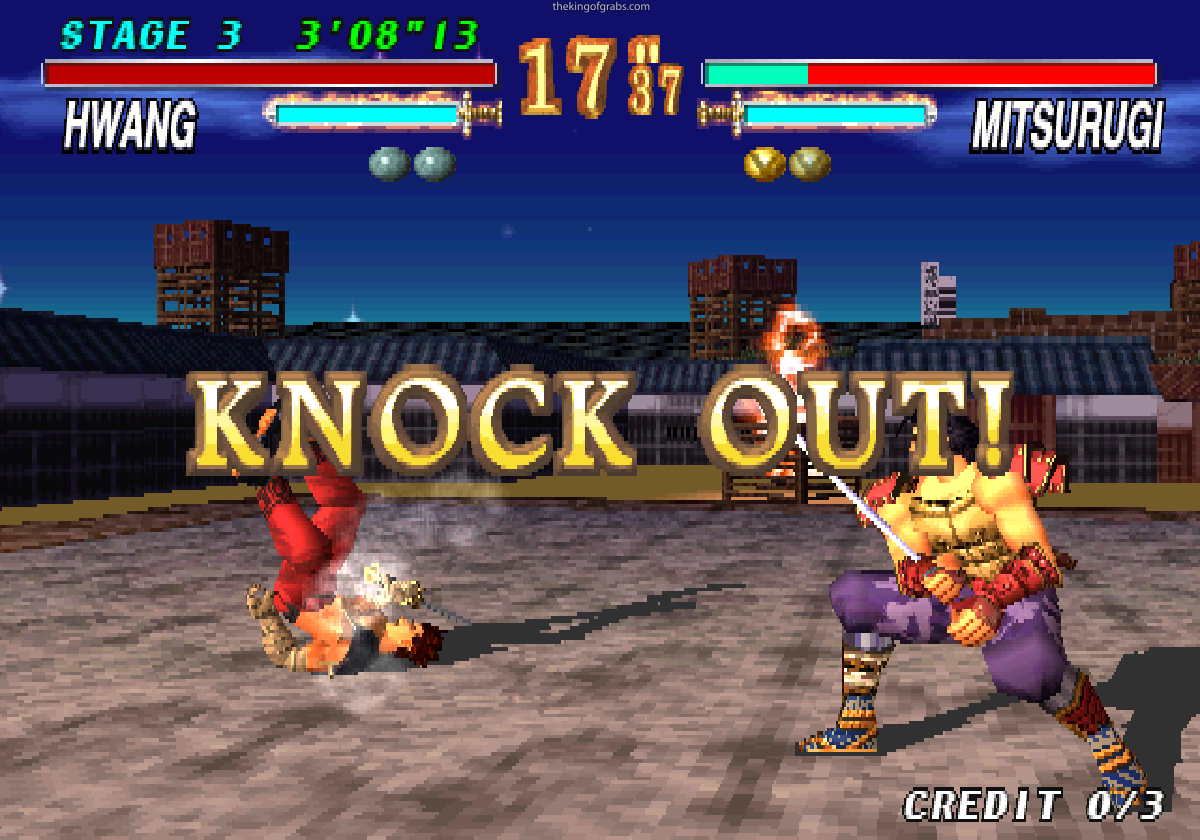
Soul Edge(NAM):
Samurai Shodown paved the way for the concept of weapon-based fighting game
combat, but Soul Edge paved the way for it in 3D. Yes, I was actually able to find an arcade
cabinet of this.
Technically the first 3D game to use weapon-based combat was
Tamsoft’s Battle Arena Toshinden, but that’s like saying The King of Fighters
94 is the first King of Fighters game. It’s
technically true, but it’s such garbage that we try to pretend it doesn’t
exist. It’s funny how the very same
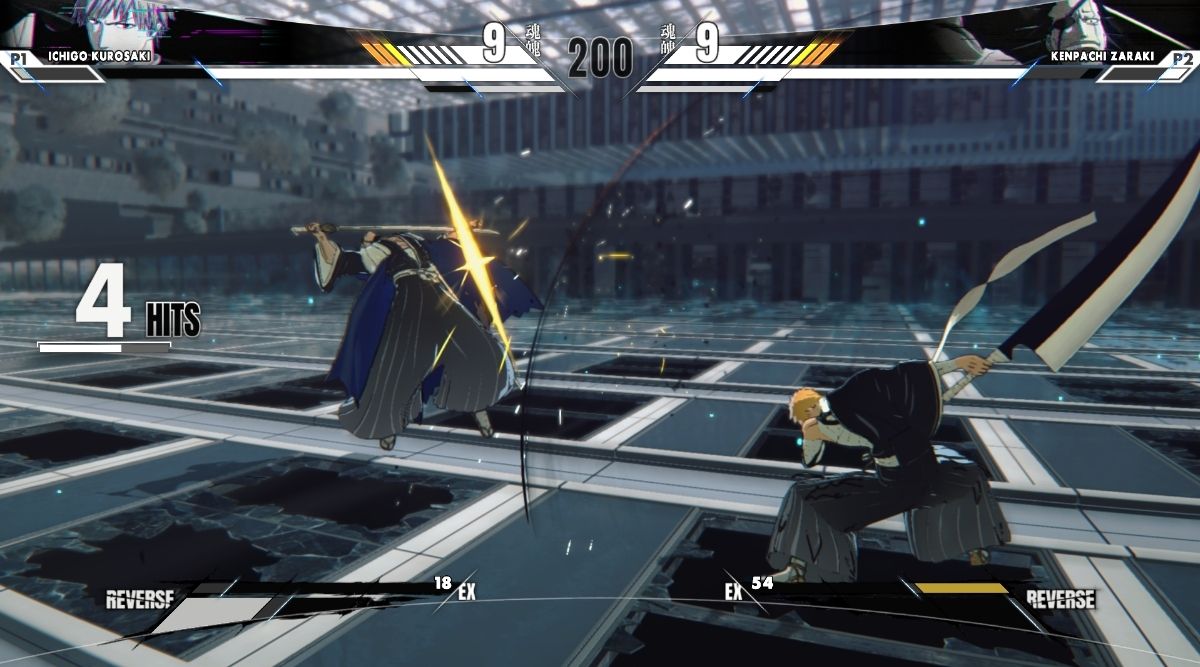
developers of that tripe would go on to make the 3D weapon fighter Bleach:
Rebirth of Souls three decades later.
Rebirth of Souls is great. Go
play that instead.
Soul Edge tells the story of the eponymous evil sword (or
swords, if it feels like it) that was stolen by the dread pirate Cervantes
DeLeon. Now warriors around the world
seek the Soul Edge for their own reasons, be it to destroy it or take its power
for their own. The cast of characters
include a Samurai, a ninja, a Greek warrior lady, a German Knight and Cervantes
is a Spanish pirate. Soul Edge mashes
all kinds of genre staples into one game.
The only time Samurai Shodown got as diverse as this was in Samurai Shodown
Sen, but even then that game is a Soul Calibur knockoff.
Soul Edge is easy to compare to Tekken at a glance. They both have chunky 3D models, both allow
sidestepping, neither have fancy hadouken-style special attacks and both have a
lot of detail put into the combat animations of each of the characters. Soul Edge is a lot different when you
actually play it though. Instead of
punches and kicks, there is one kick and weapon slashes of the horizontal and
vertical variety. A dedicated guard
button is also seldom seen in fighting games even today. Visually the game differentiates itself from
Tekken further by the environments actually being in 3D for once instead of the
infinite voids with backgrounds the Tekken games take place in. You can even send someone off the edge for a
ring out.
As expected for the first game in a franchise, Soul Edge’s
combat is basic, but fun. Reading the
opponent takes precedence. Players can
backstep to dodge horizontal slashes, sidestep to dodge vertical ones or simply
block attacks, but that last one brings a weapon closer to breaking, causes
knockback when ring outs are possible and can be bypassed with a grab.
If Samurai Shodown is like the single stroke battle of a
Samurai movie, Soul Edge is more like flynning. Both games put importance on finding the
right moment to strike and both have a blade locking system, but Soul Edge skews
more towards combos and aggressive play.
I mean when Haohmaru was finally in a Soul Calibur game, he got some of
the franchise’s play style, but his best move is his home franchise's heavy slash.
Soul Edge plays just fine, but it clearly got a leg up on
its brother Tekken in the presentation.
The 3D battlegrounds look great for their time, characters have more
expressive motion, clanging sound effects sell the swordplay and there are
character endings for once with hand-drawn artwork. Overall it’s a solid game.
Maximum Force(MID): This might as well be a conversion of
Area 51, except instead of enemies made from miniatures to shoot at, it’s all
digitized actors. The actors are integrated
into the game really well and the environments are more dynamic and varied than
Area 51, but when you get right down to it, Maximum Force is just another
basic, short-lasting shooting gallery of a rail shooter. Midway is lucky I wasn’t able to find a Time
Crisis 2 machine because by my recollection that game does everything this one
doesn’t.
Rampage: World Tour(MID): The original Rampage was a shallow,
boring, unsatisfying attempt to make a game about the joy of kaiju destroying
cities. Rampage: World Tour realizes
that potential with the advancement in technology.
Explosions are pretty and buildings shatter and fall apart
in satisfying clouds of dust and debris.
Each of the three playable characters are expressive and cartoonish
thanks to the use of the same kind of pre-rendered sprite technology Rareware
was using for Donkey Kong Country so it’s fun as hell watching them fling
civilians into their gaping maw or kick the puny tanks and policemen.
What looks like a game of mindlessly destroying city after
city actually has some depth to it that rewards optimal play. Punches and kicks have different properties
in different situations, the monsters can fight off the military force to get
some heat off of them and players need to be wary about what they choose to eat
out of a building because some items heal and some hurt. It’s a good moment-to-moment gameplay loop
that’s easy to pick up and play, but has enough intricacies to keep me hooked.
The problem with Rampage: World Tour is that it starts to
run out of ideas about half an hour in.
A half hour of time wasting entertainment isn’t bad for an arcade game,
but if you look at longplays online, this game is at least 3 hours long and as
far as I can tell there’s no level select of any kind like Maximum Carnage
had. With a length like that, it’s
inevitable the gameplay will get stale.
If there were level select passwords, like in Total Carnage, World Tour
would be a good game to pick up, make some progress in for a while and then
come back to continue another time.
Since the arcade version doesn’t have that, it’s best to pretend the
game doesn’t have an ending and play until boredom sets in, which will take a
while because the game is pretty darn fun.
Tekken 3(NAM):
Tekken 3’s story mixes up the formula of the previous two games
considerably. Instead of another bout
between the Mishimas, Tekken 3 takes place at least 15 years later and stars a
new main character with a new villain.
It turns out at some point Kazuya fathered a son with Jun Kazama and
their kid, Jin, inherited his dad’s super devil power. Heihachi, having taken back the Mishima Zaibatsu
in Tekken 2, formed a privatized military force, which accidentally uncovers an
ancient evil warrior monster. The
monster, called Ogre, goes around the world injuring or otherwise killing the
strongest warriors and that just to happens to include Jun, who disappears
after Ogre attacks her. Jin, seeking
revenge and on the prior instruction of his mother, goes to his grandpa
Heihachi to learn how to fight and Heihachi starts a new King of Iron Fist
tournament to lure Ogre out.
It’s quite a step up from the simple “bad guy with bad
company runs tournament” and the gap in time since Tekken 2 can be seen in the
character selection. Michelle Chang,
Marshall Law and Kazuya Mishima are replaced by their offspring, Baek Doo San
is replaced by his student and Heihachi’s hair is now gray. Only a few characters from Tekken 2 return
and Tekken 3 introduces future Tekken frequenters Bryan Fury, Ling Xiaoyu and
Eddie Gordo.
A lot has been changed up in the character selection, but
not so much the gameplay. Tekken 3
controls just like Tekken 2, but as it’s made on more powerful hardware,
environments and character motions look better and smoother. The environments in particular now look like
real locales instead of environmental areas in vast expanses. They still aren’t fully 3D environments with
boundaries like in Soul Edge, but it’s an improvement from the previous game.
Gameplay improvements are more subtle, with more grounded
physics (no more jumping like characters are on the moon), snappier controls
and overall less jank. Characters have even
more moves than Tekken 2 and that’s thanks in part to new characters like Ling
Xiaoyu and Eddie Gordo, who can take stances that allow for another set of moves.
Tekken 3 is good, but I think it’s overstated how big of a
leap it is from the previous game.
Tekken 3 is touted as the major turning point for Tekken and to this day
is considered one of the greatest fighting games of all time even in the face
of its sequels. This is the Tekken
game that got a big fancy virtual gameplay device at Gameworks on a stage for hyped onlookers. I’ve played it and I really really miss Gameworks.
I recall a big screen for the onlookers when I played it.
However, other than the story shift, it’s really not a major
leap for the franchise or the best game in it.
Tekken 2 was the point where the games went from functional to good and
there’s no way I would put Tekken 3 above Tekken 5 or 6. I think the extras and enhancements to the
PS1 ports is where it gets that reputation.
For the arcade version, where all it has is the combat, it’s an incremental
improvement from Tekken 2 rather than a giant leap for gamingkind.
Now let’s see how Midway handles their 3D fighting game.
Mortal Kombat 4(MID): While it doesn’t have a major time
skip like Tekken 3 does, Mortal Kombat 4 does shake things up with a new
villain not associated with Shao Kahn.
This time the villain is Shinnok, a fallen elder god who once attempted
to destroy earth, but thanks to the efforts of Raiden he was banished to the
Netherrealm without his amulet that allows him to traverse the realms. Now, after some trickery with his follower
Quan Chi, he has taken over the realm of Edenia.
Compared to Tekken 3, Mortal Komat 4 has a huge leg up on
setting up its plot with supplemental material.
Tekken 3 has a page of text in the PS1 version’s manual. MK4 has a whole game and a comic.
The game is Mortal Kombat Mythologies: Sub-Zero. Mythologies adds to the backstory of the
original Sub-Zero and introduces Shinnok, Quan Chi and the Netherrealm. It’s infamously full of bullshit game design
and scarce checkpoints. I agree it’s not well-made as a game, but if you cheat your way through it with save
states and rewinding in the Mortal Kombat Legacy Kollection, it has its fun parts,
some great visuals and entertaining live action cutscenes the actors were
clearly having a blast making. In the
Legacy Kollection there’s a whole 20+ minute video showing its creation and there
is something very funny about seeing Quan Chi, in full makeup, sipping beer and
acting like a goof on set.
The prequel comic came with the later PC port of the game,
after skipping on making one for Mortal Kombat 3. It primarily sets up the plot
of Mortal Kombat 4 and its playable characters, but it also adds to the
backstory of Shinnok and the Netherrealm.
It explains that the Netherrealm is actually what humans have referred
to as the afterlife for bad people, like Hell, Hades and presumably Naraku. When Shinnok was banished there, Lucifer, the
devil himself, beat Shinnok using all the souls that Shinnok sent there in his
time as an elder god and trapped him for a lifetime of torture until Quan Chi
came in and busted Shinnok out to take Lucifer’s throne. It’s a great backstory and is more in-depth
than being an otherworldly conquerer.
A shame the game doesn’t do a lot with that.
Gameplay-wise Mortal Kombat 4 sticks to its guns and plays
exactly like Mortal Kombat 3. Fights
take place on a 2D plane and there is a means of sidestepping projectiles sometimes,
but it’s not essential to the overall combat.
The only other new addition is weapons characters can pull out of
nowhere, but they take way too long to get out and getting knocked down makes
characters drop them so they’re practically useless.
Mortal Kombat 4’s biggest failing is that it doesn’t look
especially good, which is really bad in a franchise that puts so much emphasis
on the raw violence and impact of a fight.
Character animations are stiff and look amateurish. They do the same motions as Mortal Kombat 3,
but without the detailed digitized martial arts that sold the impact of
the hits. Now characters make their robotic
victory poses with expressionless faces and chunky character models. I will give it to Mortal Kombat 4 that some of the
Fatalities now have camera angles with the 3D space to show them off better and
it boasts some very nice-looking stages that harken back to the fantastical
stages of Mortal Kombat 2 so I can at least give it that above Tekken 3. Bad visuals carry over to the endings, which are the most
amateurish I think I’ve ever seen from a major franchise. Endings are character models doing static
poses while garbage voice acting from people who clearly aren’t voice actors play
over them. It was the right call to move
on from the text endings, but they were better than this crap, even if it's unintentionally funny.
Mortal Kombat 4 really needed to look and play better than
the previous games to make up for its lack of content. Each character, of which there are fewer, has
only 2 fatalities and there are only a handful of stage fatalities. There are alternate costumes, which is a nice
way of taking advantage of 3D character models, but that’s the only unique
thing it has. No more animalities,
babalities, friendships or brutalities.
It doesn’t even have a final boss, really. Shinnok barely counts as one because he’s a
regular playable character and is given no unique advantage in the final battle
other than raised AI difficulty, which thankfully plays relatively fair this
time. He doesn’t even get his own boss
stage. The combat works and there are some new characters to play
with so Mortal Kombat 4 is fun for a little while, but it doesn’t have any of
the staying power of the other games in the franchise, partially because until
recently playing it was next to impossible. I’ve used the term “Primal Rage problem” before, but you
could just as well rename that the Mortal Kombat 4 problem because just like
Primal Rage, getting MK4 to run on anything other than the original arcade
board was impossible for decades. There
were home conversions like the aforementioned PC port and another for the
Dreamcast, but nobody could get the original arcade version to run until the
Mortal Kombat Legacy Kollection and then it had to keep being patched and
one of the stages noticeably runs worse.
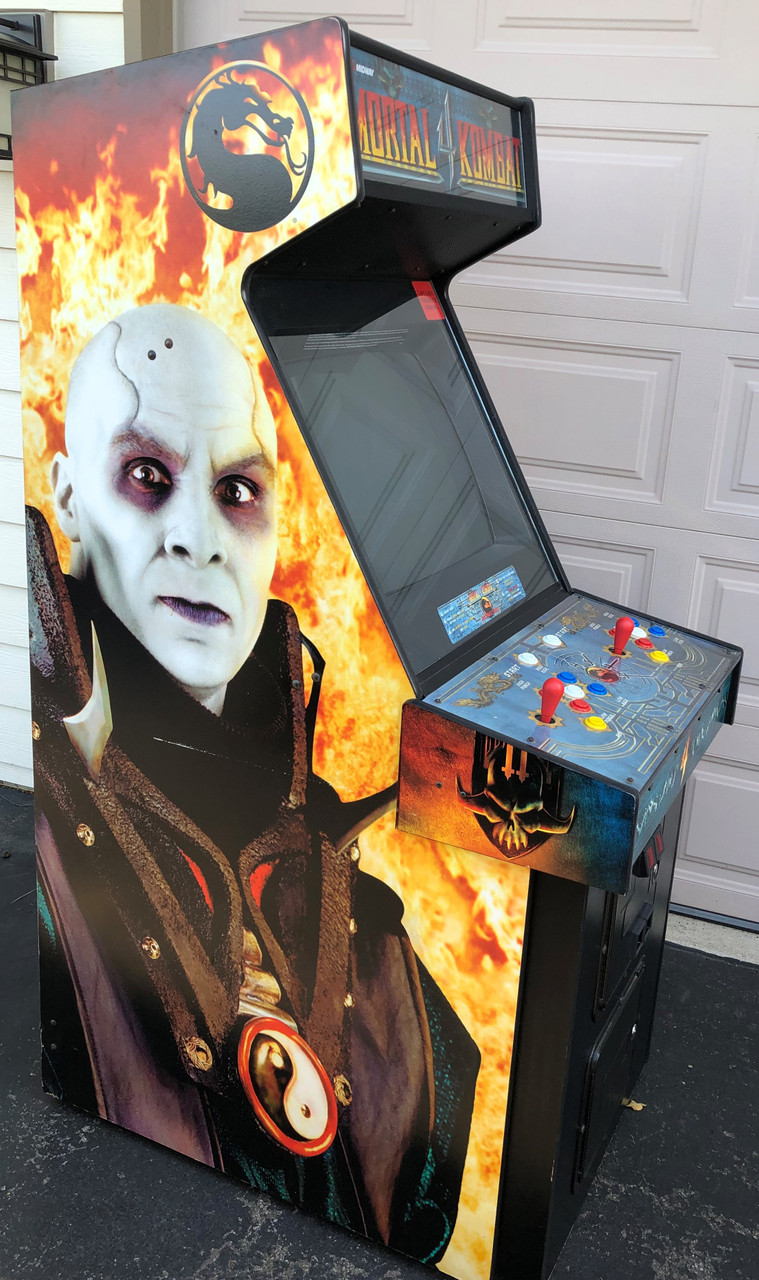
I played MK 4 for this on both the Legacy Kollection and a
legitimate arcade machine just to be sure there were no meaningful
differences. Actually I had played it on
an arcade machine long before that. Way
back when it was new, when I was a grade schooler, the local movie theater
(which is still going strong) had Mortal Kombat 4 and I vividly remember the
game over screen of falling to my death and Richard Divizio on the cabinet staring into my
soul.
I would lose a staredown.
I only played on that machine once back then, but now that
I’m older and I appreciate fighting games far more, I can safely say I wasn’t
missing a lot.
NFL Blitz(MID): This was created by the same guys behind NBA
Jam and it carries a lot of that game’s design philosophy into it. It cuts the fat, keeps things simple and is
easy to pick up and play. There aren’t
too many plays to choose from, but there’s still skill and strategy involved in executing each of them.
What makes it stand out from the other football games I’ve
played in my life (which isn’t that many) is the Midway flavor and obvious lack
of any penalties. Players don’t just get
tackled in this game. They go flying,
they get punched and players can even body or elbow slam someone who’s already
down, all while loud sports commentators shout about the goings-ons and the
audience audibly reacts to every tackle, touchdown and fumble.
So many people remember NBA Jam, but I never hear anyone talk
about NFL Blitz. I think it’s just as
good and deserves your attention if you like sports arcade games.
The Winner
With two major successes in fighting games on Namco’s side,
a lot rode on the latest game in Midway’s flagship franchise. It’s not that Midway had a bad year; Maximum
Force was mediocre, but Rampage: World Tour was fun for a while and NFL Blitz
is great, but those weren’t good enough to topple the big winners Namco put
out. Midway needed Mortal Kombat 4 to
shine. Too bad then that it wasn’t especially
exceptional or special. I would play
Soul Edge or Tekken 3 any day of the week before Mortal Kombat 4 so that means
Namco is the winner of this round.
Capcom and SNK had practically perfected the art of the
fighting game in 1997. They were making
even better sequels to already great games with Street Fighter 3: Second
Impact, Vampire Saviors and The King of Fighters 97, but even the new
properties like Shock Troopers, Battle Circuit and The Last Blade were up there
with the best of them. The King of
Fighters 97 in particular really solidified the King of Fighters as the best
fighting game by removing all the jank that was left after The King of Fighters
96.
From an aesthetic standpoint, 3D technology wasn’t good
enough to match up to the 2D sprite work from the previous contestants. From a content standpoint, all of the
previous contestant’s games had dialogue, cutscenes and endings, bringing the
player into their worlds. Soul Edge at
least had endings, but Tekken 3 didn’t and Mortal Kombat 4's were laughably
inept. Namco and Midway didn’t stand a
chance.
The scores are tied.
It’s down to the wire. Whoever
wins 1998, there will be a possibility of a tie for 1999. Next time we’ll see which company is going to
take that lead.




No comments:
Post a Comment