Wednesday, November 20, 2019

The King of Fighters: Allstar Review

Every big franchise seems to have a licensed “gacha” game these days.  There’s one for Senran Kagura, Fire Emblem, Marvel, Love Live and Castlevania.  While some decry such games for being exploitative and microtransaction-ridden, I’ve always thought the collection aspects combined with a solid core gameplay looked fun, but both the licenses and core gameplay didn’t hook me most of the time.  There just wasn’t a gacha game I could get into unless you count Yu-Gi-Oh: Duel Links.

KOF Allstar got all the hooks to catch my interest: it’s a beat-em-up with collectible characters utilizing the KOF license developed by the mobile company Netmarble.  Obviously I’m a huge KOF fan, I’ve enjoyed action mobile games with touch controls in the past and I’ve read both good and bad things about Netmarble.  The idea of a beat-em-up based on a fighting game franchise where only two fighters are going at it at a time may seem like an odd idea, but KOF has always had characters fighting gangs of enemies, it was just rarely shown.  I had some careful optimism.

In preparation for the global version, I played the Japanese version for a couple of weeks, both because I was excited to play and so that I could write about any possible differences between the two.  I couldn’t utilize every one of the game’s features as my Japanese isn’t expert level, but from what I can tell the only substantial difference is that the new content for the global version is coming out much quicker because it has a year of updates from the Japanese version to work with.  Now that I’ve gotten to play the global version, this review can be written proper.

Wednesday, October 2, 2019

SNK Heroines: Tag Team Frenzy Review

SNK has always admired its history and legacies, no matter how old or forgotten.  This is the company that brought back Hwa Jai for KOF 13 after being in just one game decades before and callbacks to the first Art of Fighting game are omnipresent, both visually and in gameplay. With SNK, you never know what they’re going to dig up next and I can definitely say I did not expect a follow-up to SNK Gals Fighters.

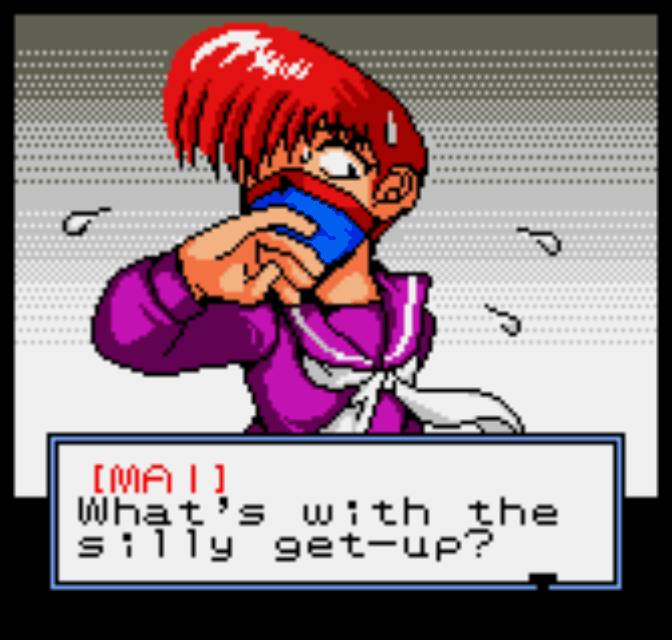
SNK Gals Fighters was a silly fighting game on the Neo Geo Pocket Color where a bunch of SNK’s girl fighters compete to win a wish in the girls-exclusive Queen of Fighters tournament, spearheaded by the enigmatic-yet-familiar-looking Miss X.

At first I thought it was Iori in drag wearing Eiji's mask, but she specifically says "私は庵ではない!"
The roster was mostly KOF girls like Whip, Leona and Shermie, but with other SNK characters like Shiki and Nakoruru from the Samurai Shodown games and Kyo’s largely offscreen girlfriend Yuki.


Everyone in the game was drawn as chibis, there was a mechanic in which the fighters clashed in a big ball of violence not unlike the Persona games post-2 and the new characters Yuki and Miss X had moves that included hysterical slapping, tripping and tearing apart the opposition with a fork and knife.

Needless to say, it was not a serious game. It was fun and silly with simpler controls.  It’s a breed of game we don’t seem to see as much of anymore since most fighting games want to be the newest competitive affair. That’s why the spiritual follow-up, SNK Heroines: Tag Team Frenzy, being released on the PC was such a pleasant surprise.


Sunday, May 26, 2019

Senran Kagura: Shinovi Masters Review

The first Senran Kagura anime is one of the worst game-to-anime adaptations I’ve ever seen.  It took what made the first Senran Kagura game such a well-crafted story and gutted it by taking out critical character moments and what was kept was changed enough to miss the point entirely.

Despite this, the announcement of the new Senran Kagura anime, Shinovi Masters, had me optimistic, and not from the more subdued trailer nor the presence of Bebe-tan (although that certainly helped).  I was convinced to watch it based on one name credited.  I’ll give you one hint as to what that name is.


I’ve said it once and will again: Yukinori Kitajima is the lynchpin of Senran Kagura.  He’s on the level of J. Michael Straczynski, Greg Weisman and Joss Whedon in writing talent.  He can make anything work and his writing for Senran Kagura is a key reason it’s as good as it is.  You could not convince me not to watch something with his name on it unless Kitajima himself told me not to.  Sure enough, Shinovi Masters has the writing you'd expect from him.

Tuesday, April 23, 2019

Digimon: Data Squad Review

In my review of Yu-Gi-Oh: Duel Links I said Yu-Gi-Oh was an anime that stuck with me, but another franchise that defined my childhood just as much was Digimon.  The show was Fox Kid’s juggernaut back when it was around, almost like what Teen Titans Go is to Cartoon Network today.  In direct contast to Teen Titans Go, however, it was a well-written character-focused adventure with a lot of heart that many people, including myself, still love to this day.

The first two seasons are the ones the most people remember since they’re within the same continuity and hooked everyone to begin with.  Like some people, I lost interest in Digimon around the time Tamers came along because of the unfamiliar characters and tonal shift.  Then I missed out on the fourth season, Digimon Fronteir thanks in part to airing on a new channel.  I did catch up with the ones I missed on Disney channel re-runs and appreciated them on their own merits, but I still preferred the original adventure.  When I got to Digimon: Data Squad, the fifth series, I wasn’t able to catch every single episode, but what I did watch was interesting and possibly even darker than Tamers.  Fusion, the most recent one, I was able to watch in its entirety.  It was pretty fun, but certainly not my favorite.

For a long time Digimon was unlocky when it comes to home releases.  It was a very TV-only affair for a long time.  Some of the seasons got a few episodes on VHS or DVD if it was lucky.  You could only really watch the series outside of TV through recordings of the TV airings, which weren’t the optimum quality.  After over a decade of this, things changed around the 2010s when New Video Group released them all in DVD box sets for relatively cheap prices.  Crunchyroll also streamed the Japanese versions of the earlier series and Netflix added Digimon Fusion to their lineup.  Since it’s one of the more controversial Digimon seasons not enough people have seen, I thought it best to take advantage of this and get the box set for the season I don’t think enough people have seen: Digimon: Data Squad.

Wednesday, April 3, 2019

428: Shibuya Scramble Review

Most visual novels don’t capture my attention.  I can read an ungodly amount of text in games, but that’s only when they’re accompanied by gameplay and visualized with detail.  I can read all those files describing monsters and biological functions in Resident Evil’s history, but that’s because you get to see those aspects in practice.  I love the Ace Attorney games and Zero Escape games, but those are broken up with puzzles and interaction on the player’s part (and in 999’s case, the long-winded text did wear on me).  I couldn’t even get an hour into Doki Doki Literature Club because it’s so visually uninteresting.  I know I can’t expect much from that example since it’s a free game, but the majority of visual novels are made like that.  Too much telling, not enough showing.

This is all a preface to why I bothered with the visual novel 428: Shibuya Scramble.  The game has long walls of text and essentially no gameplay so there would have to be something major to set it apart and at a glance that something isn’t apparent.  There is one very important person who made this a must-buy: Yukinori Kitajima.

I’ve mentioned Kitajima more than once on this blog.  He’s the writer of the excellently written Senran Kagura games, the 3DS Ace Attorney games (including working with the Professor Layton writer in their crossover), the underrated Okamiden and at least contributed to the aforementioned 999.
Before all of those, Kitajima’s claim to fame was 428.  It was originally released on the Wii in 2008 and was showered with praise, being one of the very few games/visual novels to ever get a perfect score in the Japanese gaming magazine Famitsu.  After the initial release it was ported to the PS3, PSP and iPhones to reach even more players.

In Japan.

And nowhere else.

It took a full decade for it to finally come out in America and I wanted to play it for about half of that time after being exposed to Kitajima’s genius.  It was finally translated and localized by Spike Chunsoft in 2018.  For reasons I’ll get into, it’s kind of understandable as to why it wasn’t originally released.