Sunday, January 13, 2013

King of Fighters Retrospective: 98

With the Orochi saga having come to an end in The King of Fighters 97, it was time for the series to move toward its next story arc with new villains and heroes to fight and fight with, respectively.  But before that, SNK gave the Orochi saga one last celebratory installment with what is considered one of their most successful games, King of Fighters 98.


For the first time, a King of Fighters game did not have a story.  Instead, KOF 98 focused on the multiplayer potential by having the largest character selection of the time and tweaked, refined combat and graphics.  After saving the world and beating down stupid-rich madmen, KOF 98 is something of a respite.

Good thing Heavy D is wearing sunglasses, because looking directly into Ralf's eyes saps your strength.
With the exceptions of Goenitz, the boss team from ’96, Orochi, Iori and Leona’s wild forms, Kasumi Todoh and Eiji Kisaragi, every character from the Orochi saga is playable.  That includes Saisyu Kusanagi from ’95, who forms a team with the other two badass dads, Takuma Sakazaki and Heidern, who were both also last seen in '95.  Also returning are Mature and Vice from ’96, and the American sports team from the very first King of Fighters game.  Some characters have had new moves added and new outfits as well to update them for the 1998 King of Fighters standards, making for an extremely impressive selection.


The huge character selection is one of the main draws of the game that most people seem to remember, and it’s what makes ‘98 ideal for multiplayer.  But like the other games, some of the best parts of the characters are their personalities, which got even more attention this time around.

King of Fighters 97 had a modest number of special character introductions, but the number in ’98 practically tripled since then.  If two characters have any kind of history with each other (especially if they’re from the same team), chances are they’ll say or do something that nods to the established story.  It’s always brief, but, as stated in the '97 post, even something as small as a friendly gesture can tell players something about each character.


To sweeten the deal, the character-specific themes were brought back with updated reversions after being absent from ’97.  There are even new themes for two of the Orochi team fighters.  Character-specific stages were brought back as well, but only for a couple of the teams.


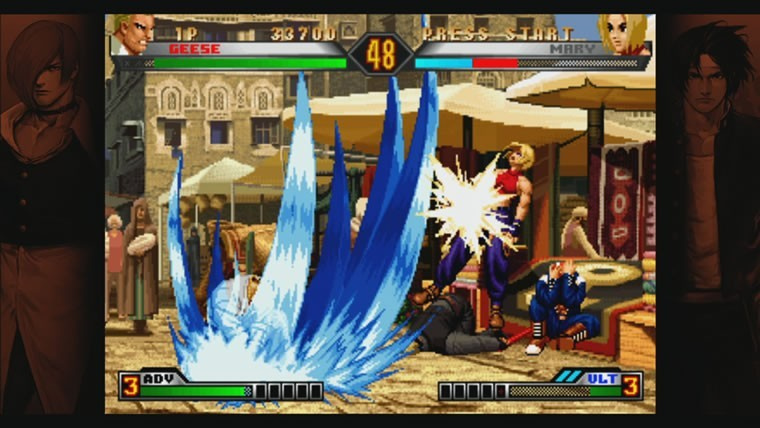
To the gameplay, ’98 added the advantage system and continue bonus.  Simply put, if you lose a teammate, the advantage system gives you one more maximum super stock holder in advance mode and a shorter charge gauge in extra mode.  Apart from that, it’s the same combat everyone loved from the last two games, but with tweaks and balances here and there to make an even better experience.

King got a new white shirt that carried over to KOF 99.


The continue bonus is the biggest addition, and a staple that would be carried on to every game after ’98.  When you lose and continue, a roulette gives you a random bonus for continuing.  Such bonuses include moving on to the next level, lowering the difficulty, and, the most useful, taking away two-thirds of your opponent’s health.  The bonuses can be refused, but there’s no shame in taking advantage of them, especially when it comes to the final boss.  It’s a great way to keep you playing, and it often has the benefit of saving time.
There are few things more frustrating than just barely losing a match and having to spend another few minutes fighting the same characters all over again, but with many of the continue bonuses, you can win in a very short time and move on with the game, or even skip the level you’re on entirely.  Many of the bonuses are only present in this game too.  Every game after '98 gives 3 voluntary continue bonuses to choose from instead of the roulette.

You may have noticed I mentioned a final boss, even though I stated at the beginning that The King of Fighters 98 has no story.  That is correct; it doesn't have a story, but it does have a memorable finale to end on.


The best way to describe King of Fighters 98 as a whole is that it’s polished.  The character selection is impressive, the graphics are updated and emphasize realistic textures slightly less, the character portraits are mostly spot-on, and everyone’s favorite aspects, like win quotes and character themes, are brought back.  It’s one of the best choices for a fighting game out there, and a must-buy.


King of Fighters 98 is available on the Orochi Saga collection on the PS2, PSP, and Wii.  It is on the Wii's Virtual Console as well.  A remake titled King of Fighters 98: Ultimate Match is available on the Xbox Live Arcade and PS2.  Ultimate Match has the Orochi saga characters that were absent from the original game, as well as more stages, updated menu screens, and selectable arranged tracks (rather than tracks from the Neo Geo version), among a few other details here and there.  With the new characters, Ultimate Match also has multiple final bosses and mid-bosses.  If you just want the original though, there’s a “Neo Geo mode” that lets you play it in its original form.


Alas, it was time for the King of Fighters games to move on.  With the Orochi saga left behind, The King of Fighters started its new storyline in ’99, and with that came big changes.

And now for something completely different.


KOF Finales: '98


Judging by the bubbles, blue color, and aquatic sounds, I’d say this takes place underwater.

Somewhere down there, there’s a tub ringed with skulls, and apparently somebody has a major ouchie that causes the tub to fill.

Interesting symbols.


The blood flows through the cracks of the room and concentrates in one area, flowing life into something that bursts out of what I assume is the floor.


Didn't I see this in Hellboy?


What could this mysterious monster possibly be?


Yes, Omega Rugal is back in a brand new form.  For the first time in the series, you get to fight Rugal in a quality King of Fighters game against a semi-fair AI.  They practically make a homage to the fight from the first game by both having the fight take place in the sunken Black Noah control room and playing a new version of the original final boss music.


His moves have gotten a bit of an upgrade.  Omega Rugal has ditched the Kaiser Wave in favor of two much more powerful attacks.
The first is an electric barrier he can form around his body before firing it straight at you.  It’s pretty much impossible to jump over, it absorbs all projectiles, and even when guarding against it, a significant amount of health is chipped off, and that adds up quickly.  If timed right, dodge rolling past them is an option, but it’s best not to risk it, because their size makes them difficult to avoid.  He can easily keep you in the corner firing the things.
The second is a common shonen speed move in which he dashes past your character and they take a dozen hits one second after he reaches the other side.  True to form, there is very little time to react to it.

Also, the genocide cutter’s back, and it hits three times instead of once (though it does about as much damage as in previous games).  Thankfully, the sugar-high kid with the button seems to be absent in '98.  Rugal spams the genocide cutter with absolute priority whenever you get within its range, but this time he can miss.  It's not likely he will, since he waits until you attack at close range, but it can happen.

Boom!  Counter!


Even with the continue bonuses, and even at a low difficulty setting, this boss is hard hard hard!  Omega Rugal's attacks are overpowered and he’s abnormally good at guarding.  Like Goenitz, fighting Omega Rugal takes a lot of strategy alongside raw skill.  Memorizing his AI patterns and watching for brief moments of telegraphing his attacks is key, as is finding vulnerabilities to exploit.
For example, although his electric barrier covers his body, it can’t protect him from a lot of attacks that unleash a combo after the first hit connects, as long as it’s done before he shoots it.  There are also moves that strike from above, bypassing the barrier, so if you get the unlimited super stocks bonus, you can win easily with the right character.  Hell, Iori’s maiden masher has him slither along the floor, completely avoiding the barriers even after Rugal shoots them!  So, once again, Iori dominates.


But even taking everything I've stated to heart, it is nigh impossible to beat him on the first try unless you’re extremely (by no exaggeration of the word) good.  Chances are you’ll likely have to win by keeping him at bay after getting the health bonus to time him out.  If someone can beat Omega Rugal on the lowest difficulty setting, they’ve already proven themselves a strong player in my eyes.  He is the ultimate test of skill.


After your eventual, triumphant victory, Omega Rugal executes one more callback to the first game.

Somebody set us up the bomb.


And…


After the detonation, the credits display a scrapbook of sorts, showing what I assume are memories of the characters in their off-time during the Orochi Saga.  I have to question some of the artwork on the pictures, but for the most part, they look great.


Stick around to the very end of the credits, and you’ll get a special image depending on what combinations of characters you’re using.  There’s the usual combination of teammates…


But you also get images for using more specialized combinations of characters.  For example, this one is shown if your team consists of Kyo, Terry, and Ryo:


Trying out different combinations adds a lot of replay value, and since King of Fighters 98 is such an excellent game, there’s no reason not to play through it again and again.  It's a great way to end such an important part of such an excellent franchise.

Monday, January 7, 2013

King of Fighters Retrospective: 97

With only a year between releases, following up on the major turning point that was KOF 96 with another overhaul was pretty much impossible.  So, as one would expect, SNK simply made the sequel much like its predecessor, but with its share of additions and omissions.  In some ways, The King of Fighters 97 is an even more solid game.


KOF Finales: 97

I have my work cut out for me.  I already posted about King of Fighters 97's finale, but I didn't go over the ending.  I was going to make a running joke about being killed in every epic gaming moment, but keeping that up would be too much of a burden.  I'll finish what I started in this post.

After you beat Orochi, he tells your team they should stop fighting and let him destroy humanity before it destroys itself.  In a rather naive line, your team brushes it off and says that he doesn't need to worry about them.


Orochi then sends everyone to some kind of dark dimension.  Though this would seem like some sort of last-ditch effort to kill your team, he instead tells your team that he is returning to his sleep.

With that, he teleports your team back to the real world with a flash of light, and the game ends with a brief epilogue questioning whether Orochi was truly evil.  It's pretty anticlimactic if you aren't playing for a specific ending.


The best of the specific endings you get when you play through the game as the the holders of the three sacred treasures: Iori, Chizuru, and Kyo.  The ending and cutscenes you get for playing with them are drastically different and have very extended cutscenes.  You'll just have to play for yourself to see what happens there.

Friday, January 4, 2013

King of Fighters Retrospective: 96

It’s pretty hard to deny that the first two King of Fighters games have aged about as well as the original Mortal Kombat games.  Maybe it was fun to play them with friends back in the 90s, but today we see them for the almost-unplayable mess they are.  I hardly even consider KOF 94 and 95 King of Fighters games, because they don’t carry the core values of what I love about the series.

With that, you may as well forget that King of Fighters 94 and ‘95 even existed, because King of Fighters 96 is where the quality titles truly started.