When it comes to shonen manga, anime and games, there are few with as much knowledge and love as the Shonen Otaku. Join me as we look at all different varieties of action-packed media. Mostly games.
As I pointed out in the previous post, Namco has a lot
riding on just one game for 1988. It’s
not that they didn’t make a lot of arcade games that year or that they weren’t
even making good ones. I mean they had
an even better arcade board for even better games. It’s just that almost none of their games
came out in American arcades. They made
games that appear to be strong contenders like Ordyne, Marchen Maze and
Phelios, but none of that was for America. From what I can tell the only games from this
year that came out in English are Splatterhouse and Metal Hawk, but since Metal
Hawk heavily relied on a fancy motion simulator machine it means it never got
re-released for new consoles with standard controllers. None of my local places have a Metal Hawk
machine either so Namco is placing all their bets on Splatterhouse. It had better be the game of the year if they
want to win.
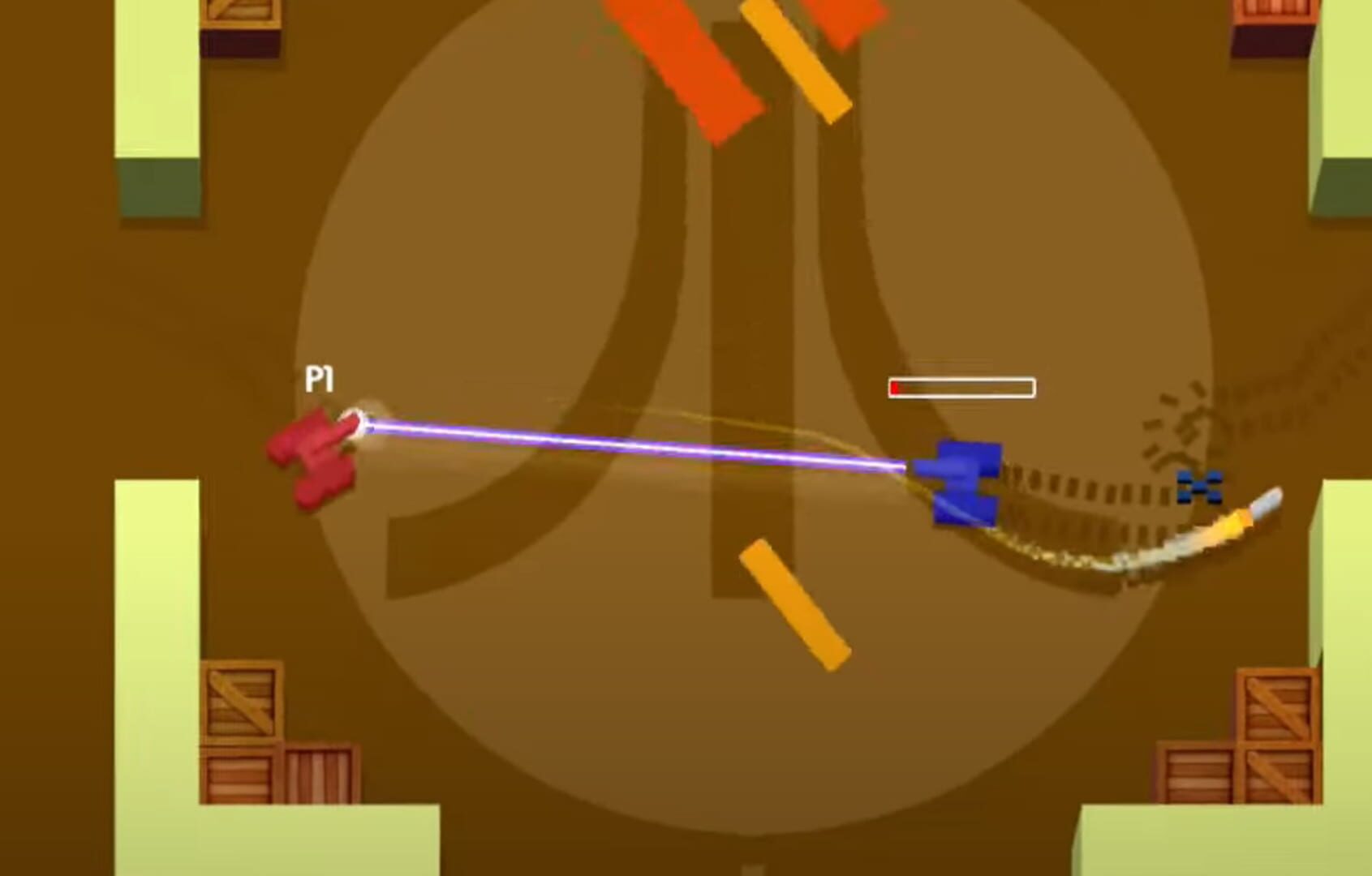
Vindicators Part 2(MID): The most notable thing about this
game is the controls. Instead of a control
stick the tanks are controlled by 2 levers, where steering them up or down
makes the tank move forward or turn.
This control style was already used by Atari’s old game Combat and
modern re-releases of such controls nowadays has players using dual thumbsticks
for the same function. The Atari 50
collection even added a new tank combat game based around those controls
that’s pretty fun to play with a few friends.
Play this instead.
Vindicators part 2 sets itself apart from Combat with an
obvious upgrade in graphics and some gameplay additions. Controlling the tank’s turret is one, but
more notable is an upgrade system where your tank gets better as the game goes
along. That’s a lot of work for a game
that’s just a standard series of gauntlets with very limited enemy variety. There’s little of note.
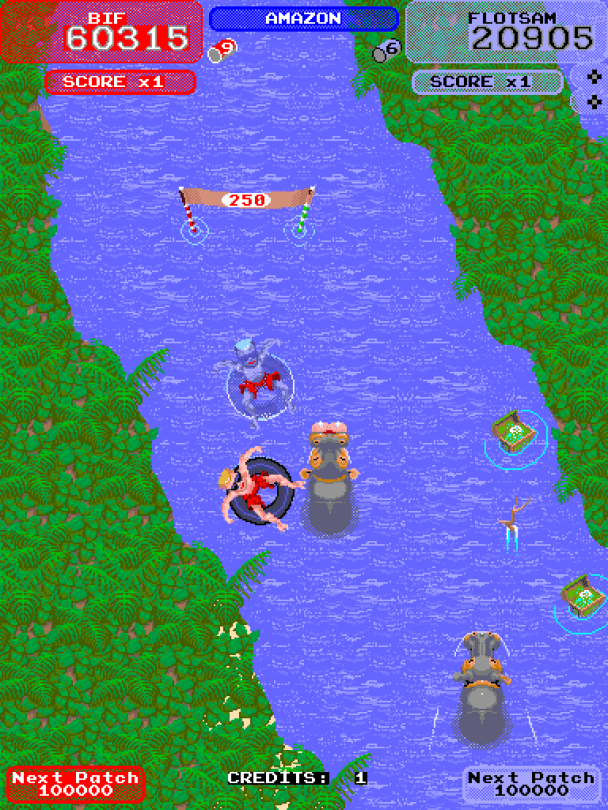
Toobin(MID): Another game with an unconventional control
scheme. In this one you play as a pair of dudes on inner tubes and go tubing down a river while avoiding falling trees,
rocks, fishermen and alligators because apparently these guys go down the most dangerous rivers they possibly can so they can beat Jackass to the punch. To
control the tube you use a button for each hand to either paddle that hand
forward or backwards, making turning similar to Vindicators, except you have to
rapidly tap buttons instead of moving a lever.
The bright and surprisingly relaxing visuals with the surf music and original control
scheme makes it fun to play for a few minutes, but I forget about it as soon as
I’m done.
Tournament Cyberball 2072(MID): It’s football with
robots. That’s it. Some things are changed up, like players
being able to die and downs being marked by how close the ball is to exploding,
but those come off to me like token attempts to make it different when it’s
otherwise a bog standard football game and not an especially enjoyable one.
Strictly speaking the first game is Cyberball and Tournament Cyberball is the slightly updated version from 1989, but they're so similar and there's so little to talk about that I'm lumping them together as one game.
Splatterhouse(NAM): Namco returns to a style of
action game not unlike that of Rolling Thunder, but this time with melee
weapons in a big love letter to the horror movies that were making it big at
the time, including Evil Dead, Poltergeist and Friday the 13th.
Later games make the Terror Mask resemble a skull more.
Like Rolling Thunder, it’s a game where you’re expected to
fail as you figure out the optimal strategy to get through each room except
Splatterhouse does right a lot of what Rolling Thunder did wrong. The titular protagonist Rick can take more
than two hits and when you continue you start at the beginning of a chapter
rather than the entire game.
Splatterhouse is also a little easier overall thanks to the hit box for
Rick’s fist being surprisingly large, making precision less demanding. Having to go over rooms you already have down
pat just because of one section is still annoying, but it’s not nearly as bad
as other games around this time. I’m
making sure to judge these games based on how they were when they were
originally released, but I will say that using save states in the Namco Museum
Switch collection mitigates that issue, obviously.
Mirror monsters. Classic.
Splatterhouse’s visual design is its standout, being to slasher
movies what Castlevania was to classic monster movies. There are worms coming out of entrails,
enemies spill green, pus-like ooze when they’re cut in half and the enemy
designs themselves are creepy and grotesque.
It’s something largely unseen in games at the time and looks great even
today. I don’t know about the sound
design though.
The background music for Splatterhouse is good stuff, being
ambient and blood-pumping at the same time, but the sound effects stick out in
a bad way. The audio samples of monsters
are good, but the punching sound effect is a stock, electronic hit sound and
when enemies are hit with a melee weapon of any kind the impact makes the original
Super Smash Brother’s hit sound effect that sounds like a tennis ball being
served. If it's not the same sound effect then it's extremely close.
I would expect messily slicing a creature in
half would make a squelching sound and smacking a water creature into a wall
would make a visceral splat, but nope. I
got to play this game in a real arcade cabinet at a convention once upon a time
and the cabinet was fitted with curtains and custom speakers to really let
you hear the sounds in the darkness, but those sound effects gave it the
opposite effect. The NamcoMuseum
collection on the Switch even uses that hit sound effect as the game’s menu
confirmation sound. Why? Stop it.
Some bad sound decisions don’t detract from the satisfying
gameplay, gritty and artistic style or nuggets of storytelling that make
Splatterhouse memorable. Namco only had
this game to represent themselves for this year, but it’s way better than
Midway’s entries thus far, meaning if Midway’s last game for 1988 isn’t as good
as Splatterhouse, Splatterhouse will be the best game of the year and Namco
will actually win.
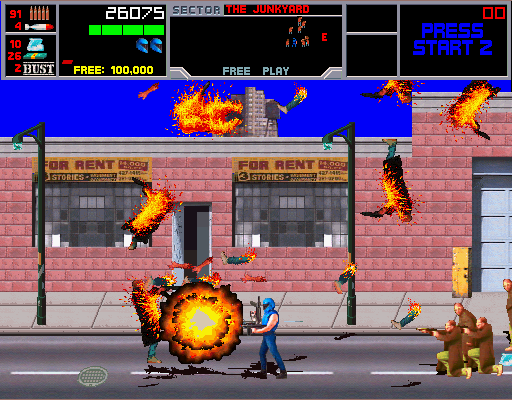
NARC(MID): This game takes the war on drugs to a whole new
level as you spend the game dual wielding machine guns and a rocket launcher to
murder drug dealers, drug addicts, gangsters and attack dogs, all in an effort
to kill Mr. Big, who it turns out before kidnapping Yuri Sakazaki was a drug
kingpin.
It’s difficult for me to tell how satirical NARC is supposed
to be. Am I supposed to be laughing at
the sheer absurdity of the very concept of a war on drugs causing so much
destruction or am I supposed to be satisfied that I get to shoot down
druggies. I’m not especially empathetic
to people who choose to throw their lives away to blow money on psychoactive
substances, but my disdain isn’t usually to the point of wishing violence on
them. I haven't seen a straight answer from Midway on this. It seems like they
threw in whatever was popular in the media in 1988: police shootouts, drugs and fancy cars (Miami
Vice being directly cited). I guess
you’re not supposed to think much about it beyond “shoot them up.”
Kaboom.
Shooting them up is what NARC is all about. Dozens upon dozens of enemies come at you
from all sides wielding guns, dumpsters and hypodermic needles and they fall as
quickly as they come. You can arrest
some criminals for extra points if you get close enough, but it’s rarely
practical. Shooting is 90% of the game
and there’s not a lot else to it. You
can crouch and jump, but before long enemies are shooting both high and low so
both of those are practically useless and the game becomes a battle of
attrition where you unavoidably get hit as you hit back and hope they die
before you do. It’s style over substance
so it’s a good thing it has a lot of style.
This was the debut of Midway/William’s new 32-bit arcade technology
that allowed for more animation and real actors digitized into the game. The actors, voice lines and hard-hitting sound
effects make the act of shooting so many enemies gratifying that no game so far
has done, questionable police brutality aside.
Perhaps because the designers knew the game is shallow, NARC is on the
short side, taking less than half an hour to beat. It’s a perfect example of video game junk
food; all spectacle and fun in the moment, but not especially long-lasting. I’d definitely play this one with friends
after a cup of sake. Not after hard drugs though. I think this game made its message clear.
The Winner
NARC did not beat Splatterhouse. NARC was video game junk food, while
Splatterhouse was a full meal with great visuals, fitting music, a fair
challenge and tight controls. I can’t
believe I’m typing this, but even though Namco only had one game for this year
against Midway’s three, they have won 1988.
Splatterhouse is that good.
1988, like 1984, was dominated by Capcom. SNK’s Paddle Mania was zany enough to stand
out, but was an average game taken on its own and the rest of their games were
either mediocre or just plain terrible.
Capcom made arcade games better than anyone, including our current
contestants. Ghouls n’ Ghosts is a
better side-scrolling action game than Splatterhouse and Forgotten Worlds is a
better shooter than NARC. Both Namco and
Midway had their new and powerful hardware, but Capcom had both the hardware in
their CPS system and the compelling game design to go with it. Between Ghouls n’ Ghosts and Splatterhouse
though, Splatterhouse comes pretty close for me.
With Namco winning, this puts the score at a tie! Both companies have won 4 years!Namco was able to catch up from Namco’s lead
after all, but Namco’s problem for 1988 is even bigger for 1989. In 1988 they only had one game to compete
with. In 1989 they have nothing. It looks like we’re going to have a 2-year
time span judgement next time and Namco is going to have to pull off another Splatterhouse.



No comments:
Post a Comment