1994 was a slow year for our two competitors, for arcades at
least. Midway was busy with the home
ports of Mortal Kombat 2 and as usual Namco was not releasing games in English
because… Because. Both companies did put
out at least one game each in 1994 though. On Midway's side is a
tried and true rail shooter that sticks to a lot of its companies established
conventions and a stop motion fighting game. On Namco's side is the beginning of one of the biggest names in fighting
games. It’s a one-on-one. We shall see which game carries their company to victory.
It’s easy to laugh at the 90s-era anti-authority attitude
that is so indicative of the time, but a fascist army of masked forces terrorizing
people and trying to censor and shut down dissent and things they don’t like
through violent force echoes far more true to today’s reality than back
then. I think I would choose the New Order
Nation over the racist, fascist meth head in the White House now, actually.

It doesn’t take long for Revolution X to go from its
now-realistic premise to complete insanity.
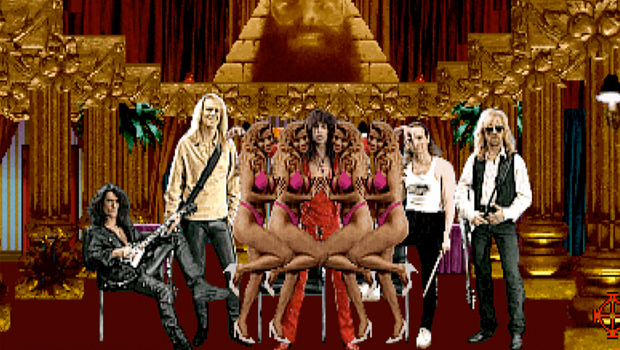
This was made a good while after Aerosmith got sober and they must’ve
offloaded some of their spare drugs to Midway because this game is full of
bizarre and outlandish imagery, as if seeing digitized Aerosmith talk to the
player about fighting an evil empire wasn’t enough. Steve Tyler throws you the keys to a car
through a video transmission on a TV that’s probably broken, there’s a giant
slime monster that pops eyeballs out of its head as an attack and an executive
desk turning into a flying gunship is one of the less strange things in the
game. All of this is to a soundtrack with
clips and riffs of Aerosmith songs and Steve Tyler screaming to declare the
power-ups. The series Weird Video Games
has a great rundown on the craziness of Revolution X that I highly recommend watching.
I love Revolution X.
What a trip. It is textbook 90s Midway:
sticking to the man, rock song references, digitized actors (including future
Sonya Blade, Kerry Hoskins) and flashy action.
Compared to Lucky & Wild from last year, Revolution X is a more
standard rail shooter without the immersive touches that made Lucky & Wild
one of the best, but it too has to be played at least once.
Primal Rage(MID): The appeal of Primal Rage begins and ends
with its presentation. I love the effort
that went into animating the immaculately detailed stop motion models. It looks like Mortal Kombat if every
character was like the Shokan and Motaro.
It’s such a shame the game plays like ass.

For the record, this was played on an actual arcade unit. I remember my local Red Robin had it decades
ago and now one of the arcades near me has it.
Straight ports of Primal Rage are notoriously difficult to make work,
but I can safely say that even a perfectly functional version of the game is
not very fun to play. Combat does not
flow. Attacks rarely feel like they can
combo into each other and if the game was going for a style of play focused
around getting powerful single hits in like Samurai Shodown, it doesn’t pull
that off either because hits lack impact and I think there’s something off
about the hit detection too.
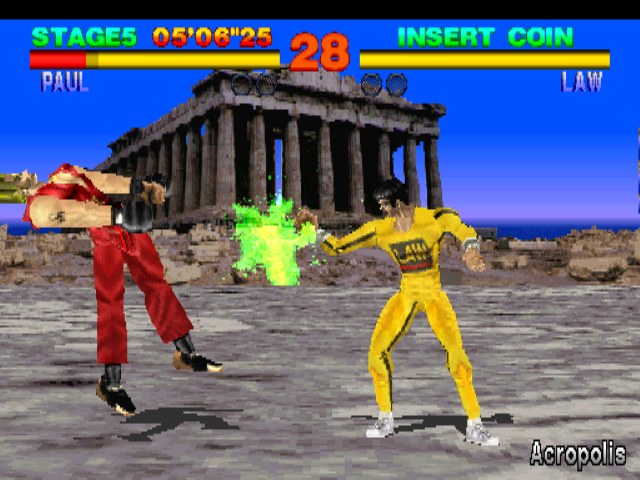 |
| Why does this game put the stage name at the bottom? |
The only story given (in the PS1 port’s manual at least) is
that Heihachi Mishima, the head of the Mishima Zaibatsu, is holding the King of
Iron Fist tournament and every character has their own reason for joining. The reason his son Kazuya enters is to take
over the Zaibatsu and take on the world as well as to get revenge for Heihachi
throwing off a cliff when he was young.
The reason Heihachi did that isn’t (canonically) explained until Tekken
7 decades later so in this game it’s treated like a small detail thrown into the
plot instead of a central traumatic event in Kazuya’s character.
 |
| PS1 exclusive meme. |
Tekken isn’t bad for a first go, but it feels like a beta
test for something better. Sort of a proof of concept game. A demo.
The Winner
In a reversal from the last round, it is Midway that made the crazy rail shooter and Namco that started a major fighting game franchise. Like Lucky & Wild, Revolution X is an awesome rail shooter that everyone needs to play at least once, but Mortal Kombat 1 and 2 were enough to win out against Namco’s amazing shooter last time. Tekken does not pull off the same feat.Tekken gets points from me for being a big leap forward for
3D fighting games and being fun enough to play even to this day, but once you
get past the fact that it’s 3D fighting with more grounded combat, there’s not
a lot to make it stand out. Not the
music, not the actual graphics and the gameplay, even if it works, needs refinement. Revolution X is a standard rail shooter
gameplay-wise, but all the crazy visuals, music and level variety firmly burn
the experience into my mind and to this day there is no other game like it. Primal Rage also left an impression with its
visuals, if nothing else.
When I interned at Screwattack I found out the next
convention was going to have a Revolution X Cabinet and wrote about it in a
piece all about some of the standout arcade games the convention was going
to have, to get people hyped up. If the
first Tekken were there, it would not be included in that piece. Midway wins again.
Big hits and big misses made Capcom and SNK’s 1994 all over
the place. There were some big hits like
the D&D: Tower of Doom and Samurai Shodown 2, but also huge misses like the
English version of Super Street Fighter 2: Turbo and The King of Fighters 94,
both of which are games that should have never been allowed to see the light of
day in the state they were in.
Next time, Midway is striking back. Mortal Kombat will return and Namco will have
the sequel to their hit new 3D fighting series.
It’ll be a brawl of the one-on-one brawler. Who will win?
No comments:
Post a Comment