So far in this competition we’ve seen both companies pushing
the limits of 80s technology. Most
notably they’ve been able to flood the screens with enemies or make a 3D effect
out of 2D graphics, both things that on their own would still be impressive
into the 90s. We’ll find out how much
more these companies are capable of as we go over the games of 1983.
Xevious(NAM ):
Whoah! A shooter that’s not set in
space! This had to be an attractive new
look, but the big new idea for gameplay is the addition of targets below the
flying plane that must be hit by dropping bombs on them. The problem is that unlike the usual vertical
shooting, where your shots go across the screen, the bombs only drop on exact
locations a little ways in front of the ship, meaning you have to be a lot more
precise and if you miss a turret building you have no choice but to let it
shoot you from behind until it’s offscreen.
Even without that annoyance, there’s a lack of enemy variety and even
though it’s nice to get out of space for once, the environment never changes. That’s forgiveable in space because outer
space is a big black void, but planets should have a lot more to show. I first played this game as a bonus in Star
Fox Assault and I didn’t think it was very good then either.

 |
| The ultimate space weapon is meme fodder. |
The first big problem is that the controls for the player
ship is fast and loose, which isn’t inherently bad, but the crystals you need
to get are so tiny that they’re easily mistaken for stars and the programmed
area that registers them as being grabbed is very tiny, resulting in countless
instances of circling around crystals because the damn ship won’t pick them up
unless it runs right into them with pixel perfect precision, wasting time in a
game where time is of the essence. Even
when incomplete Sinistar takes a lot of these bombs to kill and after you
unload a full salvo of bombs you’ll have to go back to get more crystals while
the enemies repair him so the aggravating crystal collection is long and
drawn-out.
If the enemy ships successfully build Sinistar you might as
well quit because the game is just over.
All he has to do is get close and then he can insta-kill you, something
you can’t avoid because you have to get close enough to not have your bombs
intercepted, meaning to get a shot on him you have to be flying close to him
and inevitably get insta-killed. This
game is known for its high difficulty, but it’s only difficult because it’s so
badly made.
There are no jump physics to this game, so using the trampolines is more like holding down the jump button to get to the exact right height you want to be at. On the trampoline the bandits can’t kill you, but they can when you’re off it, resulting in cheap deaths because you happened to be going to the same floor as them and the cheap deaths don’t stop there. A very common scenario is two bandits coming at you from both sides because without the trampoline you’re only moving in two directions and the only means to fight back is opening doors on them, which is easier said than done because the doors only seem to want to re-close when they feel like it. It’s not fun.
This is one of those games that is so simple
it might as well be a minigame in Mario Party.
You move around as a bubble collecting dirt, grime and baby roaches
until you become a big enough bubble to go down the drain to the next
level. There are scrubbers and razor
blades that will pop the titular bubble on contact, but the biggest problem are
the adult roaches that come out of the drain when a baby goes down it because
apparently this is the sink where the humans wash off growth acceleration
mutagen.
 |
| Compare the gaps to the bubble's size. |
The difficulty comes from both the clouds of dangerous
objects that can instantly pop you and the intentionally slippery
controls. It does indeed feel like
you’re controlling a soap bubble, where letting go of the control stick means
you continue to glide along, and that would be fine if the game didn’t quickly
demand impossible precision before long.
It’s at least an amusing distraction for a few minutes, which is better
than Mappy.
.png)
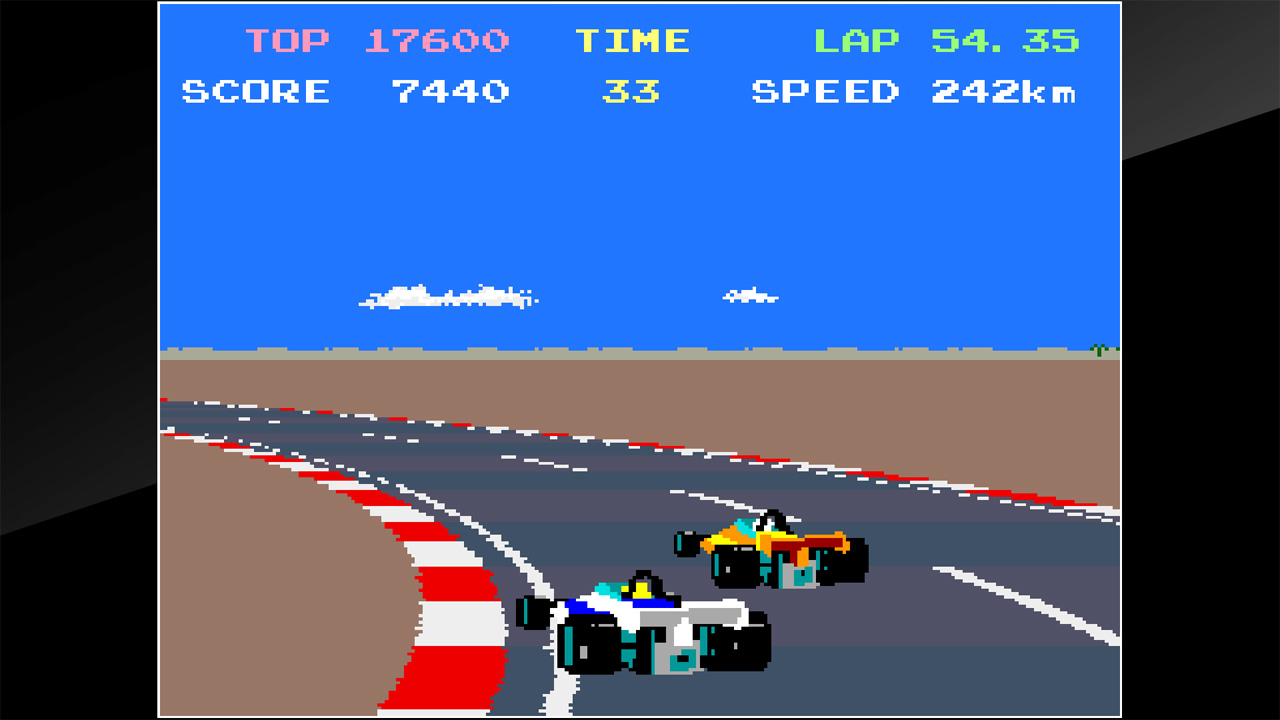
Pole Position 2(NAM): More of an update than a real sequel, Pole Position 2 has all the problems the first one did and just adds selectable tracks and some new graphics. Choosing the track beforehand eases the problem I had with sudden turns, since you know what to expect, but only a little. It doesn't do enough to make this significantly better than the original.
The Winner
1983 was not exactly a stellar year for these two. From Namco we got a weak shooter with a
frustrating secondary fire, a badly-designed maze game, an alright spin on
Pac-Man and a sequel that didn't fix anything. From Midway we got a really
badly designed space shooter, a fleetingly amusing minigame and a boring,
poorly thought-out car combat game.
Nobody is winning any awards, but alas I have to choose a winner
regardless. Between the two, I have to go with Midway, if only because
the simplicity and novelty of Bubbles kept my attention for slightly longer
than Namco’s games. Even if it’s not an
especially captivating game, I’d rather play a game that hasn’t been done
before than Namco’s games that are just “X, but worse.” Better luck next time, Namco.
Meanwhile...
The only SNK game I played for this year was Munch Mobile, a game with a neat premise, but finicky controls. It was about as mediocre as everything else here. 1983 just wasn't the best year for anyone, I guess. Maybe next year will fare better.
No comments:
Post a Comment